Technocrats: High Priests of the Latest Doomsday Cults

In early 2020, I attended a conference put on by tech companies in association with a university in Wellington. The opening provocation was something about preventing public pushback to technocracy. I recall candid questions being exchanged, such as: “How do we stop them from killing us?” That was the tone-setter. Not how do we include people? or how do we serve the public good? but how do we manage the inevitable irritation of the masses when they realise what’s being built for them, rather than with them.

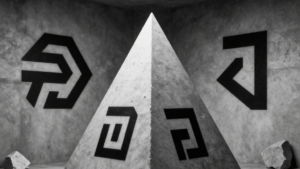
The New Doomsday Cult – Image generated by AI

As the conference unfolded, what struck me most was the paranoia of our self-appointed harbingers of the apocalypse – Bill Gates, Peter Thiel, Marc Andreessen, Jeff Bezos, Elon Musk and their various satellites – as communicated through their acolytes. Beneath the sleek sermons and benevolent rhetoric lies a deep suspicion of the human being. Many of them, and their postulants, appear convinced – after a century of institutionalised technocracy – that the human has become an impediment to progress. There are simply too many people destined for, what Yuval Noah Harari’s calls, the “useless class,” all too fleshy and too fallible to continue serving the sacred pyramid of civilised order. For this divine techno-order to flourish, some necrotic flesh will need to be sacrificed – and no prizes for guessing who that will be.

To hear the tech gurus speculate, often with messianic intensity, on utopian or dystopian futures has been revealing. What appears to be missing from almost all of these visions is people like you and me, dear reader. The human shows up mainly as a problem to be solved; an inefficiency to be optimised away, or a legacy system awaiting decommission. Depending on which esoteric order you belong to, the apocalypse arrives via one of the four horsemen – war, famine, conquest, or death – with the modern add-on of pestilence for good measure. Whatever the mechanism, extinction is assumed. The debate is not if, but how.

From there, the factions emerge. Some devotees of accelerationism argue that we should actively hasten the apocalypse, fusing with technology in order to liberate the human intellect from the messy constraints of the body. This is a rough-and-ready summation of Nick Land’s “Dark Enlightenment,” but it captures the mood: abandon the human form, upload what matters, and let the rest burn. Others imagine a post-catastrophe world of technates – planned communities where survivors are neatly organised and every aspect of life is micro-managed by AI, overseen by a priestly class of ordained engineers.

It all sounds like dreadful pulp science fiction. The trouble is that it’s a fiction sincerely believed by some of the most powerful and influential people on the planet. I see traces of this thinking seeping into policy papers, funding models, research agendas and academic language. Words like “legacy,” “scalability,” and “sustainability” quietly replace older ideas such as curiosity, investigation and lived experience. The human is reduced to a sequence of variables and processes, while faceless systems of governance steadily relegate us to the annals of history.

And yet – here’s where I stay upbeat – this worldview only holds if we accept its premise. It is merely a cult like any other. I refuse the premise that the human is a problem to be solved. We are not a transitional inconvenience on the way to some silicon rapture. We are meaning-making creatures, embedded in places, bodies, histories and relationships that cannot be fully reduced to an algorithm. The real danger of this technocratic doomsday cult is not that it predicts the end of the world, but that it might bring about a world without us in it – not through extinction, but through erasure.

I do not accept that technocratic utopias or dystopias are the only meaningful options for a future that still includes humanity.

As always, my a’th kar!

We Need to Talk About NATO!

Whether we like it or not, people need to start asking some serious questions about what NATO is actually doing – apart from serving, of course, as a ‘peaceful defensive alliance’.

Here’s something I’ve been noticing, behind the slick corporate think-tank presentations and branding, where NATO operates on the ground, there are frequently covert operations, huge propaganda campaigns, coups, assassinations, armed militias running around murdering people, false-flags, mass civilian casualties and – coincidently – US corporations on hand to profit from rebuilding critical infrastructure (1).

Not that most people I have met at NATO conferences seem to be aware of any of this. The type of person you meet at a NATO conference is the kind of mid-wit functionary who believes that Putin has been running the US executive branch since 2015, and that the CIA cares about Queer rights in Iran.

If you’ve read my earlier posts – Why You Should Be Embarrassed to Be Associated with UK News and Is Cornish Nationalism Part of a Broader Strategy of Tension? – you’ll know I don’t shy away from asking challenging questions about power, policy, and influence. NATO seems to echo the role that the East India Company played in the (former) British Empire – it’s a bloated non-governmental institution that meddles in disputes for shareholder profits. The NATO shaped elephant in the room just got more difficult to ignore, and it should be obvious to anyone paying attention that whatever has happened in Ukraine has certainly been facilitated in large part by NATO.

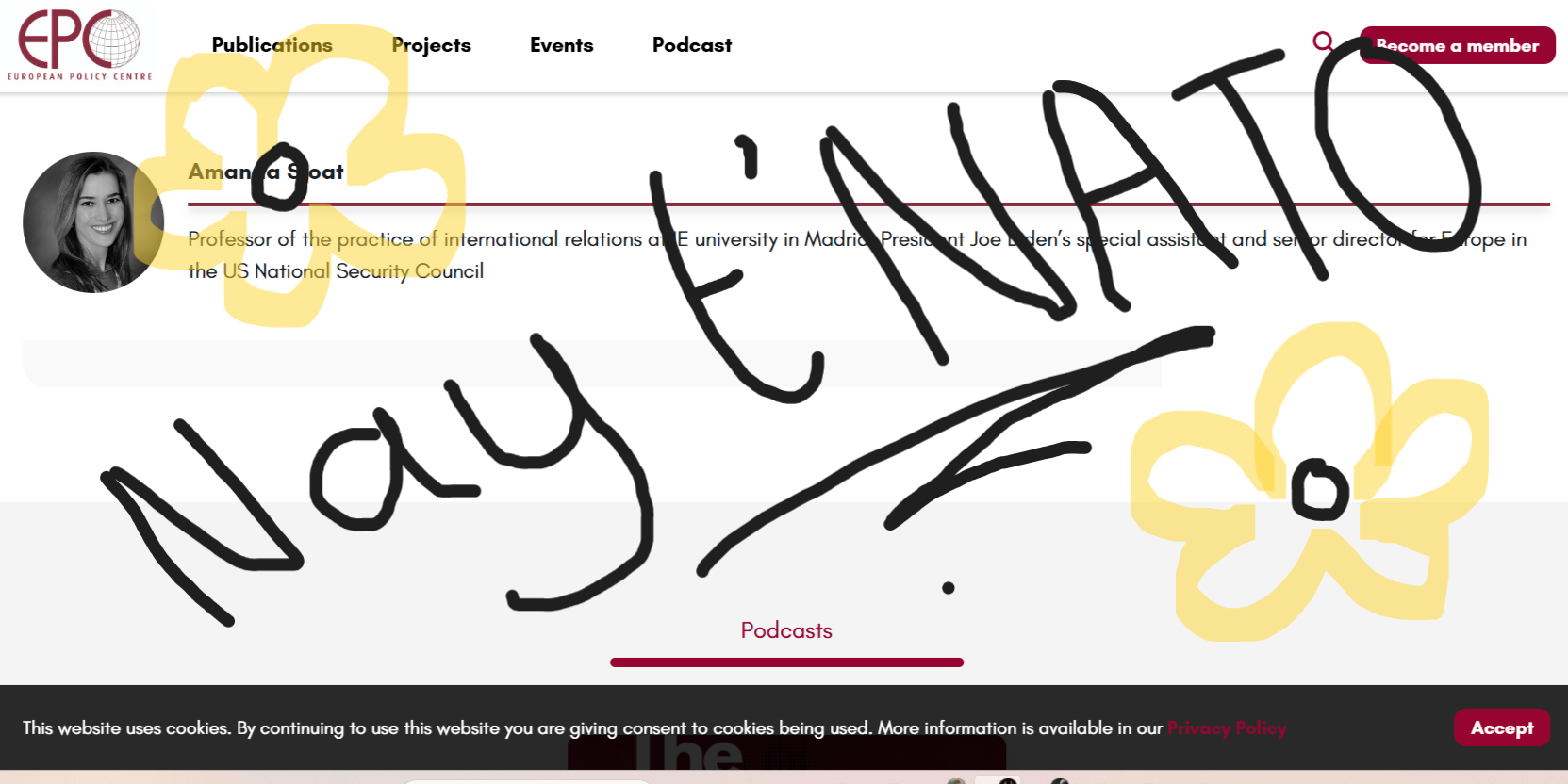
Amanda Sloat, who was Biden’s top Europe strategist on the U.S. National Security Council, let slip in a candid moment that what Western policymakers allowed to happen with NATO and Ukraine helped make this devastating war possible. She said that if Ukraine had clearly told Russia it would not join NATO – or if U.S. and UK envoys had advised Ukraine to drop that aspiration – this “may well have prevented the destruction and loss of life” we’ve witnessed over the past three years (2).

Not that this is news to anyone with the slightest understanding of NATO’s – uh, shall we say “colourful” history. To be clear: Sloat’s revelations are coming from a conversation with pranksters posing as Ukrainian officials, and yes, it’s apparent that while Amanda Sloat has served as an administrative functionary, she seems blissfully unaware of the gritty underside of NATO operations. But here it is, proof that Western policymakers considered explicitly ruling out NATO membership for Ukraine, and then decided against it. That decision, Sloat implies, might have made all the difference (2).

So let’s unpack this.

For years, people who said NATO expansion was reckless – especially into Ukraine – were shouted down, called “conspiracy theorists,” or worse, accused of being “Kremlin puppets.” This isn’t fringe commentary any more (not that it ever was) it’s an admission from inside the policymaking apparatus. Sloat just admitted, off the record, that maybe it was a strategic misstep. I’m going to go out on a limb here and suggest that it wasn’t a strategic misstep at all, because chaos, fear and destruction seem to be the common outcomes of all NATO interventions. It’s almost like this chaos is the strategy – some wily conspiracy theorists might call this a strategy of tension! It’s hard to know precisely what NATO is doing, so much of their activities are mired in deep reservoirs of PR bullshit and think-tank wonk. A lot of this requires faith and devotion. People are obliged to trust an opaque organisation that seems to operate without any meaningful oversight or accountability – I’m not going to do that. How many people have to die before we really start to get an honest look at what NATO has been doing for decades?

My personal experience of being on the fringes of empire – where NATO operatives have a documented history of proactively employing the services of some groups who we’re all supposed to fear – reminds me that power without accountability is dangerous. Does anyone believe that NATO had nothing to do with overthrowing Assad and installing a member of al-Qaeda and ISIS as its newly besuited Israel-friendly ruler? I mean, I don’t pretend to know everything about the middle-east, but surely anyone looking at how this fucking scumbag al-Julani is now being paraded around the halls of ‘respectable’ Western governance like a hero can see this is an utterly shameless PR campaign (3). Whether it’s the Balkans, Afghanistan, Iraq, Libya, or now Ukraine, NATO’s footprint has always left debris in its wake – but of course, as we have always been told, it’s just a ‘peaceful, defensive alliance’.

As always, my a’th kar!

References:

(1) Wadhams, N. (2025). BlackRock’s Larry Fink Joins Trump Team Talks to Rebuild Ukraine. [online] Bloomberg.com. Available at: https://www.bloomberg.com/news/articles/2025-12-10/blackrock-s-larry-fink-joins-trump-team-talks-to-rebuild-ukraine [Accessed 17 Dec. 2025].

(2) Big News Network.com. (2022). Ukraine could have avoided conflict with one key step – ex-Biden adviser. [online] Available at: https://www.bignewsnetwork.com/news/278749126/ukraine-could-have-avoided-conflict-with-one-key-step-ex-biden-adviser?utm_source=chatgpt.com [Accessed 17 Dec. 2025].

(3) Proletarian TV (2025). The sad downfall of the Syrian government. [online] YouTube. Available at: https://www.youtube.com/watch?v=rHdIDWKuQM8 [Accessed 20 Dec. 2025].

Demystifying The Kernewek Language

I have argued in Mesotopia: Towards a Place of Lyrical Inquiry (1) that yes, there is a real world, but no, it does not open itself to our complete comprehension. We are always half-in, half-out of its meanings, fumbling toward the real but never quite gripping it. This weird middle place – a mesh of physical and conceptual terrains – is the domain of the meaning-makers. The poets, the oracles, the interpreters of signs have historically been quite happy to hide their operations behind opulent rituals or clever distractions. But does it have to be this way? My lyrical work has long been an effort to demystify poetics and language, to free these communicative events from the dictates of esoteric schools and elite fraternities who still treat language as a proprietary ritual.
Naming, after all, has long been the preserve of priestly classes: the magi, the monks, the keepers of alphabets and incantations. In many religious orders, “the Word” is not just a tool but a cosmological foundation – articulation itself becomes sacrament. And once you take this seriously, it becomes impossible not to notice how incantations, chants, spells, prophetic mutterings and other religious-poetic forms lean heavily on the idea of language as conduit to hidden truths. This is the vatic, the mantic, the magical dimension of poesis, the belief that words do not merely describe the world but summon, shape, or invoke it.

Modern linguistics attempts to scrub all this clean. Structuralists, post-structuralists, cognitive scientists, psycholinguists; they all gather with laboratory-grade detachment to “demystify” language production. This is good in theory. But if you ignore the presence of mystery altogether, you’re not demystifying anything. You’re merely tucking your priestly robes into your slacks and hoping nobody notices the ancient hems. Many materialist linguists strike me as devout priestly magi decked out in secular boardroom drag. Here’s one of the many unspoken secrets of our supposedly rational institutions: even empirical research often rests on vast scaffolds of speculation. Each irrefutable graph serves as an article of faith – it’s an ‘educated guess’ berobed as a principle.

This is why it is difficult to determine how many theoretical schools are engaged in re-mystifying the archive of human knowledge – although some hide in plain sight. Even Tim Morton, spear-heading investigations into the ecological implications of object-oriented ontology, is overt about (eco)gnostic leanings.

Consider the accelerationists (2): the former CCRU crowd who hallucinated Deleuze and Guattari into a cybernetic fever dream, pushing symbolism to liturgical extremes. Their rapid decoupling of meaning from symbol, in pursuit of some machinic singularity, often sounds to me not unlike kabbalistic numerology or ecstatic glossolalia. It is not insignificant that many modern tech-titans are devotees of Nick Land. Listen to the quasi-prophetic ramblings of Peter Thiel or Marc Andreessen as they speak of merging symbolic and material terrains; you will hear the cadences of a neo-cult, not a scientific proposal. Meanwhile, various deciples of the structuralists continue to worship The Corpus Linguistic with devotional intensity. ‘and the Word was God,’ they seem to say – and seemingly never notice they are mimicking devotees of Thoth, Hermes or even John 1:1 .Once again, the priests return, this time wearing the unbuttoned casuals of liberal intelligentsia.

In contrast, I often return to etymology, a much subtler way of demystifying meaning. Not by banishing mystery, but by acknowledging its layers. English gives the game away easily: most of our “proper” vocabulary is padded with Greek and Latin. The professional-managerial classes (PMC) learn just enough of these roots to keep the bloated machinery of liberal institutions functioning. Autobiography: self-life-writing. Philosophy: love-of-wisdom. Nothing mystical, only inherited structure.

When we apply the same etymological pressure to Kernewek, interesting stories surface. Pysk, the Kernewek word for “fish,” appears to descend from Latin piscis. This aligns with what Celtic linguists tell us: the Brythonic languages had more prolonged contact with Roman, Norman, and Saxon cultures than their Goidelic cousins. History leaves fingerprints on phonemes.

Or – and here’s a mischievous alternative – it suggests that one of the more “colourful” characters in the history of Kernewek revivalism simply inserted Latin or Greek terms (along with Welsh and Breton borrowings) to fill lexical gaps. The line between linguistic evolution and linguistic invention is not always tidy.

On page 76 of my thesis, I discuss Linguist Professor Price’s uncompromising position: Cornish is dead, he insists, and modern “revivals” are “partially invented” (Price, 1984: 134). He writes:

“The Old Celtic speech of Cornwall died out two centuries ago. It is still dead, and will evermore remain so… The present century has seen the propagation by a small band of enthusiasts of a type of language that is partially derived from the old Celtic speech of Cornwall, but it is also partially invented… I shall reserve the term Cornish for the genuine language and refer to the modern pseudo-Cornish as Cornic.”

I do have issues with Price’s framing. As I wrote:

“What is involved in inventing a language? What is a pseudo-language? What does a ‘genuine’ or ‘authentic’ Kernewek sound like? I remain confused by the extent to which Price uses terms such as authentic, genuine, and pseudo in relation to Kernewek.” (Verran, 2025: 76)

Whether or not one accepts Price’s verdict, the point stands: Kernewek should be preserved and spoken as a breathing archive of our past, not re-engineered as an esoteric tool of ethnonationalism. We know too well what can happen when fringe political movements revive ancient languages to manufacture legitimacy. And it doesn’t surprise me that Celtic circles frequently attract a plethora of esoteric characters: Zionists, Catholic Religious Orders, Rosicrucians, Masons, New-Age Druids, Shamans or Wiccans – all projecting mystical significance onto minority languages. Why this conviction that certain tongues contain secret indigenous wisdom? Romantic nationalism, folklore, and the Arcadian fantasy of an unbroken Celtic lineage have all fed this impulse.

The more I learn about figures like Iolo Morganwg or Robert Morton Nance – who seem to have consciously cultivated a priestly order of Celtic mystics modelled on Julius Caesar’s accounts of ancient Britons – the more frustrated I become. We don’t need to live inside the art projects of eccentric artists or poets – and yes, that includes me! Trust me, we definitely shouldn’t live inside anything I create.

As a poet, I enjoy bending language into unorthodox shapes. I fabricate littoral places inside my verse, places that shimmer and sometimes misbehave. But I do not belong to the mystery schools of modern priestly classes, who still seem intent on fabricating material realities for entire populations to inhabit according to the whims of neo-feudal aristocrats or digital landlords.

For me, the mystery is not something to eradicate but something to remain in dialogue with. I continue to wrestle with the languages I have inherited. I am consciously rejecting past myths or Arthurian tropes all too often associated with Celtic languages. Through lyrical poetry, I keep listening – probing the metaphysical uncertainties that Kernewek, in all its contested life and afterlife, continues to stir.

As always, my a’th kar!

All References Available From Verran, 2025:

(1) Verran, T. (2025) Mesotopia: Towards a Place of Lyrical Inquiry. Thesis. University of Plymouth. Available at: https://doi.org/10.24382/nv45-pk79

(2) Monoskop.org. (2017). Cybernetic Culture Research Unit – Monoskop. [online] Available at: https://monoskop.org/Cybernetic_Culture_Research_Unit.

Sober Talk: The Politics of Fun. Written at/ with/ for Pattaya 2025

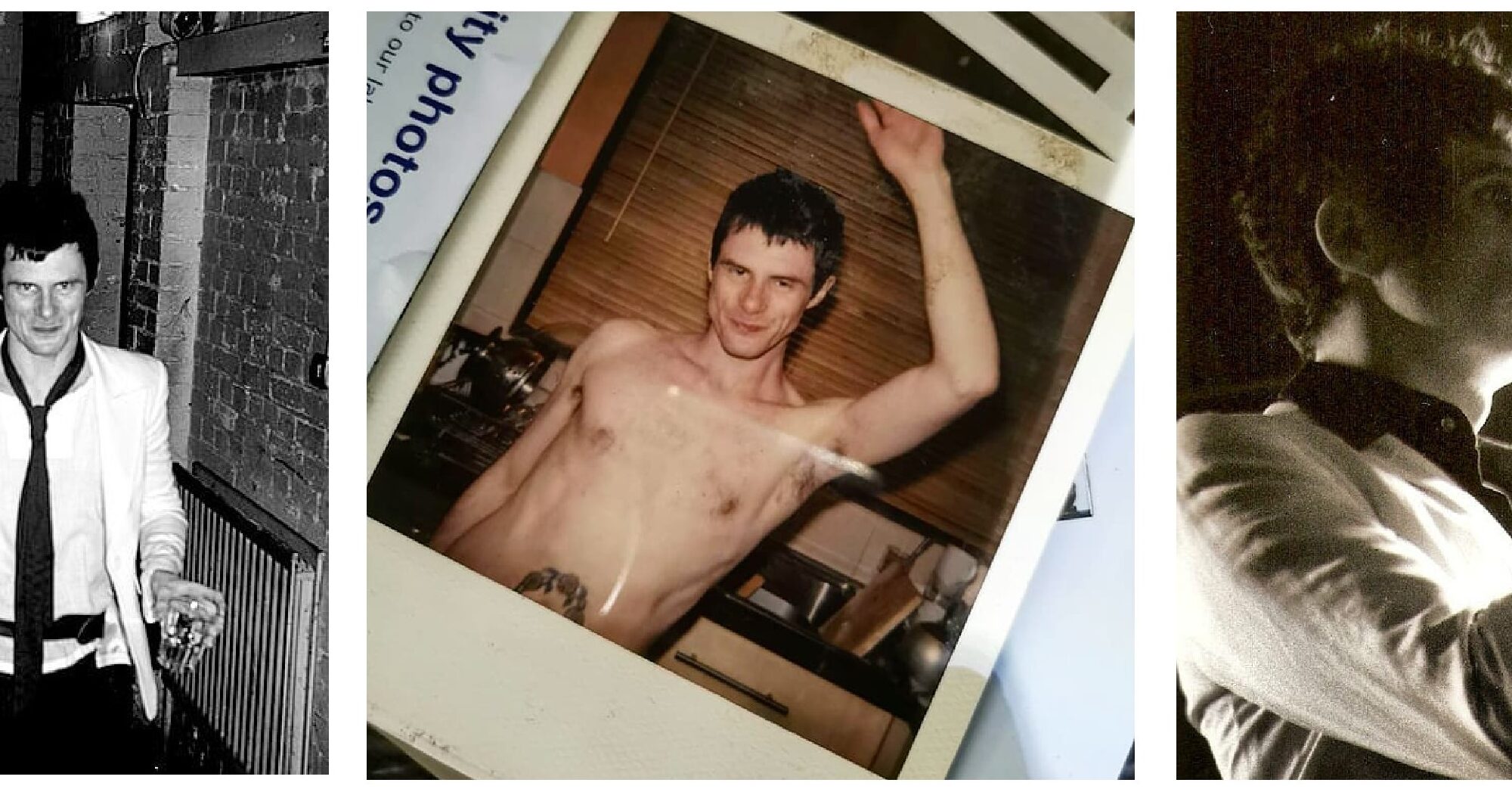
When I first became sober eleven years ago, the line I heard most often from old drinking companions was: “You used to be so much fun!” At first, I honestly believed them. Yes I used to be fun. I had been a spirited drunk, the first on the dance-floor, the man who could stretch a mildly amusing anecdote into a raucous tale of comedic exaggeration. There I was, the very embodiment of a boozy raconteur fun distilled into human form.

That’s what I told myself, anyway.

The truth was: I was deeply unhappy. I used revelry as a way to mask the creeping recognition of malignant trauma. I believed that fun was performance: the loud laugh, the daring dare, the clever comeback. Fun was something manufactured, something flung outward as distraction. It wasn’t until I stopped drinking that I recognised just how much emotional labour had gone into appearing fun, and how little joy I had actually experienced.

In day to day life, sobriety gets interpreted as accusation. People don’t tend to hear “I don’t drink,” they hear, “I disapprove of your drinking.” They don’t hear choice – they hear judgment. How do we talk about things that aren’t conventionally regarded as ‘fun’ without sounding like pious pricks?

Here’s something I’ve slowly come to understand: the politics of fun is fundamentally about not noticing. I’m not just talking about ‘drunk’ fun either – so much fun is learning how to switch off noticing certain things. It’s a conspiracy of selective blindness. Alcohol helped me blur the boring, soften the painful and gloss over the inconvenient. Sobriety, on the other hand, is the opposite of that. Sobriety is noticing – often against your will.

When I stopped drinking, the world sharpened. I suddenly noticed that A+E departments weren’t mysteriously chaotic on Saturday nights – they were flooded with intoxicated people who had fallen, crashed or fought. I noticed that many of the people I had grown up with – perfectly average ‘social drinkers’ – might more honestly be described as functioning alcoholics. I noticed how many relationships quietly revolved around the highs and lows of alcohol use. I noticed that behind many of the funniest people I knew lurked deep wells of avoidance, anxiety, grief and violence.

Alcohol was the soft-focus filter on reality. By removing it, reality became uncomfortably clear.

This great ‘noticing’ I have been continuing to experience has not been limited to the effects of substance misuse. No, it has affected me on a profoundly personal and political level. I started to notice that most of the things we buy or use are mined, farmed or produced by an invisible underclass of peasants. That’s not fun. I started to notice that so much of the world is actually built by slave or exploited labour – that’s not ‘fun’ either. I also started to notice endless war machines producing millions of displaced people wandering the world looking for sanctuary – so I volunteered to work in refugee camps. That, my friends, is definitely not fun.

So what can we do? You can’t just demand that everyone stops having fun any more than you can dictate what is or isn’t fun. I don’t have the answer. The problem is – so much of life for so many people just isn’t fun. In order to have fun, you have to not notice the trafficked people building your ‘wellness holiday retreat’ or serving your wine. You have to not notice that the economic heart of so much fun is that someone somewhere is losing out.

Now, before anyone feels judged – let me be clear: I don’t care what people choose to do with their bodies, their evenings, or their holidays. I don’t hold some puritanical moral high ground. I don’t deliver sermons. I am not the ghost of Christmas Temperance. I choose sobriety because I like it. I like noticing things. It suits me.

I’ve been trying to balance ‘noticing’ with ‘fun’ and believe that I’m much more fun now than I was as a drunken jester. My attention is real. My presence is not performance. Unfortunately, some of my former drinking buddies disagree – chiefly because I no longer serve as supporting cast in the theatre of their intoxication, but that’s just the way it is now – I can’t go back to ‘not noticing’.

It’s actually really challenging for me to live in the UK, given that so much of UK life revolves around substance misuse and existing in a state of ‘not noticing’. Fun now – for me – is clarity. It’s noticing. It’s connection. It’s feeling it all rather than numbing it away. And if that makes me “no fun” to the still-blurred, then so be it. I’d rather notice.

As always,  my a’th kar!