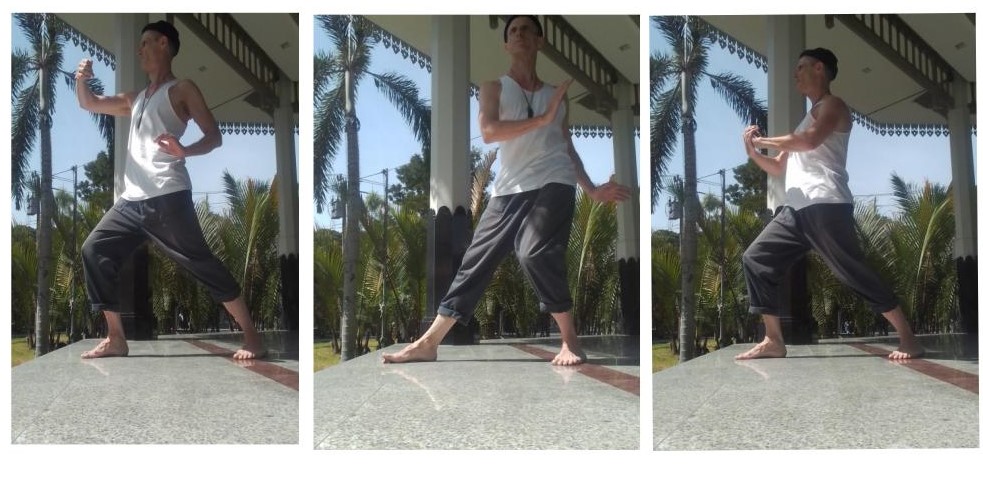
Psy-omatics Meets Tai Chi Chuan

Over the past several years, I’ve devoted much of my research and practice to developing what I’ve come to call psy-omatics – a poetic method of listening to what the body knows, and how meaning unfolds through its encounters with the environment. In psy-omatics, I treat the body not as a sealed-off vessel or a machine of muscles and joints, but as a site of relational inquiry: a perceptual instrument that feels itself into meaning by collaborating with the world.

Recently, I have been learning Tai Chi and Chi Kung and practising these movements daily. Here is a summary of some of the similarities and differences I have noticed so far between Tai Chi and my own psy-omatic positions.
Morning Tai Chi

Similarities: 

1. Both are philosophies of somatic practice.
Tai Chi is not simply a sequence of postures; it is a philosophy embodied – Taoism in motion. Psy-omatics similarly is not a self-help technique or method of stretching, it is a conceptual practice of embodied inquiry. Both interpret movement as thought; posture as worldview; gesture as epistemology. In both, theoretical abstractions are explored through deep investigation of movement within the body and the intellect.

2. Both are praxis of mind/body attunement to environment.
During Tai Chi, our coach has encouraged us to attend to our surroundings, to feel the movement of breath and breeze as continuous, to sense other bodies in the room not as distractions but as events. Psy-omatics likewise revolves around attunement – the ways the body opens to acoustic, tactile and spatial cues from the environment. In both, we feel our way into the world.

3. Both require deep introspection to somatic processes.
Whether noticing the shift of weight from heel to toe in Tai Chi, or listening to the subtle tensions in the ribcage in psy-omatics, both practices call for inward attention. Not an analytical attention, but a felt awareness. In psy-omatics, I often ask, what emotion or language does the body want to produce in this moment? In Tai Chi, the question is more, how does the movement flow through me? Yet both move through this same domain of embodied introspection.

4. Both require “grounding,” although there are subtle differences here.
In Tai Chi, grounding involves drawing energy upward from the ground. The earth is a resource of chi, a reservoir of subtle force. In psy-omatics, the ground is not a battery or an energy source. The contact between body and soil (or floor) becomes an exchange, a site of meaning-making, almost conversational. In psy-omatics, I encounter the ground as an interlocutor rather than a source of power.

Differences:

The most important divergences, I have found, emerge from metaphysics – from the different assumptions about what the world is.

1. Tai Chi emerges from a Taoist metaphysics of energy, whereas psy-omatics engages with substances and flows.
In Tai Chi, everything is energy and flux: yin and yang exchange endlessly; movement arises from the circulation of chi. In psy-omatics, I do not encounter a world of things that are solely composed of invisible energy. I encounter textures, pressures, acoustic reverberations, material resistance, physiological intensities. In short, I encounter a world of both substances and flows. These differing metaphysical frameworks shape the practice in fundamental ways. Tai Chi moves like liquid through an interconnected whole; whereas psy-omatics moves like a body negotiating encounters with other things. This fundamental difference requires further contemplation.

2. Tai Chi encourages the mind to lead the body, whereas in psy-omatics sometimes the body leads the mind.
In Tai Chi, my coach has often repeated: the mind leads the chi, and the chi leads the body. The intention precedes the gesture. In psy-omatics, I often find that the body responds before intention forms. A shoulder tightens, a hip withdraws, a hand reaches—and only afterwards does the mind grasp meaning. The body becomes an author of thought rather than merely its medium.

3. Tai Chi relies on visualisation and imagination, whereas psy-omatics resists ocularcentric vocabulary.
In Chi Kung, we trace points of energy, imagine roots descending from our feet and visualise streams of chi entering our bone-marrow. Psy-omatics avoids these visual metaphors because they privilege sight over other senses. I argue that so much body-work eludes sight. Instead, I turn to acoustics – resonance, rhythm, reverberation; to tactile sensation, proprioception, density and vibration. Meaning is not simply seen but felt.

4. Some ‘new-age’ adaptations of Eastern philosophy emphasise self-improvement, whereas psy-omatics acknowledges multiple vectors of causation.
I have noticed a tendency, in some versions of Tai Chi teaching, to emphasise personal enlightenment, self-realisation, inner peace. While these are valuable pursuits, they can imply a passive stance toward the world: the belief that one should accept things as they are, retreat inward, and cultivate serenity. Psy-omatics, by contrast, views the human as a causal actor among many. The body does not merely adapt to the world; it helps shape it. Somatic practice becomes an act of participation, not withdrawal.

Closing Thoughts:

Overall, I genuinely enjoy Tai Chi, and I continue to learn from it – not just physically but philosophically. I am always aware that I may have misunderstood or oversimplified some aspects of its metaphysics, and I remain open to correction from more experienced practitioners. I am learning new dimensions of bodily awareness through Tai Chi and Chi Kung, but for understanding the poetic process at the heart of psy-omatics, I encounter a very different world.

Perhaps that is the core discovery from my encounter with Tai Chi and Chi Kung: different movement practices require different metaphysical assumptions. Rather than seeking a single ‘correct’ account of the body and its movements, I am learning to hold these differing frameworks gently, letting each illuminate different contours of embodied experience.

As always, my a’th kar!


Introducing Klewes: Listening in the Expanded Field

When I first began formulating the ideas that would eventually become my concept of mesotopia, I needed a way to describe the strange middle-ground where perception, place, and meaning fold into one another. I sensed that our encounters with the world happen both ‘out there’ and ‘in here’ but identifying with any kind of precision that place between ‘out there’ and ‘in here’ would require contemplation of both the psychological and somatic techniques involved in meaning making – hence my ongoing research into psy-omatic practice (1). Before working on my thesis, I had been playing with a method that helped me navigate that in-between space with more precision. That practice is what I now call klewes.

Klewes by Maruay Makekurdchoo (2018)

Klewes is a word from Kernewek, the Cornish language, meaning “to hear, think, feel, perceive.” The word immediately resonated with me. Its definition already gestures beyond the narrow sense of hearing and toward a fuller, more embodied mode of knowing. I realised that what I needed was a practice of attending that begins with the body’s capacity to listen – not just with the ears, but with everything capable of sensing vibration. I wasn’t seeking a metaphor. I wanted a method. So klewes became the name for that method.

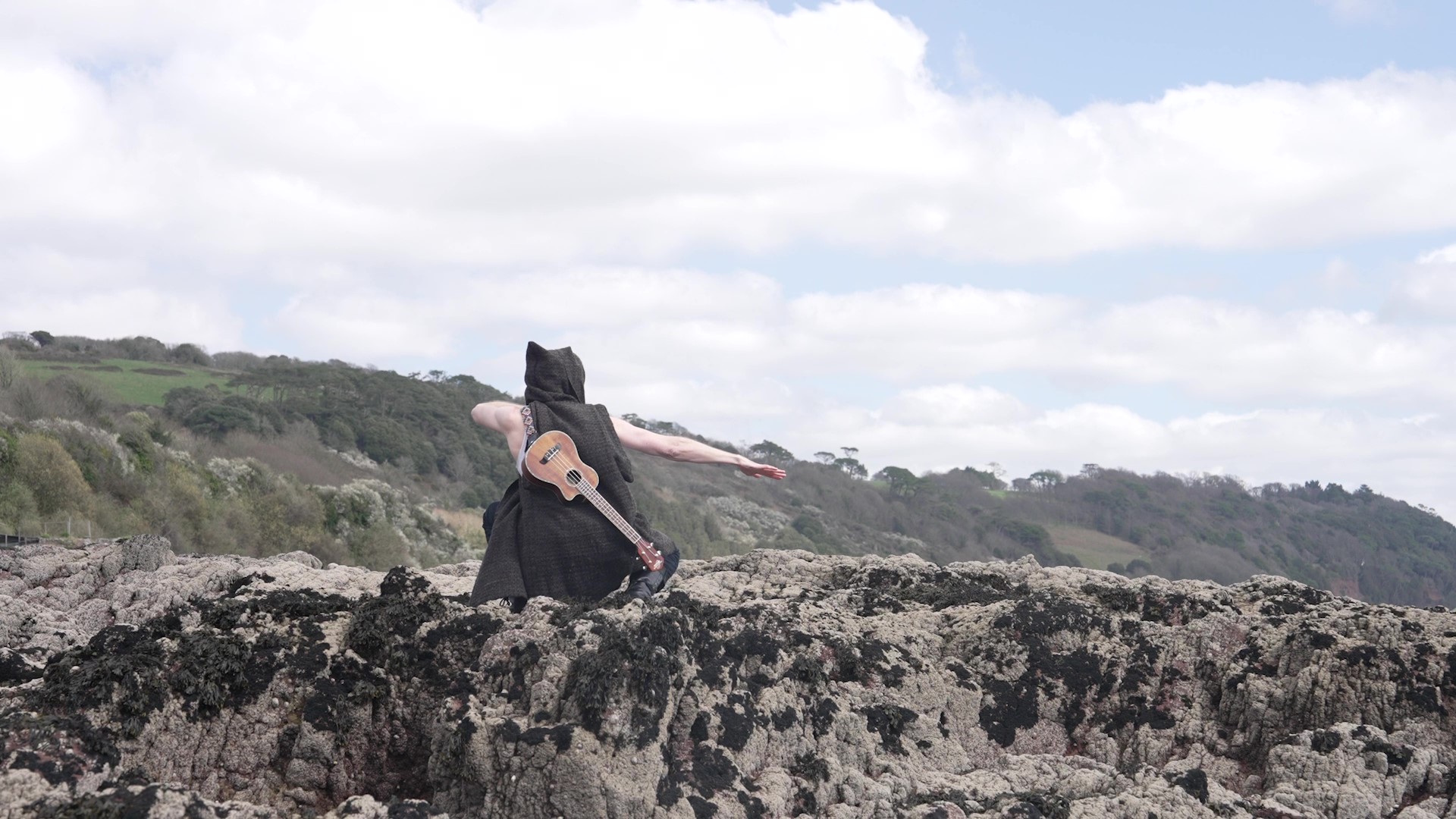
The procedure is simple, but the effects can be disarming. When I arrive at a site of composition – whether a field, a coastal path, an abandoned industrial corner, or a patch of woodland – I lie down. I close my eyes. I take long, slow breaths for about fifteen minutes, sometimes a bit more, until my attention begins to settle. With my vision removed from the foreground, something else starts to happen: the body reorients itself. The ground becomes not a surface beneath me but a resonant partner. Vibrations travel upward – small tremors, shifting pressures, the faint hum of heat working its way through soil and stone. In those moments, I begin to “hear” with the back of my skull, with my ribs, with the folds of clothing touching the ground.

This is what I mean by listening in the expanded field.

The point of klewes isn’t to romanticise nature or to retreat into some meditative cocoon. It’s a deliberate unsettling of the visual habits that dominate our encounters with place. Modern life, and even much ecological thinking, leans heavily on the eye: the view, the image, the landscape. Vision often leads to a sense of distance reinforcing an “I over here” observing a “world over there.” That separation underpins an anthropocentric way of relating, one in which the human becomes the sole interpreter of meaning.

When I practise klewes, I don’t begin with seeing. I begin with hearing. The site arrives first as vibration, pressure, pulse. Instead of interpreting the place, I let the place impress itself upon me. Hearing – expanded into feeling – becomes a way of entering into relation without assuming that what I see defines what is there.

I’ve found that this shifts the entire tone of composition. Rather than imposing structure onto the site, I allow the site to tune me. The thinking, composing or writing that follows carries traces of that initial, ear-led encounter. It is quieter, more porous, and more situated.

Klewes is, ultimately, an invitation: to hear our way into place, to perceive without rushing to picture, and to recognise that the world meets us long before we claim to look at it.

As always, my a’th kar!

References:

(1)Verran, T. (2025) Introducing the Psy-omatics of Encounter. https://myathkar.org/introducing-the-psy-omatics-of-encounter/

(2) Verran, T. (2025) Mesotopia: Towards a Place of Lyrical Inquiry. Pearl. The University of Plymouth.

Is Tommy Poppers Real?

Since 2010, I’ve been experimenting with how to be a writer on the internet. I’ve made blogs, stories, anonymous profiles and strange hybrids that lived somewhere between art and autobiography. Some of these experiments worked; others fell flat or disappeared into the algorithmic abyss. But across these fifteen years of testing the limits of online identity, one question keeps returning to me: is Tommy Poppers real?

The short answer is yes—and no.

Tommy Poppers exists. He writes, he posts, he provokes. He’s had conversations with real people. He’s been misread, adored, and blocked. But he isn’t real in the metaphysical sense. There is no withheld essence to Tommy Poppers that could exist independently of me. He’s not sitting in some digital backroom waiting to log on. He is a performance, an appearance—a sensual object projected into a particular medium at a particular time.

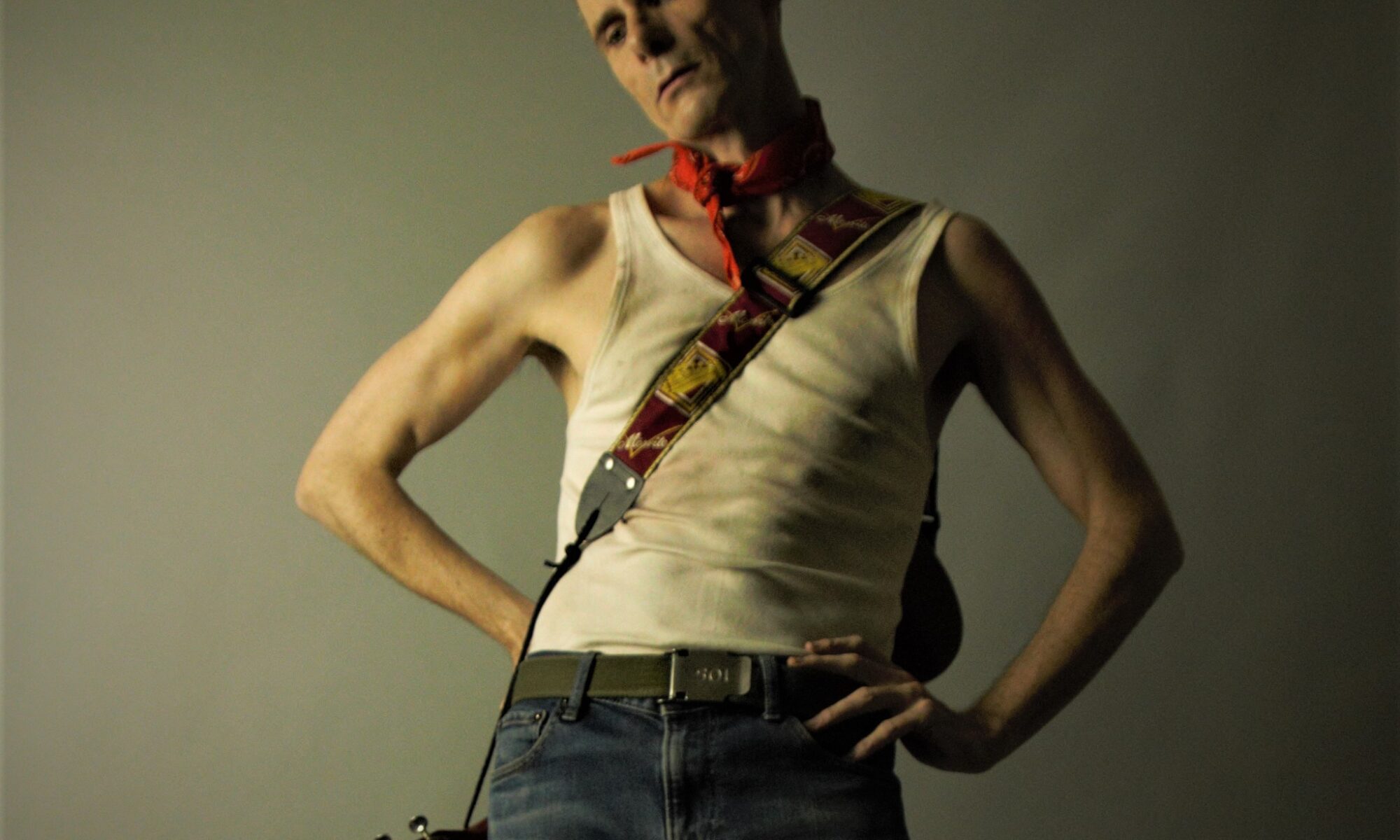
This troubles Graham Harman’s notion that every object, whether material or immaterial, has an autonomous essence—something withdrawn, beyond all relation. I simply don’t see that in Tommy. He only flickers into being when someone reads, reacts, or misinterprets him. He’s not withdrawn but relational; not autonomous but dependent. He depends on my creative act and the network that sustains him. When the internet is turned off forever, this version of Tommy vanishes into the ether. Perhaps a version of Tommy would continue to compose and sing to people in ‘real’ life, but this would still be a projection of the ‘real’ me. After a performance, the sailor hat would be returned to the box, and I would concern myself with other things.

What’s more unsettling is how these digital experiments have rippled offline. Over the years, I’ve seen people respond to my avatars as if they were separate beings—proof, perhaps, that our culture has quietly accepted digital personas as real. Yet what these encounters reveal, to me at least, is that the internet exists—but it isn’t real. It’s a sensual distraction, an elaborate mirage designed to sustain the illusion of technocratic supremacy. It convinces us that the symbolic realm—the feeds, the data, the curated self—is somehow more meaningful than embodied life.

To clarify: yes, Tommy Poppers exists. So does an bardh wyls, and so, for that matter, do I—Tryg. These are not “characters” in the fictional sense. They are working avatars, conceptual tools I use to explore difficult themes. Tommy helps me confront the performance of masculinity and the shadow of male violence. An bardh wyls, “the wild poet,” emerges when I write through the lyric’s relationship to place about environmental decadence and grief. Both are masks, but masks that reveal as much as they conceal.

I never post everything about where I am or who I’m with. That’s deliberate. It’s not secrecy—it’s philosophy. The digital realm cannot contain the totality of human existence. It can gesture, distort, amplify—but it cannot hold.

Offline, my life is grounded. I work with people I respect, in situations that demand attentiveness and care. Those relationships are real. They’re not content. I would never diminish them by performing them online.

So, is Tommy Poppers real? He’s as real as any reflection, as any poem, as any name you’ve ever written down and then outgrown. He is the shimmer of the self meeting its medium—a reminder that being online is not being alive.

Introducing The Psy-omatics of Encounter

In my earlier writing on Mesotopia: Towards a Place of Lyrical Inquiry, I proposed that meaning doesn’t live in the mind or the world alone, but somewhere between — in the mesotopic zone where bodies, environments, and language meet. The mesotopia is not a fixed place but a field of relation: a shifting terrain in which the real and the unreal, the felt and the thought, co-emerge through the act of encounter. This is not the materialist view that there is a “real world” out there waiting to be known, nor is it a purely idealist stance that the world is just a projection of the mind. The mesotopian perspective holds that the world is real, but it can never be fully known — only felt, intuited, translated and partially expressed through our sensory and linguistic entanglements with it.

This brings me to what I call the Psy-omatics of Encounter. By this I mean the subtle interplay between psyche and soma — mind and body — in the process of making meaning from environmental experience. Every encounter, whether with a tree, a breeze, or a city street, is not simply registered by the senses but interpreted by the nervous system, the emotions, and the imagination. These layers overlap and modulate one another in complex ways. The body registers vibrations and textures; the psyche weaves these into narratives, memories, and associations. Meaning, in this sense, is a psycho-somatic improvisation — an event that unfolds in the middle space between our physiological being and the environment’s affective impositions.

This is where I locate the process of lyrical production. My process of lyrical poesis emerges from these embodied encounters. Rather than treating poetry as a form of representation, I use it as a method of inquiry — a way to stay with the textures of experience before they are translated into fixed categories. Through this practice, I explore how different languages orient us differently toward the environment. Some languages, for example, frame the nonhuman world as animated and relational; others cast it as a passive backdrop for human action. By writing through and with these differences, I seek to expose the underlying psychic and bodily rhythms that shape our sense of environmental being.

It is crucial to emphasise that these encounters are localised events. They happen in the specificity of place — this humidity, this soundscape, this particular alignment of body and weather. Yet our minds often intervene, filtering these sensations through anthropocentric schemas. We name, measure, and categorise what we meet. This filtering process makes the world intelligible, but it also diminishes its strangeness. It reduces the real weirdness of environmental being — the sense that the world exceeds our concepts, that it vibrates with meanings we cannot fully articulate.

For this reason, I argue that intuition remains fundamental to any inquiry into the environment. Intuition is not anti-intellectual; it is the body’s capacity to sense patterns before they crystallise into thought. It is how we orient ourselves toward the more-than-human field of existence. Much of what we call environmental knowledge, from early cosmologies to modern ecological insight, has emerged from this intuitive mode of knowing. The Psy-omatics of Encounter, then, is not just a theory — it is an invitation to feel-think our way into the world again, to rediscover the lyrical intelligence that has always connected psyche, soma, and earth.

As always, my a’th kar!

Here is a link to my thesis which features a more detailed description of my work:

https://pearl.plymouth.ac.uk/ada-theses/113/