
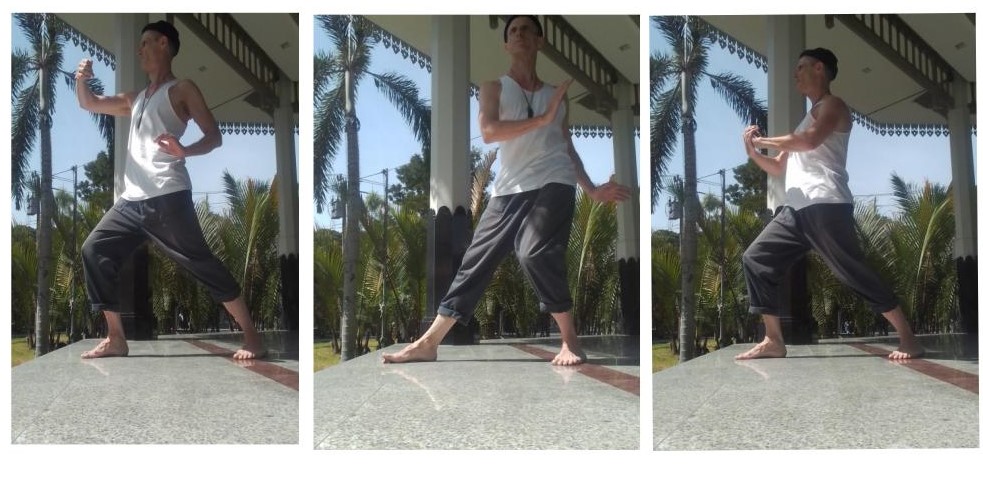
Over the past several years, I’ve devoted much of my research and practice to developing what I’ve come to call psy-omatics – a poetic method of listening to what the body knows, and how meaning unfolds through its encounters with the environment. In psy-omatics, I treat the body not as a sealed-off vessel or a machine of muscles and joints, but as a site of relational inquiry: a perceptual instrument that feels itself into meaning by collaborating with the world.
Recently, I have been learning Tai Chi and Chi Kung and practising these movements daily. Here is a summary of some of the similarities and differences I have noticed so far between Tai Chi and my own psy-omatic positions.
Similarities:
1. Both are philosophies of somatic practice.
Tai Chi is not simply a sequence of postures; it is a philosophy embodied – Taoism in motion. Psy-omatics similarly is not a self-help technique or method of stretching, it is a conceptual practice of embodied inquiry. Both interpret movement as thought; posture as worldview; gesture as epistemology. In both, theoretical abstractions are explored through deep investigation of movement within the body and the intellect.
2. Both are praxis of mind/body attunement to environment.
During Tai Chi, our coach has encouraged us to attend to our surroundings, to feel the movement of breath and breeze as continuous, to sense other bodies in the room not as distractions but as events. Psy-omatics likewise revolves around attunement – the ways the body opens to acoustic, tactile and spatial cues from the environment. In both, we feel our way into the world.
3. Both require deep introspection to somatic processes.
Whether noticing the shift of weight from heel to toe in Tai Chi, or listening to the subtle tensions in the ribcage in psy-omatics, both practices call for inward attention. Not an analytical attention, but a felt awareness. In psy-omatics, I often ask, what emotion or language does the body want to produce in this moment? In Tai Chi, the question is more, how does the movement flow through me? Yet both move through this same domain of embodied introspection.
4. Both require “grounding,” although there are subtle differences here.
In Tai Chi, grounding involves drawing energy upward from the ground. The earth is a resource of chi, a reservoir of subtle force. In psy-omatics, the ground is not a battery or an energy source. The contact between body and soil (or floor) becomes an exchange, a site of meaning-making, almost conversational. In psy-omatics, I encounter the ground as an interlocutor rather than a source of power.
Differences:
The most important divergences, I have found, emerge from metaphysics – from the different assumptions about what the world is.
1. Tai Chi emerges from a Taoist metaphysics of energy, whereas psy-omatics engages with substances and flows.
In Tai Chi, everything is energy and flux: yin and yang exchange endlessly; movement arises from the circulation of chi. In psy-omatics, I do not encounter a world of things that are solely composed of invisible energy. I encounter textures, pressures, acoustic reverberations, material resistance, physiological intensities. In short, I encounter a world of both substances and flows. These differing metaphysical frameworks shape the practice in fundamental ways. Tai Chi moves like liquid through an interconnected whole; whereas psy-omatics moves like a body negotiating encounters with other things. This fundamental difference requires further contemplation.
2. Tai Chi encourages the mind to lead the body, whereas in psy-omatics sometimes the body leads the mind.
In Tai Chi, my coach has often repeated: the mind leads the chi, and the chi leads the body. The intention precedes the gesture. In psy-omatics, I often find that the body responds before intention forms. A shoulder tightens, a hip withdraws, a hand reaches—and only afterwards does the mind grasp meaning. The body becomes an author of thought rather than merely its medium.
3. Tai Chi relies on visualisation and imagination, whereas psy-omatics resists ocularcentric vocabulary.
In Chi Kung, we trace points of energy, imagine roots descending from our feet and visualise streams of chi entering our bone-marrow. Psy-omatics avoids these visual metaphors because they privilege sight over other senses. I argue that so much body-work eludes sight. Instead, I turn to acoustics – resonance, rhythm, reverberation; to tactile sensation, proprioception, density and vibration. Meaning is not simply seen but felt.
4. Some ‘new-age’ adaptations of Eastern philosophy emphasise self-improvement, whereas psy-omatics acknowledges multiple vectors of causation.
I have noticed a tendency, in some versions of Tai Chi teaching, to emphasise personal enlightenment, self-realisation, inner peace. While these are valuable pursuits, they can imply a passive stance toward the world: the belief that one should accept things as they are, retreat inward, and cultivate serenity. Psy-omatics, by contrast, views the human as a causal actor among many. The body does not merely adapt to the world; it helps shape it. Somatic practice becomes an act of participation, not withdrawal.
Closing Thoughts:
Overall, I genuinely enjoy Tai Chi, and I continue to learn from it – not just physically but philosophically. I am always aware that I may have misunderstood or oversimplified some aspects of its metaphysics, and I remain open to correction from more experienced practitioners. I am learning new dimensions of bodily awareness through Tai Chi and Chi Kung, but for understanding the poetic process at the heart of psy-omatics, I encounter a very different world.
Perhaps that is the core discovery from my encounter with Tai Chi and Chi Kung: different movement practices require different metaphysical assumptions. Rather than seeking a single ‘correct’ account of the body and its movements, I am learning to hold these differing frameworks gently, letting each illuminate different contours of embodied experience.
As always, my a’th kar!