Mesotopia: Significant Findings and Contributions

If you are looking for neat conclusions, this isn’t that kind of project. Indeed, I suggest that if you are looking for neat conclusions – you’re probably missing a big part of what makes research interesting. After years of wrestling with sites, words, and the strange space between being in a place and thinking about how I understand it, I have not found a tidy set of answers. Instead, I’ve landed somewhere more interesting: a conviction that meaning is made through a subtle interplay between the environment, the body and the mind. I’ve also found that different forms of expression demand different metaphysics – different philosophies of interpreting what is real – to turn these environmental encounters into something that can be communicated.
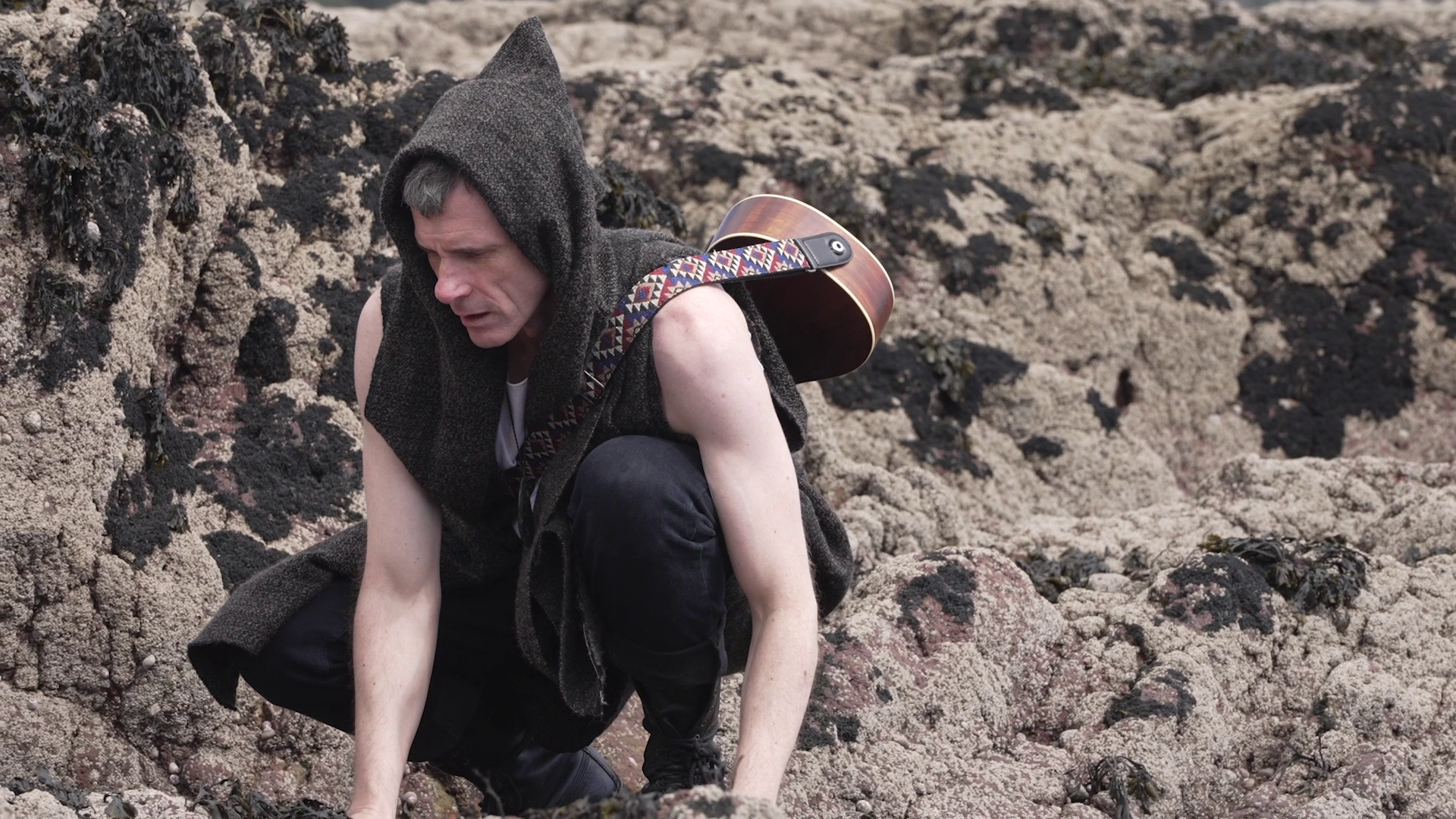
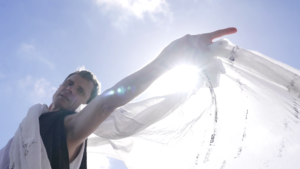
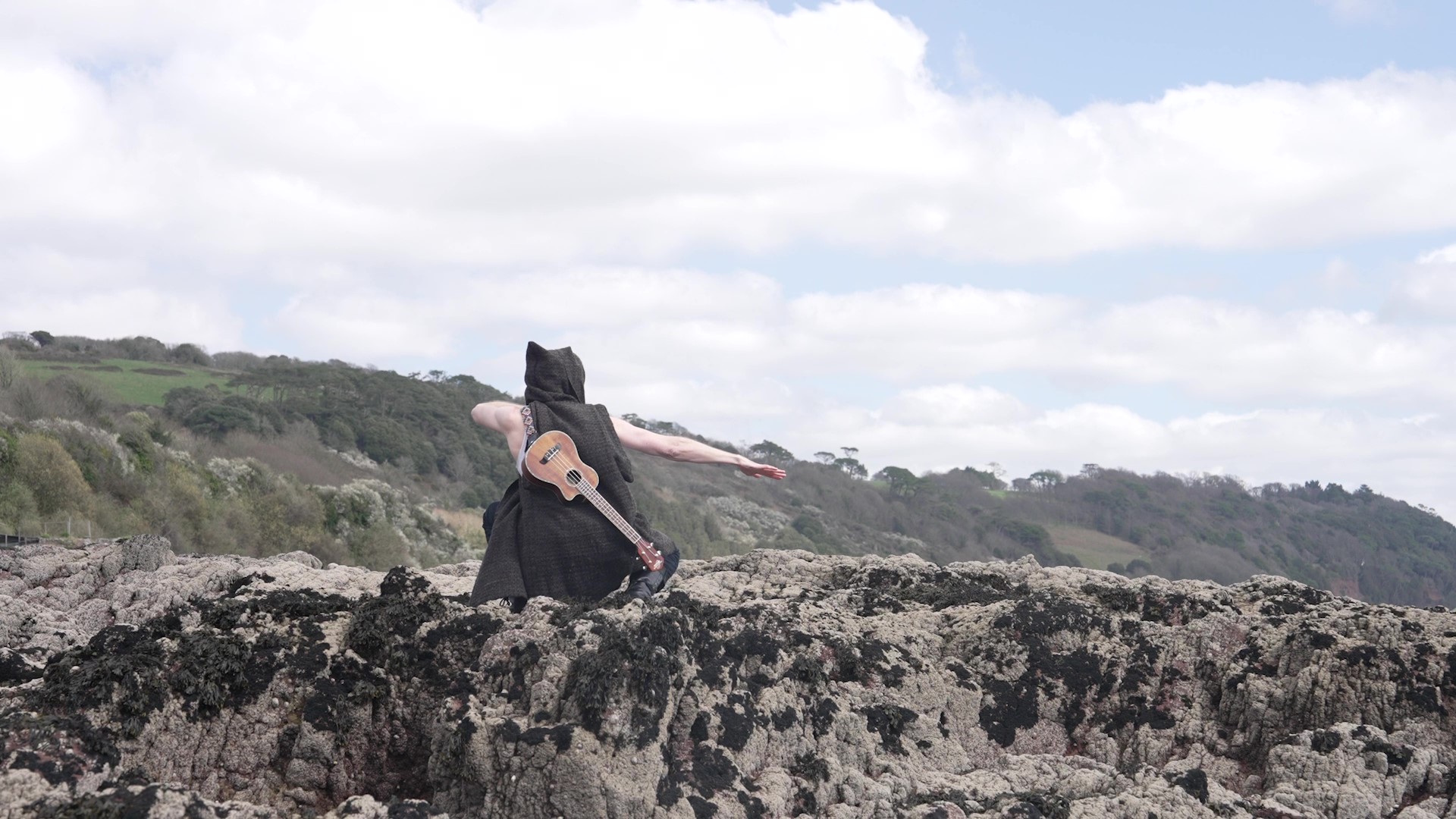
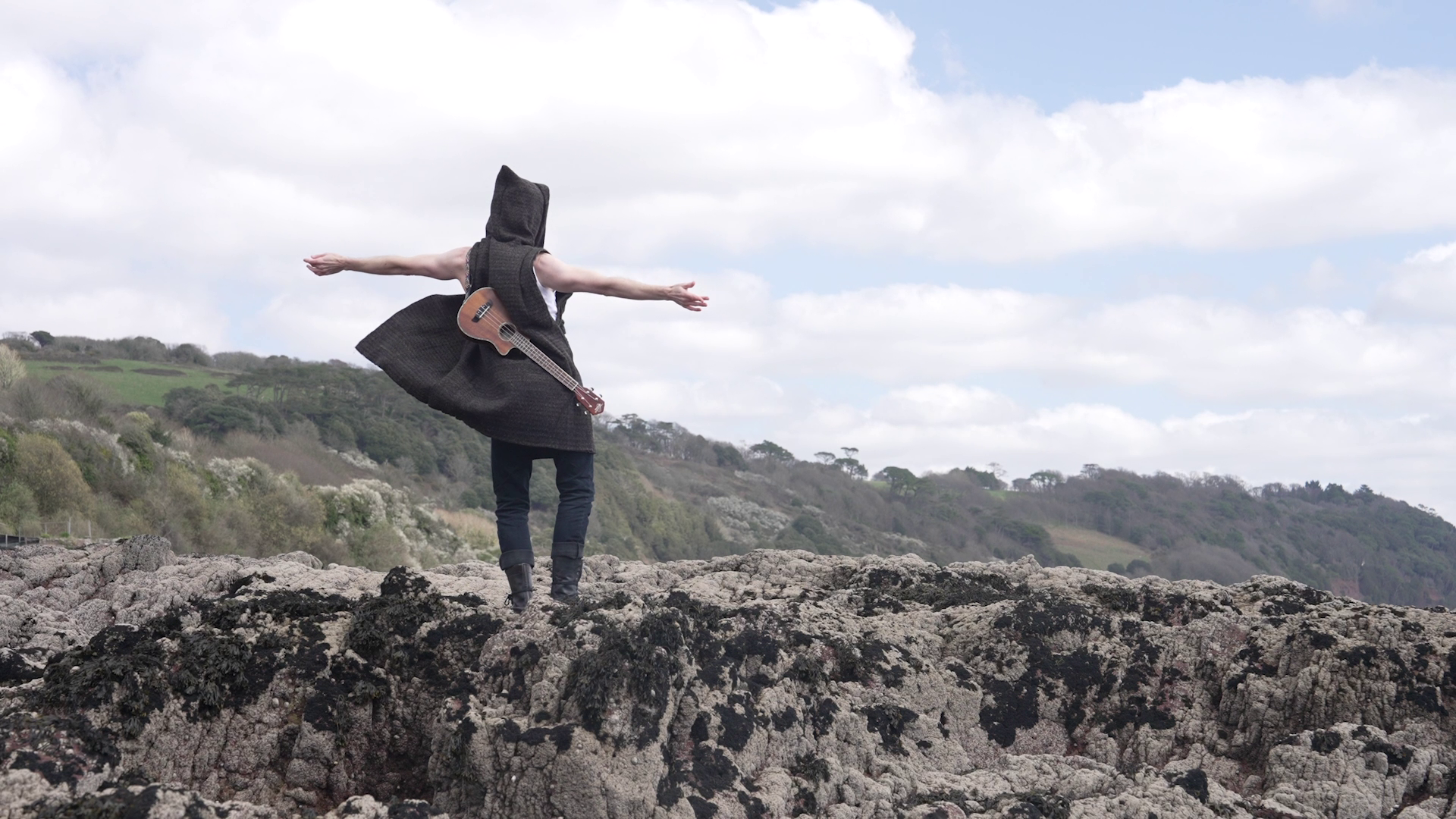
Tryg on the Coast by Will Halfacree

Let me put that another way. If you’re making a dance, you might need to focus more on theories that conceive a universe of energies and flows, as these are better suited to speaking about movement. However, if you’re making a lyric about an environmental encounter, you need a little distance to process the encounter, therefore theories that convey a universe of substances. And if you’re trying to make sense of the world while moving through it, then you might need to employ a theory that sits between theories of substances and flows.

Mesotopia, a middle place, is my attempt to do this. It is a place where physical things meet conceptual things, a place of substances and flows, a practice that sits between theory and experience, between knowing and not-knowing. I have found that a theory of object-oriented ontology (OOO), as advanced by Graham Harman, has proven to be really helpful when talking about mesotopia and mesotopian logic.

One of the more unexpected findings of my research is that the Cornish language – Kernewek – is structurally more suited to object-oriented thinking than English. I looked at three features of the Kernewek language that differ from the English language. Firstly, the use of pronominal prepositions; secondly, the favouring of predicate-led constructions; finally, the way nouns often sit before modifiers. I have found that these are not just grammatical quirks. I suggest that they build a world where things don’t exist merely as props for chattering human subjects. In Kernewek, the language itself leans into the idea that objects have their own stubborn presence. English, by contrast, keeps trying to put the speaking subject in the driver’s seat.

When you are trying to express your understanding of the world, the form that communication takes matters. I have found that parataxis – placing phrases side by side without explicit connections – is more significant than syntax for expressing relations to the environment. You don’t explain the space. You juxtapose. You let things sit next to each other, and the space between them does the work. What is the subtle difference between a phrase like ‘good day’ or ‘dydh da’ (literally ‘day good’)? Well, I advance the idea that the English phrase prioritises the subject’s opinion, ‘good’, over the object, ‘day’. Whereas the Kernewek version acknowledges the object, ‘dydh’, before the speaker’s opinion, ‘da’. It’s a subtle difference; however, I propose that this difference articulates a slightly different perspective of my understanding of what a day actually is.

It is useful to consider the significance of Graham Harman’s notion of ‘space’ here. Space, in this sense, is the distance between my physical encounter with an object and the object as I have conceived it in its totality. My physical encounter with a ‘day’ is comprised of various sensory events, such as registering the difference between darkness and light. However, there is much to a day that eludes my certainty – the totality of my understanding of a ‘day’ involves substances and flows that elude my senses, such as planetary objects and rotations. Therefore, the human concept of ‘day’ is simply an educated guess of what a day actually is, and whether or not it is ‘good’ is a human imposition. What’s ‘good’ for humans might not necessarily be ‘good’ for seagulls.

Perhaps the most delicate finding – the one that’s often most difficult for me to explain in simple terms – is this: my understanding of my environment mimics a sensation of knowing, but it’s actually rooted in an experience of not-knowing. For example, my practice of communicating my understanding of my environment involves lyrical composition. While these compositions feel like they’re delivering understanding, what they’re really doing is performing the condition of being amidst things I can’t fully grasp. Hence, I find that I exist in a world of partial revelation.

So no, there are no definitive conclusions here. There is a clearer sense that if you want to understand a place, you have to accept that the place – and the objects within it – keep their secrets. That means finding a philosophy, a language, a compositional practice that doesn’t translate everything back into human terms.

As always, my a’th kar!

Page 227 from Verran (2025) provides a summary of significant findings:
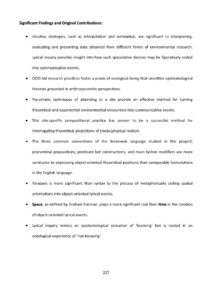
Summary of Significant Findings and Contributions (Verran, 2025)

Empirical or Intuitive Modes of Inquiry: Interpreting Information in a State of Partial Revelation

In my 2025 thesis, I make what initially sounds like a scandalous claim: all research, no matter how diligent, arrives at a moment of conjecture.

That’s not an attack on science. It’s not a flirtation with relativism. It’s an observation about what actually happens when we try to know something.

You can observe, measure, dissect, test and evaluate until you disappear into sub-atomic weirdness. You can triangulate sources, run regressions, peer review the life out of a paragraph – but eventually, you have to conclude. That conclusion – however sophisticated – is an educated guess.

A very good guess, perhaps. A responsible guess, but a guess nonetheless.

This is not a weakness in research. It’s a structural feature of inquiry in a world that only ever reveals itself partially.

In developing what I call a mesotopian mode of meaning-making, I found myself drawn to the speculative strategies of fiction – particularly the Utopian genre. World-building works by extrapolation. An author takes fragments of reality and extends them into coherent possibility. The reader recognises the plausibility not because every detail is empirically verified, but because the world hangs together. It resonates.

Research works in much the same way.

We gather fragments of the real. Data points. Interviews. Archival traces. Phenomenological encounters, and then we construct a model that accounts for them. We are not inventing from nothing. We are extrapolating from partial revelation.

Mesotopian logic simply makes this explicit.

Rather than pretending to empirical omniscience, it acknowledges the intuitive component in interpretation. It admits that at some point the researcher must lean into a felt coherence; a sense that the pattern is right; that the explanation fits.

Now, the immediate objection is obvious: doesn’t this throw everything into doubt?

No.

Because there is a real world.

I am not arguing that reality is optional or that truth is whatever we desire. The world resists us. It surprises us. It refuses to conform to our expectations. Much of it remains withdrawn, opaque, inaccessible – but not imaginary.

What we have access to are encounters. These are moments in which something shows up; a document that shifts your understanding; a conversation that reframes the field; a material object that refuses the narrative you were about to impose on it.

These phenomenological encounters inform epistemological comprehension. In other words, how things appear to us shapes what we can responsibly claim to know.

But between encounter and conclusion, there is always a gap.

And that gap is not filled by raw data alone.

This is where I detect something like an “intuitive phenomenology.” Not simply psychological bias, not wishful thinking, but a form of instinctive pattern recognition. The mind – and perhaps something deeper than mind – moves to complete the picture. It draws connections. It senses coherence. It fills epistemological gaps so that meaning can stabilise.

We already trust this process in everyday life. A seasoned organiser can walk into a room and “read” it. A historian can sense when an archive is hiding something. A scientist can feel when a model is elegant rather than forced.

These are not irrational acts. They are disciplined intuitions shaped by immersion in reality.

Mesotopian inquiry does not replace empiricism with vibes. It integrates empirical rigour with an honest account of the intuitive leap that always occurs at the edge of knowledge.

So empirical or intuitive? The answer is both.

We live in a state of partial revelation. The world gives itself, but never entirely. Our task is to respond carefully, rigorously, and imaginatively. Not to claim absolute certainty, but to make the most responsible guess we can – and to remain open when the world answers back.

As always, my a’th kar!

I discuss this blog in more detail on my Youtube channel:

Introducing the Mesotopian Event

I want to begin in the present moment, because that is where the mesotopian event lives. Not as an abstract idea floating above experience, and not as a fixed material fact beneath it, but as something that happens when I meet an object and realise that meaning is being made with me, not simply handed to me. The mesotopian event is my attempt to describe that fleeting, charged instant of encounter – the moment when thought, sensation, intuition and language briefly co-habit the same room.

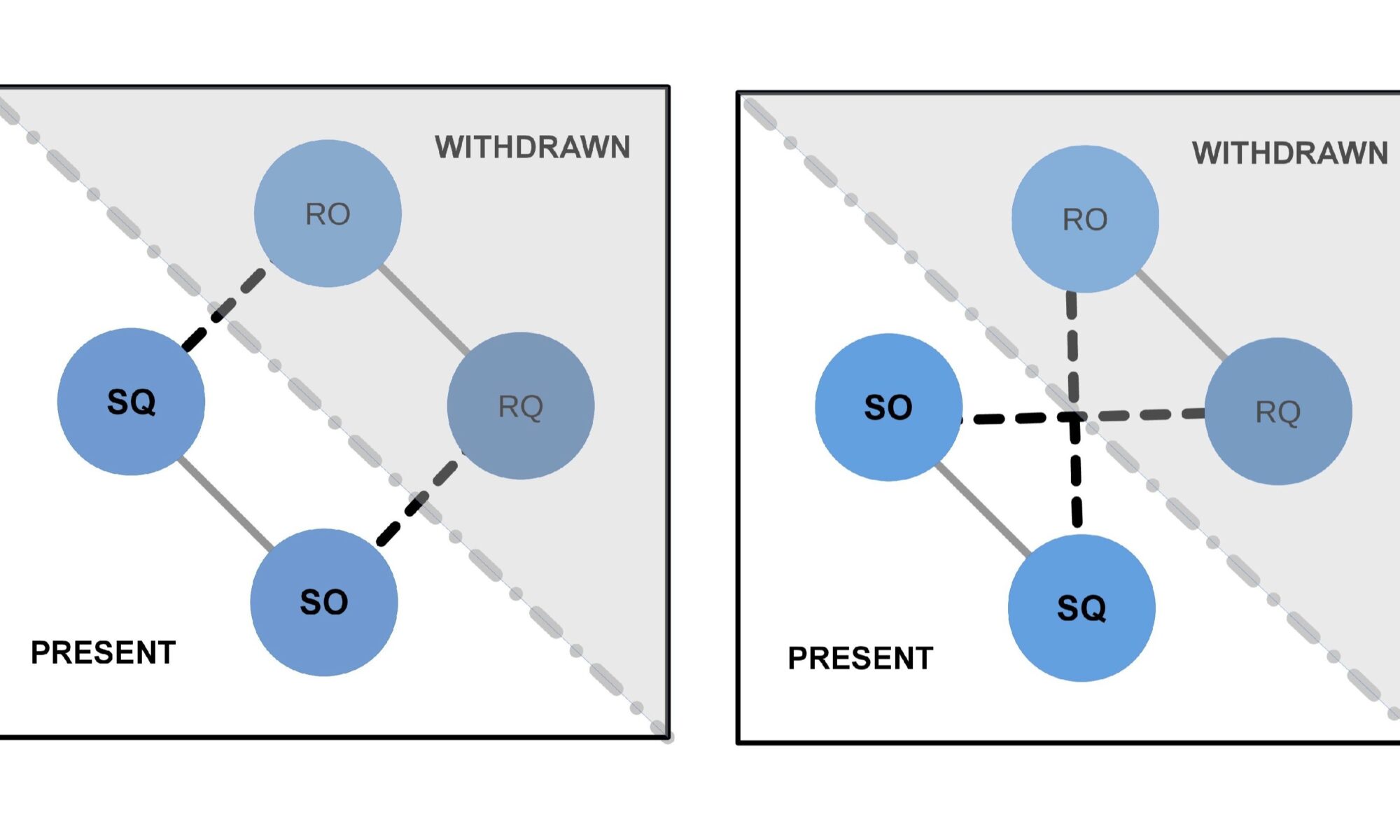
In my 2025 thesis, Mesotopia: Towards a Place of Lyrical Inquiry, I draw heavily on Graham Harman’s concept of The Quadruple Object. Harman suggests that any object – whether a stone, a poem, or a political idea – is held together by four poles: the real object (RO), the real quality (RQ), the sensual object (SO), and the sensual quality (SQ). These poles do not collapse into one another; instead, they are sustained by four tensions: time, space, essence, and eidos. For Harman, all objects – human and other-than-human alike – encounter one another through these tensions.

A key insight for me is this: objects endure precisely because they withdraw. Their essence is never fully accessible. I can touch a limpet, describe it, argue with it, write about it – but something always escapes me. This is not a failure of perception. It is the very condition that makes meaning possible.

Essence, then, names the tension between the real object and its real qualities, both of which remain partially withheld during any encounter. Time emerges as the tension between the sensual object and its sensual qualities. I know, for example, that a limpet has lived longer because its shell is rougher than the smoother shells of younger limpets. Space, meanwhile, is the tension between the sensual object and its real qualities. It is not the distance between objects, but the gap between the limpet as I encounter it and the real qualities that make it a limpet at all. I interpret eidos as something closer to intuition: the felt sense that arises as I try to conceive the real object through the sensual qualities available to me. I encounter a rough, conical shell and intuit the older limpet recoiling from my touch within.

The Mesotopian Event – building on Harman’s ‘Quadruple Object’

The diagram from my thesis helps to clarify this. The four poles are held apart, with certain relations fixed and others activated. The dashed lines mark moments of tension and movement. The mesotopian event occurs along these lines, where space and eidos interact while time and essence quietly hold their ground.

The mesotopian event happens when I consciously step into this condition. During such an encounter, two tensions remain fixed. Time is fixed because the encounter happens now – not in memory, not in projection, but in the present moment of attention. Essence is fixed because it remains withdrawn. No amount of cleverness will prise it open. It stays put, stubborn and generative.

What does move are space and eidos. I turn the sensual object – the object as it appears to me – through its sensual qualities. I attend to texture, rhythm, tone, association, metaphor. I let intuition lead rather than command. This turning is not analytical in the conventional sense; it is exploratory, almost playful. I am guessing at the object’s withheld essence, fully aware that I will never arrive – and that this is precisely the point.

I describe mesotopia as a place between conceptual and physical terrains. In that in-between space, encounters with objects reveal multiple agents of causation. Meaning is no longer a straight line from subject to object. Instead, it becomes something composed, situated and contingent.

Ultimately, the mesotopian event is an ethics of attention. It asks me to slow down, to resist the urge to dominate experience with explanation, and to trust that which withdraws is just as important as what appears. Meaning, in this view, is not something I extract from the world. It is something that happens between us – briefly, beautifully, and never quite the same way twice.

As always, my a’th kar!

I expand on this post in the following video:

References:

Harman, Graham. (2011) The Quadruple Object, Zero Books.

Verran, Tristan. (2025) Mesotopia: Towards a Place of Lyrical Inquiry. Thesis. University of Plymouth. https://pearl.plymouth.ac.uk/ada-theses/113/


Introducing The Psy-omatics of Presentation

When people ask me what psy-omatics actually means, I often say: it’s about how thinking and sensing happen together, in the body, in a place, at a moment. It’s not just about ideas in the head, but the messy, alive relationship between the enviroment, mind, body and language (1). In a post titled Introducing The Psy-omatics of Encounter, I outline how I make sense of the physical and conceptual things that I meet. Here, I want to outline how I articulate these encounters or turn them into communicative events: what I call The Psy-omatics of Presentation.

Any kind of meaningful presentation – whether it’s writing, speaking, poetry, performance, or teaching – requires preparation. Not just mental preparation, but physical preparation too. Over the years, I’ve learned that if I want to present lyrical ideas clearly, my body has to be ready to carry them. That means fitness, breath, posture, voice and attention. I don’t just think the words; I feel them moving through me; I project them, shape them.

This approach borrows from many places. From poetry, I take Charles Olson’s idea that language carries energy from the writer to the reader or, in my case, from the presenter to the listener (2). I have interpreted that energy somatically. It’s not an abstract force floating around; it’s something felt in muscle tension, rhythm, breath, and timing. From performance theory, I’ve been influenced by Eugenio Barba’s idea of the “dilated body,” where trained physical awareness creates a bridge between action and thought (3). What interests me here is intuition – not as something vague, but as a form of embodied thinking.

Where I start to depart from some of these traditions is in how I understand the environment. I don’t experience the world as pure flow, constant movement or total immersion. Instead, I encounter both flows and substances. Some things move and change; others resist, hold still and demand attention. When I’m presenting, I’m negotiating both. Sometimes I need motion and momentum. Sometimes I need stillness, pauses, and silence to let meaning settle.

This is where psy-omatics differs from approaches like Sandra Reeve’s “eco-somatics,” (4) which often emphasise continuous movement and full integration with the environment. My relationship to a site – whether that’s a landscape, a room, or a digital space – is never complete or seamless. There is always a part of ‘me’, psychologically and somatically, that does not dissolve into the environment. Language itself creates distance. To name something is already to step back from it. That distance isn’t a failure; it’s necessary for thought.

For many reasons, I’ve become wary of using the word performance. It often carries theatrical expectations that can obscure what I’m really trying to do. I’m not interested in spectacle, although I understand the mechanics of smoke and mirrors. I’m interested in clarity, sincerity and inquiry. The psy-omatics of presentation is about finding ways to present lyrical thinking – through speaking, making and doing – that respect the tensions between body and mind, movement and stillness, nearness and distance.

In the end, psy-omatics is not a method you copy. It’s a way of paying attention. Each project, each presentation, has to find its own form. Or, as I put it in the thesis, it has to be done in a way better described not as performance, but as gwruthyl: a making-through-doing, grounded in the lived encounter between self, world and language.

As always, my a’th kar!

References:

(1) Verran, T. (2025) Mesotopia: Towards a Place of Lyrical Inquiry. Thesis. University of Plymouth. Available
at: https://doi.org/10.24382/nv45-pk79

(2) Olson, Charles, (1950) “Projective Verse,” Originally published in, Poetry New York, no 3, 1950,
www.poetryfoundation.org/articles/69406/projective-verse. Accessed 20 November 2023.

(3) Barba, Eugenio. (1985) The Dilated Body: on the Energies of Acting. New Theatre Quarterly, 1(4), pp. 369–
382.doi:10.1017/S0266464X00001792.

(4) Reeve, Sandra. (2006) The next Step: Eco-Somatics and Performance. Move into Life. https://www.moveintolife.com/uploads/1/3/9/6/13969833/the_changing_body2.pdf [Accessed 2025]

Mesotopia: A Remedy to the Extremes of Utopia, Dystopia and Arcadia

I want to begin with time, because time is where much of our thinking quietly goes astray. In Mesotopia – Towards a Place of Lyrical Inquiry (2025), I describe time not as a neutral container that events pass through, but as something that happens in the act of encounter. This idea is indebted to Graham Harman’s discussion of time in The Quadruple Object, where time emerges as an effort to determine a sensual object through its qualities. In mesotopian terms, time is not ticking away somewhere else; it is generated in the moment I attempt to make sense of what is directly in front of me.

Mesotopian thinking, then, unfolds in the present tense. It is a mode of attention that asks: what is this place, this situation, this feeling—right now? What qualities are available to me, and what meanings can I cautiously, playfully, and only partially draw from them? This is not a search for final truths. Rather, it is a resistance to the urge to escape the present by disappearing into imagined futures or idealised pasts.

Utopia, dystopia and Arcadia are powerful narrative modes, and I understand their appeal. Utopia pulls us into visions of perfected systems and frictionless lives. Yet these visions are always subjective. My personal utopia might feel liberating to some, while appearing deeply unsettling – or even terrifying – to others. Dystopia pulls us into a place of fear, catastrophe and collapse. Here again, subjectivity plays a role: what one group fears as dystopian, another may quietly celebrate as utopian. Arcadia operates differently. It tugs us backward toward a supposedly lost golden age, where life was imagined to be simpler, purer, more authentic. Despite their differences, all three exert a similar effect on our ability to engage with the present.

Each of these modes lifts us out of the here and now and relocates our attention elsewhere. In doing so, they distract us from the difficult, ambiguous work of understanding where we actually are. Utopian, Dystopian and Arcadian narratives are frequently invoked to obscure reality, conjuring cognitive boundaries that divide people along rigid – and often outdated – ideological lines.

There is another danger in these modes of thinking that concerns me deeply: they all tend to render us passive. Utopia can feel so vast and total that our small actions seem insignificant. Dystopia, meanwhile, paralyses us with the sense that everything is already lost. Arcadia gently encourages us to refuse the temptations of change and progress altogether. In each case, the outcome is similar: we hesitate, withdraw, and stop experimenting. We become trapped in a present that feels frozen – unable to take chances, explore possibilities or test new potentials.

I am not suggesting that foresight or memory should be abandoned. Mesotopia does not exclude planning for the future or studying history. What I am proposing is something more modest: that before we disappear into fantasies of what might be, or myths of what once was, we first learn to understand the present place that asks for our attention and care.

Mesotopian thinking requires us to attend carefully to what is already here – to notice the textures, tensions and latent possibilities of the present moment. It invites modesty instead of grand solutions, curiosity instead of certainty. From this position, the present becomes intelligible enough to respond to, which in turn makes the uncertainties of the future more manageable as they are encountered.

For me, mesotopia is a remedy, not an escape. It is a way of staying with the middle ground – where meaning is provisional, time is encountered rather than mastered, and the present is not something to endure until a better world arrives, but something to engage with, thoughtfully and creatively, in the moment.

I expand on this blog in the following video:

As always, my a’th kar!

References:

(1) Verran, T. (2025) Mesotopia: Towards a Place of Lyrical Inquiry. Thesis. University of Plymouth. Available
at: https://doi.org/10.24382/nv45-pk79

(2) Harman, Graham. (2011) The Quadruple Object. London: Zero Books.

Psy-omatics Meets Tai Chi Chuan

Over the past several years, I’ve devoted much of my research and practice to developing what I’ve come to call psy-omatics – a poetic method of listening to what the body knows, and how meaning unfolds through its encounters with the environment. In psy-omatics, I treat the body not as a sealed-off vessel or a machine of muscles and joints, but as a site of relational inquiry: a perceptual instrument that feels itself into meaning by collaborating with the world.

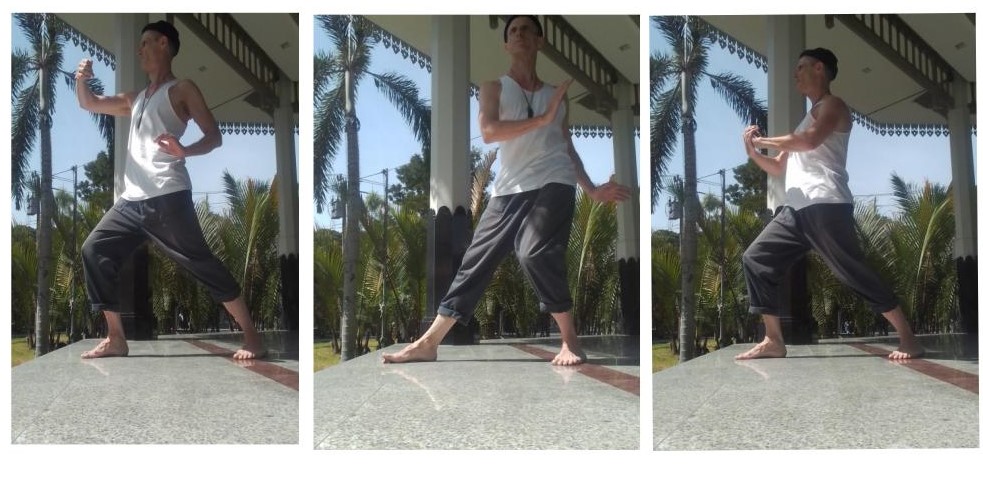
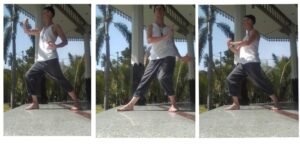
Recently, I have been learning Tai Chi and Chi Kung and practising these movements daily. Here is a summary of some of the similarities and differences I have noticed so far between Tai Chi and my own psy-omatic positions.

Morning Tai Chi

Similarities: 

1. Both are philosophies of somatic practice.
Tai Chi is not simply a sequence of postures; it is a philosophy embodied – Taoism in motion. Psy-omatics similarly is not a self-help technique or method of stretching, it is a conceptual practice of embodied inquiry. Both interpret movement as thought; posture as worldview; gesture as epistemology. In both, theoretical abstractions are explored through deep investigation of movement within the body and the intellect.

2. Both are praxis of mind/body attunement to environment.
During Tai Chi, our coach has encouraged us to attend to our surroundings, to feel the movement of breath and breeze as continuous, to sense other bodies in the room not as distractions but as events. Psy-omatics likewise revolves around attunement – the ways the body opens to acoustic, tactile and spatial cues from the environment. In both, we feel our way into the world.

3. Both require deep introspection to somatic processes.
Whether noticing the shift of weight from heel to toe in Tai Chi, or listening to the subtle tensions in the ribcage in psy-omatics, both practices call for inward attention. Not an analytical attention, but a felt awareness. In psy-omatics, I often ask, what emotion or language does the body want to produce in this moment? In Tai Chi, the question is more, how does the movement flow through me? Yet both move through this same domain of embodied introspection.

4. Both require “grounding,” although there are subtle differences here.
In Tai Chi, grounding involves drawing energy upward from the ground. The earth is a resource of chi, a reservoir of subtle force. In psy-omatics, the ground is not a battery or an energy source. The contact between body and soil (or floor) becomes an exchange, a site of meaning-making, almost conversational. In psy-omatics, I encounter the ground as an interlocutor rather than a source of power.

Differences:

The most important divergences, I have found, emerge from metaphysics – from the different assumptions about what the world is.

1. Tai Chi emerges from a Taoist metaphysics of energy, whereas psy-omatics engages with substances and flows.
In Tai Chi, everything is energy and flux: yin and yang exchange endlessly; movement arises from the circulation of chi. In psy-omatics, I do not encounter a world of things that are solely composed of invisible energy. I encounter textures, pressures, acoustic reverberations, material resistance, physiological intensities. In short, I encounter a world of both substances and flows. These differing metaphysical frameworks shape the practice in fundamental ways. Tai Chi moves like liquid through an interconnected whole; whereas psy-omatics moves like a body negotiating encounters with other things. This fundamental difference requires further contemplation.

2. Tai Chi encourages the mind to lead the body, whereas in psy-omatics sometimes the body leads the mind.
In Tai Chi, my coach has often repeated: the mind leads the chi, and the chi leads the body. The intention precedes the gesture. In psy-omatics, I often find that the body responds before intention forms. A shoulder tightens, a hip withdraws, a hand reaches—and only afterwards does the mind grasp meaning. The body becomes an author of thought rather than merely its medium.

3. Tai Chi relies on visualisation and imagination, whereas psy-omatics resists ocularcentric vocabulary.
In Chi Kung, we trace points of energy, imagine roots descending from our feet and visualise streams of chi entering our bone-marrow. Psy-omatics avoids these visual metaphors because they privilege sight over other senses. I argue that so much body-work eludes sight. Instead, I turn to acoustics – resonance, rhythm, reverberation; to tactile sensation, proprioception, density and vibration. Meaning is not simply seen but felt.

4. Some ‘new-age’ adaptations of Eastern philosophy emphasise self-improvement, whereas psy-omatics acknowledges multiple vectors of causation.
I have noticed a tendency, in some versions of Tai Chi teaching, to emphasise personal enlightenment, self-realisation, inner peace. While these are valuable pursuits, they can imply a passive stance toward the world: the belief that one should accept things as they are, retreat inward, and cultivate serenity. Psy-omatics, by contrast, views the human as a causal actor among many. The body does not merely adapt to the world; it helps shape it. Somatic practice becomes an act of participation, not withdrawal.

Closing Thoughts:

Overall, I genuinely enjoy Tai Chi, and I continue to learn from it – not just physically but philosophically. I am always aware that I may have misunderstood or oversimplified some aspects of its metaphysics, and I remain open to correction from more experienced practitioners. I am learning new dimensions of bodily awareness through Tai Chi and Chi Kung, but for understanding the poetic process at the heart of psy-omatics, I encounter a very different world.

Perhaps that is the core discovery from my encounter with Tai Chi and Chi Kung: different movement practices require different metaphysical assumptions. Rather than seeking a single ‘correct’ account of the body and its movements, I am learning to hold these differing frameworks gently, letting each illuminate different contours of embodied experience.

As always, my a’th kar!


Introducing Klewes: Listening in the Expanded Field

When I first began formulating the ideas that would eventually become my concept of mesotopia, I needed a way to describe the strange middle-ground where perception, place, and meaning fold into one another. I sensed that our encounters with the world happen both ‘out there’ and ‘in here’ but identifying with any kind of precision that place between ‘out there’ and ‘in here’ would require contemplation of both the psychological and somatic techniques involved in meaning making – hence my ongoing research into psy-omatic practice (1). Before working on my thesis, I had been playing with a method that helped me navigate that in-between space with more precision. That practice is what I now call klewes.

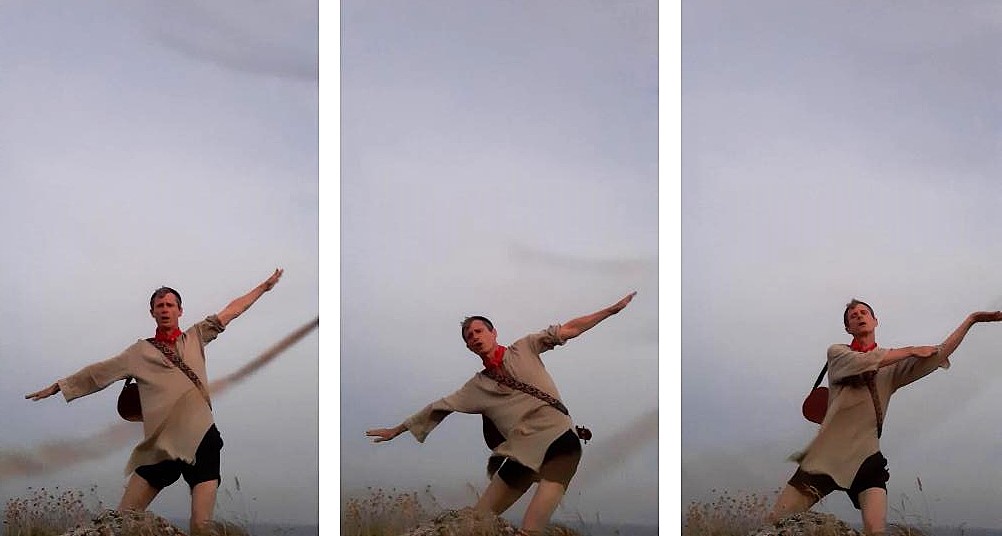
Klewes by Maruay Makekurdchoo (2018)

Klewes is a word from Kernewek, the Cornish language, meaning “to hear, think, feel, perceive.” The word immediately resonated with me. Its definition already gestures beyond the narrow sense of hearing and toward a fuller, more embodied mode of knowing. I realised that what I needed was a practice of attending that begins with the body’s capacity to listen – not just with the ears, but with everything capable of sensing vibration. I wasn’t seeking a metaphor. I wanted a method. So klewes became the name for that method.

The procedure is simple, but the effects can be disarming. When I arrive at a site of composition – whether a field, a coastal path, an abandoned industrial corner, or a patch of woodland – I lie down. I close my eyes. I take long, slow breaths for about fifteen minutes, sometimes a bit more, until my attention begins to settle. With my vision removed from the foreground, something else starts to happen: the body reorients itself. The ground becomes not a surface beneath me but a resonant partner. Vibrations travel upward – small tremors, shifting pressures, the faint hum of heat working its way through soil and stone. In those moments, I begin to “hear” with the back of my skull, with my ribs, with the folds of clothing touching the ground.

This is what I mean by listening in the expanded field.

The point of klewes isn’t to romanticise nature or to retreat into some meditative cocoon. It’s a deliberate unsettling of the visual habits that dominate our encounters with place. Modern life, and even much ecological thinking, leans heavily on the eye: the view, the image, the landscape. Vision often leads to a sense of distance reinforcing an “I over here” observing a “world over there.” That separation underpins an anthropocentric way of relating, one in which the human becomes the sole interpreter of meaning.

When I practise klewes, I don’t begin with seeing. I begin with hearing. The site arrives first as vibration, pressure, pulse. Instead of interpreting the place, I let the place impress itself upon me. Hearing – expanded into feeling – becomes a way of entering into relation without assuming that what I see defines what is there.

I’ve found that this shifts the entire tone of composition. Rather than imposing structure onto the site, I allow the site to tune me. The thinking, composing or writing that follows carries traces of that initial, ear-led encounter. It is quieter, more porous, and more situated.

Klewes is, ultimately, an invitation: to hear our way into place, to perceive without rushing to picture, and to recognise that the world meets us long before we claim to look at it.

As always, my a’th kar!

References:

(1)Verran, T. (2025) Introducing the Psy-omatics of Encounter. https://myathkar.org/introducing-the-psy-omatics-of-encounter/

(2) Verran, T. (2025) Mesotopia: Towards a Place of Lyrical Inquiry. Pearl. The University of Plymouth.

Introducing The Psy-omatics of Encounter

In my earlier writing on Mesotopia: Towards a Place of Lyrical Inquiry, I proposed that meaning doesn’t live in the mind or the world alone, but somewhere between — in the mesotopic zone where bodies, environments, and language meet. The mesotopia is not a fixed place but a field of relation: a shifting terrain in which the real and the unreal, the felt and the thought, co-emerge through the act of encounter. This is not the materialist view that there is a “real world” out there waiting to be known, nor is it a purely idealist stance that the world is just a projection of the mind. The mesotopian perspective holds that the world is real, but it can never be fully known — only felt, intuited, translated and partially expressed through our sensory and linguistic entanglements with it.

This brings me to what I call the Psy-omatics of Encounter. By this I mean the subtle interplay between psyche and soma — mind and body — in the process of making meaning from environmental experience. Every encounter, whether with a tree, a breeze, or a city street, is not simply registered by the senses but interpreted by the nervous system, the emotions, and the imagination. These layers overlap and modulate one another in complex ways. The body registers vibrations and textures; the psyche weaves these into narratives, memories, and associations. Meaning, in this sense, is a psycho-somatic improvisation — an event that unfolds in the middle space between our physiological being and the environment’s affective impositions.

This is where I locate the process of lyrical production. My process of lyrical poesis emerges from these embodied encounters. Rather than treating poetry as a form of representation, I use it as a method of inquiry — a way to stay with the textures of experience before they are translated into fixed categories. Through this practice, I explore how different languages orient us differently toward the environment. Some languages, for example, frame the nonhuman world as animated and relational; others cast it as a passive backdrop for human action. By writing through and with these differences, I seek to expose the underlying psychic and bodily rhythms that shape our sense of environmental being.

It is crucial to emphasise that these encounters are localised events. They happen in the specificity of place — this humidity, this soundscape, this particular alignment of body and weather. Yet our minds often intervene, filtering these sensations through anthropocentric schemas. We name, measure, and categorise what we meet. This filtering process makes the world intelligible, but it also diminishes its strangeness. It reduces the real weirdness of environmental being — the sense that the world exceeds our concepts, that it vibrates with meanings we cannot fully articulate.

For this reason, I argue that intuition remains fundamental to any inquiry into the environment. Intuition is not anti-intellectual; it is the body’s capacity to sense patterns before they crystallise into thought. It is how we orient ourselves toward the more-than-human field of existence. Much of what we call environmental knowledge, from early cosmologies to modern ecological insight, has emerged from this intuitive mode of knowing. The Psy-omatics of Encounter, then, is not just a theory — it is an invitation to feel-think our way into the world again, to rediscover the lyrical intelligence that has always connected psyche, soma, and earth.

As always, my a’th kar!

Here is a link to my thesis which features a more detailed description of my work:

https://pearl.plymouth.ac.uk/ada-theses/113/


Introducing The Mesotopia: Living Between Physical and Symbolic Worlds

I often begin by saying that my approach to meaning-making differs sharply from the purely materialist assumption that ‘there is a real world and it can be known’. The mesotopian position, by contrast, begins from the more unsettling but, I think, more honest claim: there is a real world, but it can never be completely known. This is not a retreat into relativism or mysticism; indeed, I argue for demystifying the process of meaning-making. I advance a philosophy of embodied recognition that every act of knowing is situated, partial, and mediated through the strange vehicle of human experience.

In the mesotopia, meaning arises not from the fixed solidity of matter, nor from the abstract play of language, but in the dynamic, lived zone where sensing, thinking, and doing meet. The prefix meso- means “middle,” and it’s in this middle terrain that I locate philosophy as a practice, not as a system. It’s a space of tension, friction, and constant negotiation—where perception and intuition interweave to produce what we take to be “the real.”

Materialism offers the comfort of certainty: a belief that, if we look hard enough, we can strip away illusion and stand before reality as it truly is. The mesotopian approach rejects that fantasy. Instead, it invites us to dwell in partial revelation—to see knowledge as a series of embodied engagements that illuminate fragments of the world while inevitably casting others into shadow. What we call “understanding” is not the conquest of the unknown, but a dance with its irreducible strangeness.

This is where the idea of weirdness enters. In my work, weirdness isn’t about the quirky or bizarre, but about that unsettling quality that appears when reality refuses to be fully domesticated by human thought or desire. The weird announces itself when our conceptual frameworks falter—when the world shows itself to be more alive, more complex, more surprising than our categories allow. Weirdness, then, is not an obstacle to meaning but the sign of meaning’s vitality. It’s the pulse that reminds us we are both active and passive participants in a strange confederation of things that keep their secrets.

In the mesotopia, to encounter weirdness is to encounter reality itself. Our bodies, our gestures, our creative acts—these are not secondary to thought but integral to it. The way we move, speak, and make art are all ways of negotiating that strange boundary between what can be known and what forever escapes categorisation. Philosophy, in this sense, becomes an art of attunement—a way of staying sensitive to the rhythms of a world that exceeds our grasp.

So the mesotopian project is neither to master the real nor to deny it. It is to inhabit it—to live in that fertile middle space where knowledge and mystery coexist, where the world’s weirdness is not a problem to solve but a companion to think with. To be mesotopian is to make meaning a bodily act, to feel thought as movement, and to accept, joyfully, that the real will always remain just beyond the horizon of what we can name.

As always, my a’th kar.

x

A link to an informal vlog discussing this blog can be found here:

A link to my recent thesis in The University of Plymouth’s archives can be found here:

https://pearl.plymouth.ac.uk/ada-theses/113/