
Mesotopia: Significant Findings and Contributions

If you are looking for neat conclusions, this isn’t that kind of project. Indeed, I suggest that if you are looking for neat conclusions – you’re probably missing a big part of what makes research interesting. After years of wrestling with sites, words, and the strange space between being in a place and thinking about how I understand it, I have not found a tidy set of answers. Instead, I’ve landed somewhere more interesting: a conviction that meaning is made through a subtle interplay between the environment, the body and the mind. I’ve also found that different forms of expression demand different metaphysics – different philosophies of interpreting what is real – to turn these environmental encounters into something that can be communicated.

Tryg on the Coast by Will Halfacree

Let me put that another way. If you’re making a dance, you might need to focus more on theories that conceive a universe of energies and flows, as these are better suited to speaking about movement. However, if you’re making a lyric about an environmental encounter, you need a little distance to process the encounter, therefore theories that convey a universe of substances. And if you’re trying to make sense of the world while moving through it, then you might need to employ a theory that sits between theories of substances and flows.

Mesotopia, a middle place, is my attempt to do this. It is a place where physical things meet conceptual things, a place of substances and flows, a practice that sits between theory and experience, between knowing and not-knowing. I have found that a theory of object-oriented ontology (OOO), as advanced by Graham Harman, has proven to be really helpful when talking about mesotopia and mesotopian logic.

One of the more unexpected findings of my research is that the Cornish language – Kernewek – is structurally more suited to object-oriented thinking than English. I looked at three features of the Kernewek language that differ from the English language. Firstly, the use of pronominal prepositions; secondly, the favouring of predicate-led constructions; finally, the way nouns often sit before modifiers. I have found that these are not just grammatical quirks. I suggest that they build a world where things don’t exist merely as props for chattering human subjects. In Kernewek, the language itself leans into the idea that objects have their own stubborn presence. English, by contrast, keeps trying to put the speaking subject in the driver’s seat.

When you are trying to express your understanding of the world, the form that communication takes matters. I have found that parataxis – placing phrases side by side without explicit connections – is more significant than syntax for expressing relations to the environment. You don’t explain the space. You juxtapose. You let things sit next to each other, and the space between them does the work. What is the subtle difference between a phrase like ‘good day’ or ‘dydh da’ (literally ‘day good’)? Well, I advance the idea that the English phrase prioritises the subject’s opinion, ‘good’, over the object, ‘day’. Whereas the Kernewek version acknowledges the object, ‘dydh’, before the speaker’s opinion, ‘da’. It’s a subtle difference; however, I propose that this difference articulates a slightly different perspective of my understanding of what a day actually is.

It is useful to consider the significance of Graham Harman’s notion of ‘space’ here. Space, in this sense, is the distance between my physical encounter with an object and the object as I have conceived it in its totality. My physical encounter with a ‘day’ is comprised of various sensory events, such as registering the difference between darkness and light. However, there is much to a day that eludes my certainty – the totality of my understanding of a ‘day’ involves substances and flows that elude my senses, such as planetary objects and rotations. Therefore, the human concept of ‘day’ is simply an educated guess of what a day actually is, and whether or not it is ‘good’ is a human imposition. What’s ‘good’ for humans might not necessarily be ‘good’ for seagulls.

Perhaps the most delicate finding – the one that’s often most difficult for me to explain in simple terms – is this: my understanding of my environment mimics a sensation of knowing, but it’s actually rooted in an experience of not-knowing. For example, my practice of communicating my understanding of my environment involves lyrical composition. While these compositions feel like they’re delivering understanding, what they’re really doing is performing the condition of being amidst things I can’t fully grasp. Hence, I find that I exist in a world of partial revelation.

So no, there are no definitive conclusions here. There is a clearer sense that if you want to understand a place, you have to accept that the place – and the objects within it – keep their secrets. That means finding a philosophy, a language, a compositional practice that doesn’t translate everything back into human terms.

As always, my a’th kar!

Page 227 from Verran (2025) provides a summary of significant findings:
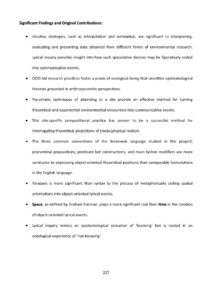
Summary of Significant Findings and Contributions (Verran, 2025)

On Celtic Nationalisms: (Aside) Why Does the UK Keep Spawning Strange Esoteric Cults?

While researching my PhD thesis, Mesotopia: Towards a Place of Lyrical Inquiry (2025), I spent considerable time visiting Celtic language communities and Celtic nationalist meetings across Britain. I went expecting to find what I’d romanticised: the last strongholds of living tradition, people gathering in draughty village halls to keep the old words breathing. What I found instead puzzled me deeply, and has since forced me to rethink my entire understanding of Celtic nationalisms and their revival.

Many of these gatherings were as I had imagined and were in village halls, but at some of these gatherings, I kept meeting members of esoteric orders, like Zionists and Mormons. They sat among Kernewek learners and Celtic nationalists, and I found myself asking the obvious question: what on earth are you doing here?

The answer is stranger than I expected.

The Hebrew Connection:

The links with Zionism emerge from something specific: the revival of the ancient Hebrew language. For many language activists, Hebrew stands as the great success story – a language of liturgy returned to public places. Israeli groups provided practical advice and strategies for growing the Welsh language during the latter half of the 20th century.

Beneath this practical solidarity lurked something more theological. For certain strands of Zionist thought, particularly those influenced by figures like Abraham Isaac Kook, the return to the Land and the revival of Hebrew were not merely nationalist projects but messianic events. So, if the revival of Hebrew carried political and theological significance for funders of the state of Israel, what of the revival of Welsh or Cornish? Is there some hidden financial or theological motive?

A Landscape of Secrets:

The truth is that the United Kingdom has long been a factory for esoteric orders that shape the political world from the shadows. We manufacture them the way Switzerland manufactures cuckoo clocks. To ignore this fact is to misunderstand our history. The history of the UK is littered with secret fraternities of posh boys performing rituals and rites. As ridiculous as they might seem to the uninitiated outsider – these people seem to believe whatever it is they are doing. Aleister Crowley alone spawned an evolving line of Thelemic sex cults, with their “Do what thou wilt” and elaborate initiations for posh boys and poets. The Hermetic Order of the Golden Dawn, the Ordo Templi Orientis, the Typhonian Order – each has promised hidden knowledge to privileged devotees, and many of their practices still reverberate through respectable contemporary societies.

Then there are the British Israelites, who emerged properly in the 19th century with the claim that the British people are literally descended from the Ten Lost Tribes of Israel. John Wilson’s Our Israelitish Origin (1840) gave the movement its founding text, and by the 1880s, Anglo-Israel associations had sprouted across Britain. These were not fringe eccentrics in any simple sense – they included clergy, peers, and at their peak claimed millions of sympathisers throughout the former colonies. It’s no surprise that ideas from the British Israelites heavily influenced the Mormon church in the United States.

And yes – the modern Zionist movement itself, in its current ethno-nationalist political form, emerged from late 19th-century Europe. These aren’t just eccentric social clubs; the reason the US Empire has evolved into a crusading force obsessed with prophecy and rapture, or the state of Israel has become an ethno-supremacist state is because of weird fringe ideas that have gestated right here in the UK. The quirks of many of these cults tap into the same soil of romantic nationalism, biblical prophecy, and the conviction that ancient peoples could be reassembled in the present.

What Do They Want?

The ultimate goals of these secret esoteric societies remain, by design, hidden. We live in what I call a state of partial revelation – we glimpse fragments, but never the full machinery. Theosophists spoke of a coming World Teacher. Crowley announced the Aeon of Horus. British Israelites anticipated the restoration of the Davidic throne through the British monarchy. According to researcher of the occult Tracy Twyman, some secret societies have sought out a mythical ‘twilight language’ which conveys secret knowledge – this might explain an interest in old languages like Hebrew, Welsh, or even Cornish. The more I look into the work of figures like Edward Williams (also known as ‘Iolo Morganwg’) or Robert Morton Nance, the more I become sceptical of their motives or methods. Whatever their goals, scattered through all of the secret societies runs a thread of sectarianism, of chosen peoples, and of elect nations.

What becomes clear, viewed from ground level, is that such groups consistently function against the interests of the uninitiated – which means the common people. They work to create division – to balkanise not only territories but imaginations. The English Mistery of the 1930s, with its mystical feudalism and its “kins” of racially pure Englishmen, sought to roll back democracy and reinstate aristocratic rule. Rolf Gardiner, one of its leaders, wrote explicitly in German journals about reviving long-lost Germanic traditions in the English social order. These are not harmless antiquarians – they are architects of division, fear and paranoia.

Demystifying the Mystery:

Mesotopian logic demands a demystification of meaning-making. Not the crude demystification that pretends mystery doesn’t exist – we can never fully know the real world, and any claim to total knowledge is itself a power move. Rather, an honest demystification that names what is not known, that refuses the priestly gesture of hiding operations behind ritual.

Celtic languages do not belong to esoteric orders. They do not belong to neo-feudal aristocrats or digital landlords or prophets of racial destiny. They belong to the communities that speak them, learn them, dream in them – communities of ordinary people trying to hold onto something precious. The mystifiers would turn these languages into keys to hidden kingdoms. I say: let these languages remain what they are – words for sea and rock and magpie, for love and loss and the hope of conveying something meaningful or, dare I say, beautiful.

As always, my a’th kar.

I discuss this blog in more detail in the video:

References:

Allen, J.H. (1917) Judah’s Sceptre and Joseph’s Birthright. 15th edn. Haverhill, MA: Destiny Publishers. [Originally published 1902].

Armstrong, H.W. (2005) The United States and Britain in Prophecy. Edmund, OK: Philadelphia Church of God. [Originally published 1954].

Bogdan, H. and Starr, M.P. (eds.) (2012) Aleister Crowley and Western Esotericism. Oxford: Oxford University Press.

Carew, M. (2003) Tara and the Ark of the Covenant: A Search for the Ark of the Covenant by British-Israelites on the Hill of Tara (1899-1902). Dublin: Discovery Programme/Royal Irish Academy.

Dietz, B. (2018) ‘Sanderson, William John’, in Oxford Dictionary of National Biography. Oxford: Oxford University Press.

Green, E.H.H. (2002) Ideologies of Conservatism: Conservative Political Ideas in the Twentieth Century. Oxford: Oxford University Press.

Griffiths, R. (1980) Fellow Travellers of the Right: British Enthusiasts for Nazi Germany, 1933-9. London: Constable.

Hedenborg White, M. (2020) ‘Rethinking Aleister Crowley and Thelema: New Perspectives’, Aries: Journal for the Study of Western Esotericism, 21(1), pp. 1-12.

Linehan, T. (2000) British Fascism, 1918-1939: Parties, Ideology and Culture. Manchester: Manchester University Press.

Mirsky, Y. (2022) ‘Rav Kook: The Leading Thinker of Religious Zionism’, Brandeis University Jewish Experience, September. Available at:https://www.brandeis.edu/jewish-experience/history-culture/2022/september/kook-zionism-mirsky.html (Accessed: 16 March 2026).

Pasi, M. (2014) Aleister Crowley and the Temptation of Politics. Abingdon: Routledge. [Originally published in Italian 1999].

Platts-Mills, J. (2001) Muck, Silk and Socialism: Recollections of a Left-wing Queen’s Counsel. Wedmore: Paper Publishing.

Posen Library (no date) Abraham Isaac Kook: Biography. Available at: http://www.posenlibrary.com/author/abraham-isaac-kook (Accessed: 16 March 2026).

Sanderson, W.J. (1927) Statecraft. London: [publisher unknown].

Sanderson, W.J. (1930) That Which Was Lost: A Treatise on Freemasonry and the English Mistery. London: [publisher unknown].

Wikipedia (2006) British Israelism. Available at: https://webarchiveweb.wayback.bac-lac.canada.ca/web/20060913000000/http://en.wikipedia.org:80/wiki/British_Israelism (Accessed: 16 March 2026).

Wikipedia (2025) Hermetic Order of the Golden Dawn. Available at: https://en.wikipedia.org/wiki/Hermetic_Order_of_the_Golden_Dawn (Accessed: 16 March 2026).

Wikipedia (2023) English Mistery. Available at: https://en.wikipedia.org/wiki/English_Mistery (Accessed: 16 March 2026).

Wikipedia Contributors (2025). Iolo Morganwg. Wikipedia. Available at: https://en.wikipedia.org/wiki/Iolo_Morganwg (Accessed: 21 March 2026).

Wikipedia Contributors (2025). Robert Morton Nance. Wikipedia. Available at: https://en.wikipedia.org/wiki/Robert_Morton_Nance (Accessed: 21 March 2026).

Wilson, J. (1840) Our Israelitish Origin. London: [publisher unknown].

Wright, P. (2002) The Village that Died for England. London: Faber and Faber.

Yeats, W.B. (1901) Is the Order of R. R. & A. C. to Remain a Magical Order? London: Privately printed.

Pride to Arrogance

I’m a word nerd. I always have been. Give me a fancy word and I’ll happily disappear down an etymological rabbit hole. Words aren’t just labels; they often carry complicated philosophies and histories. They tell us how people once felt about things, and sometimes how they still do.

Margate Pride by Jason Pay 2016

Take pride.

We tend to treat Pride – with a capital P – as an unqualified good. It is banners and glitter and rainbows filling the streets. It is colourful defiance. It’s what Aretha Franklin was getting at when she sang about pride as “a deeper love.” After centuries of shame being attached to people who have chosen alternative ways of loving and presenting themselves, pride has been a necessary corrective.

Yet as an emotional state, pride has always been ambiguous. The traditional moralists were not entirely wrong to rank it high among the deadly sins. Not because feeling good about yourself is wicked, but because pride untethered can curdle into arrogance. Push it a little further and you get hubris – an ancient Greek warning sign that someone is about to fall flat on their face.

So let’s unpack my understanding of pride. Too much pride insists that not only am I worthy, but that I am flawless. Not only that my way of loving and living is legitimate, but that it is morally superior. That is the pivot point where something liberatory can harden into something faintly sanctimonious.

The antidote to arrogance is humility. Not humiliation or self-erasure, but the quiet recognition that I am one human among many, and that all of us are fallible.

Living a liberated sex life doesn’t make me a bad person, but it also doesn’t make me a saint. It doesn’t grant prophetic insight or moral authority. It simply means I am navigating the same tempestuous terrain as everyone else: desire, pleasure, guilt, connection, and loneliness. I’m not exceptional; I’m just another awkward mammal – albeit one who can claim a few good songs.

I’ve been thinking a lot about this since reconnecting with friends and colleagues at Margate Pride. The experience has also brought another word to mind: community.

These days all sorts of organisations often brand groups of people with shared interests ‘communities’; the cycling community, the vegan community, the queer community. However, the word originally meant something closer to ‘the common people’ – those who share a place. Not the nobility; not the clergy; just the rest of us muddling through together. When I talk about community cohesion, it’s this older meaning I have in mind.

If we take that definition seriously, grass-roots engagement stops being about curating safe rooms full of ideological twins. Instead, it becomes about speaking to neighbours you might not agree with on everything. It requires enough humility to listen to what people actually say, and to recognise that we probably share more concerns than we assume.

In my experience, stepping outside your comfort zone is surprisingly productive. Most of my conversations with non-LGBT+ people within many communities have been positive. It turns out, the man who loathes ‘woke culture’ is also worried about paying his heating bill. The woman who doesn’t understand why everyone suddenly uses the word ‘queer’ is desperately anxious about her mum’s hospital waiting list.

Material concerns cut across identity in surprising ways.

For example, you might be a trendy queer artist and struggling to pay your rent and bills. Congratulations! You’re just like most people living on your street. You might be fighting for access to life-saving treatment because you’re HIV positive or trans. Most people I speak with are also fighting for access to different forms of life-saving healthcare. When you focus on housing, wages and healthcare you discover common ground, and on common ground, you can build something sturdier than a slogan or an annual event.

The secret to effective community grass-roots organising is no secret at all, it’s just talking with the people who live around you.

Pride got us out of the shadows. Humility might help us grow in the daylight.

As always, my a’th kar.

I discuss this blog in more depth over on my YouTube channel:

Empirical or Intuitive Modes of Inquiry: Interpreting Information in a State of Partial Revelation

In my 2025 thesis, I make what initially sounds like a scandalous claim: all research, no matter how diligent, arrives at a moment of conjecture.

That’s not an attack on science. It’s not a flirtation with relativism. It’s an observation about what actually happens when we try to know something.

You can observe, measure, dissect, test and evaluate until you disappear into sub-atomic weirdness. You can triangulate sources, run regressions, peer review the life out of a paragraph – but eventually, you have to conclude. That conclusion – however sophisticated – is an educated guess.

A very good guess, perhaps. A responsible guess, but a guess nonetheless.

This is not a weakness in research. It’s a structural feature of inquiry in a world that only ever reveals itself partially.

In developing what I call a mesotopian mode of meaning-making, I found myself drawn to the speculative strategies of fiction – particularly the Utopian genre. World-building works by extrapolation. An author takes fragments of reality and extends them into coherent possibility. The reader recognises the plausibility not because every detail is empirically verified, but because the world hangs together. It resonates.

Research works in much the same way.

We gather fragments of the real. Data points. Interviews. Archival traces. Phenomenological encounters, and then we construct a model that accounts for them. We are not inventing from nothing. We are extrapolating from partial revelation.

Mesotopian logic simply makes this explicit.

Rather than pretending to empirical omniscience, it acknowledges the intuitive component in interpretation. It admits that at some point the researcher must lean into a felt coherence; a sense that the pattern is right; that the explanation fits.

Now, the immediate objection is obvious: doesn’t this throw everything into doubt?

No.

Because there is a real world.

I am not arguing that reality is optional or that truth is whatever we desire. The world resists us. It surprises us. It refuses to conform to our expectations. Much of it remains withdrawn, opaque, inaccessible – but not imaginary.

What we have access to are encounters. These are moments in which something shows up; a document that shifts your understanding; a conversation that reframes the field; a material object that refuses the narrative you were about to impose on it.

These phenomenological encounters inform epistemological comprehension. In other words, how things appear to us shapes what we can responsibly claim to know.

But between encounter and conclusion, there is always a gap.

And that gap is not filled by raw data alone.

This is where I detect something like an “intuitive phenomenology.” Not simply psychological bias, not wishful thinking, but a form of instinctive pattern recognition. The mind – and perhaps something deeper than mind – moves to complete the picture. It draws connections. It senses coherence. It fills epistemological gaps so that meaning can stabilise.

We already trust this process in everyday life. A seasoned organiser can walk into a room and “read” it. A historian can sense when an archive is hiding something. A scientist can feel when a model is elegant rather than forced.

These are not irrational acts. They are disciplined intuitions shaped by immersion in reality.

Mesotopian inquiry does not replace empiricism with vibes. It integrates empirical rigour with an honest account of the intuitive leap that always occurs at the edge of knowledge.

So empirical or intuitive? The answer is both.

We live in a state of partial revelation. The world gives itself, but never entirely. Our task is to respond carefully, rigorously, and imaginatively. Not to claim absolute certainty, but to make the most responsible guess we can – and to remain open when the world answers back.

As always, my a’th kar!

I discuss this blog in more detail on my Youtube channel: