I remember the moment quite clearly. Back in 2015, I was part of a scrappy, grass-roots effort trying to understand what on earth had happened to London Pride. I’d started digging into the financials, following sponsorship pages and annual reports, trying to work out how something that once felt unruly, provincial and ours had turned into a vast corporate machine. I wrote about it at the time, half in disappointment, half in ironic detachment (4+5). What struck me wasn’t just the money, but who was supplying it.
Barclays, Citi, big law firms like Baker McKenzie, and polished NGOs with immaculate branding such as Exterion had all been sponsoring London Pride events for several years. At some point, amid the spreadsheets and sponsor logos, I asked a very simple question: why do these people care so much about my sexual orientation? When did global finance decide it was emotionally invested in my being a gay man? I didn’t feel particularly ‘seen’, as the cool kids like to say these days, I felt categorised, monetised and branded (3).
That feeling has stayed with me.
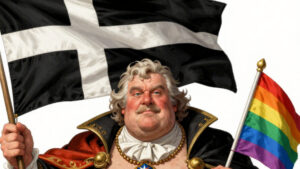
Years later, while researching my PhD on how humans comprehend their environment and articulate that through language, I found myself back in similar emotional territory. I was comparing grammatical features of the two languages of my homeland: English and Kernewek. As I dug deeper into the revival of Kernewek and the cultural discourse orbiting it, the same sensation returned. That tightening in the gut. Why? I thought. Why now? Why, after centuries of neglect, ridicule and outright economic extraction, were some very respectable institutions in the UK suddenly so interested in cultivating a Cornish cultural ‘identity’?
To be clear, I have nothing against LGBT people who pour their time and love into London Pride. Nor do I have anything against Cornish people who work tirelessly to protect Kernewek and explore Cornish culture. I admire the commitment involved in both. This isn’t an attack on grass-roots energy. It’s a plea for scepticism about institutions that have a long, well-documented habit of exploiting grass-roots movements for ends that rarely improve the material conditions of ordinary people.
Here’s the thing – symbolic recognition is cheap. Flags are cheap. Car stickers are cheap. Language initiatives, diversity panels and glossy campaigns are cheap compared to land, mineral rights or meaningful economic redress. If there were serious conversations about who benefits from Cornwall’s land and resources, things might look very different. Imagine if working Cornish people had actually benefited from generations of mining and extraction, rather than watching profits flow elsewhere.
Much of that wealth has continued to flow into multinational corporations. Some large corporations, in general, are known to fund cultural or heritage projects, often as part of wider reputational or social-licence strategies. However, my concern here is not primarily about arts funding, but about extraction and ownership. The Rothschild family, for example, through its company Imerys (formerly Peñarroya), directly profits from Cornish mineral deposits, continuing a long tradition in which the material wealth of Cornwall is extracted while local communities see limited material return (2).
This sits in stark contrast to the symbolic recognition of Cornish culture, such as Kernewek being granted Part III status under the European Charter for Regional or Minority Languages (1). I often find myself asking: would most Cornish people prefer dual-language signposts on every street and road, or would they rather see the profits of kaolin and lithium extraction invested directly into local infrastructure, housing and public services?
What I see is a familiar pattern. Cultural identity is elevated, polished and funded just enough to be celebrated – but not enough to be actually empowered. Difference is encouraged, curated and then quietly weaponised to keep people segmented and manageable. I am deeply suspicious of financial and industrial interests that have held this island, and much of the planet, to ransom for centuries suddenly presenting themselves as champions of minority issues. I do not trust people who have a proven track record of participating in land-theft, exploitation and mass-murder. This is not paranoia; it is historical materialism, grounded in patterns of extraction, enclosure and enforced dependency that are well documented.
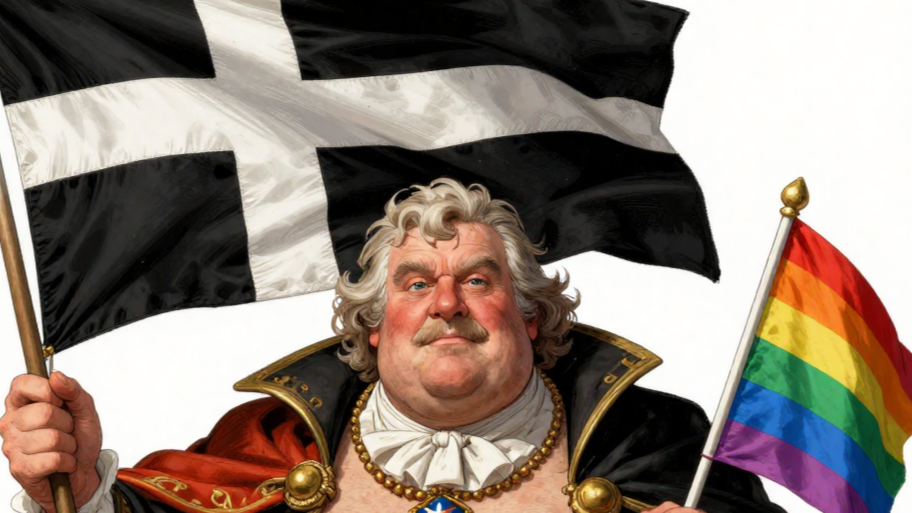
I refuse to be separated from my neighbours by each aspect of my identity. I refuse to be further divided and conquered. Yes, I am Cornish. Yes, I am a gay man. But more than that, I am descended from people who have laboured on this island, generation after generation, for the enrichment of a very small number of Mittel European families and their attendant German and Italian banking cartels. This shared material history matters more to me than any corporate badge of recognition ever could.
As always, my a’th kar!
I discuss this blog in more detail in the video below:
References:
(1) Cornwall Council (2026) Cornish language officially granted Part III status. Available at: https://www.cornwall.gov.uk/council-news/environment-culture-and-planning/cornish-language-officially-granted-part-iii-status/ (Accessed: 20/01/2026).
(2) Imerys S.A. (no date) Imerys – Our history. Available at: https://www.imerys.com/imerys-group/our-history/ (Accessed: 20/01/2026).
(3) Pride in London (2015) Sponsor Pride in London 2015. Archive snapshot. Available at: https://web.archive.org/web/20150627020110/https://prideinlondon.org/sponsors/ (Accessed: 20/01/2026).
(4) Verran, T. (2015) “Why we felt the need to bury Pride… #RIPPRIDE #QUEERFIGHTBACK”, Around the world in 80 gays!. Available at: https://tryg-aroundtheworldin80gays.blogspot.com/2015/06/why-we-felt-need-to-bury-pride-rippride.html (Accessed: 20/01/2026).
(5) Verran, T. (2016) “The moment I lost my Pride”, Around the world in 80 gays!. Available at: https://tryg-aroundtheworldin80gays.blogspot.com/2016/05/the-moment-i-lost-my-pride.html (Accessed: 20/01/2026).