
The technocracy movement has been drifting back into my awareness lately, not as a concrete policy proposal so much as a cultural mood. It presents itself as ruthlessly rational: engineers over politicians, systems over sentiment, energy over money. One of its more intriguing early voices was Harold Loeb, whose 1922 essay The Mysticism of Money – later expanded into a book – framed technocracy as an attempt to break the spell of finance itself. Money, Loeb argued, was not neutral or objective, but a kind of mass hallucination: a symbolic system that had quietly replaced material reality. Technocracy, in his view, might free society from this enchantment by reorganising life around energy, production and measurable flows.
That language alone should give us pause. Spells. Mysticism. Enchantment. Even at its most “scientific,” technocracy appears haunted by what it claims to dispel.

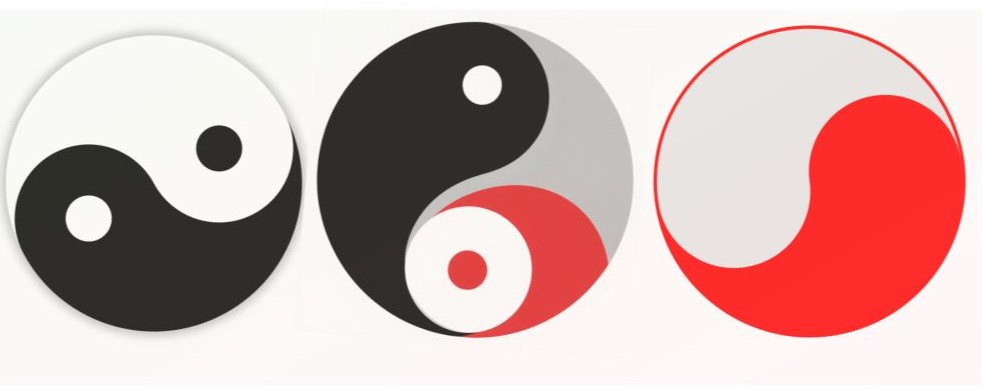
Its emblem, the Monad, reinforces this suspicion. A circle divided by a wavy line, it symbolises balance between production and consumption. Once again, society is imagined not as a messy community of competing interests, but as a system of energetic equilibrium. It is hard not to notice how closely this mirrors Daoist cosmology. The yin-yang symbol isn’t identical, but the resemblance is unmistakable: dynamic balance, reciprocal forces and the idea that stability emerges from flow rather than from endlessly negotiating discrete encounters.
This raises an awkward question. If technocracy sought balance in natural energy systems, then perhaps this supposedly rational and logical project was quietly borrowing from the Dao. Daoism does not seek to dominate nature; it seeks alignment with it. It interprets reality as process rather than structure, movement rather than command. Technocracy, for all its charts and calculations, seems to echo this sensibility – even as it insists on its own radical modernity.
Things become even more intriguing when we look at some of the cultural and literary output of the 20th century. The century which birthed technocracy also became the great age of dystopian science fiction. Utopias had been more confidently conjured in European literature during the Renaissance. However, moving into the early 20th-century, some notable Utopian fictions were published: A Modern Utopia (H.G. Wells, 1905) imagined a technologically advanced planetary society overseen by a rational ruling class. Red Star (Alexander Bogdanov, 1908) offered a socialist utopia on Mars. Herland (Charlotte Perkins Gilman, 1915) proposed a peaceful feminist civilisation without men, war, or domination.
As the century progressed and industrial systems intensified, the cult of technological solutions became institutionalised, which resulted in technology and utopian thought becoming more intricately entwined. Just as The Age of Reason had spawned the decadence of Romanticism, so the 20th century generated enduring classics of the dystopian genre. We (Yevgeny Zamyatin, 1920) portrayed a society ruled by numbers, logic and surveillance. Brave New World (1932) imagined control achieved through pleasure and conditioning rather than violence. Nineteen Eighty-Four (1949) perfected surveillance and thought control. Fahrenheit 451 (1953) burned books not out of hatred, but in the name of comfort and social equilibrium.
This waxing and waning between Utopia and Dystopia almost traces a Tai Chi trajectory. In Daoist cosmology, reality unfolds from Wu-chi – the undifferentiated void – into yin and yang, and then into Tai Chi: the animated interplay of opposites. Utopian and dystopian narratives feel like a cultural expression of technocratic yin and yang. Both work to enforce a belief system. We are simultaneously captivated by the allure of a technologically perfected, Star Trek-style future and terrified by its erosion of autonomy and self-determination. These narratives do not negate one another; they generate movement between them. Promise and warning. Hope and fear. Order and disorder.
Seen this way, utopian and dystopian stories become the Tai Chi of technocracy. They circulate around the same core assumptions: that society is a system, that humans are manageable, and that balance can be engineered by a priestly class. One narrative seduces us with harmony and efficiency; the other terrifies us with sterility and domination. We are encouraged to welcome AI or fear AI, but in either case we are quietly trained to accept the same premise: that a super-processor should be considered “intelligent.” These are not neutral debates so much as ritual incantations – symbols and spectacles that orient us toward an inevitable, optimised future.
Even our most rational, scientific and secular movements, it seems, still require their myths, their devotees and their Dao.
As always, my a’th kar!