On Celtic Nationalisms: (Aside) Why Does the UK Keep Spawning Strange Esoteric Cults?

While researching my PhD thesis, Mesotopia: Towards a Place of Lyrical Inquiry (2025), I spent considerable time visiting Celtic language communities and Celtic nationalist meetings across Britain. I went expecting to find what I’d romanticised: the last strongholds of living tradition, people gathering in draughty village halls to keep the old words breathing. What I found instead puzzled me deeply, and has since forced me to rethink my entire understanding of Celtic nationalisms and their revival.

Many of these gatherings were as I had imagined and were in village halls, but at some of these gatherings, I kept meeting members of esoteric orders, like Zionists and Mormons. They sat among Kernewek learners and Celtic nationalists, and I found myself asking the obvious question: what on earth are you doing here?

The answer is stranger than I expected.

The Hebrew Connection:

The links with Zionism emerge from something specific: the revival of the ancient Hebrew language. For many language activists, Hebrew stands as the great success story – a language of liturgy returned to public places. Israeli groups provided practical advice and strategies for growing the Welsh language during the latter half of the 20th century.

Beneath this practical solidarity lurked something more theological. For certain strands of Zionist thought, particularly those influenced by figures like Abraham Isaac Kook, the return to the Land and the revival of Hebrew were not merely nationalist projects but messianic events. So, if the revival of Hebrew carried political and theological significance for funders of the state of Israel, what of the revival of Welsh or Cornish? Is there some hidden financial or theological motive?

A Landscape of Secrets:

The truth is that the United Kingdom has long been a factory for esoteric orders that shape the political world from the shadows. We manufacture them the way Switzerland manufactures cuckoo clocks. To ignore this fact is to misunderstand our history. The history of the UK is littered with secret fraternities of posh boys performing rituals and rites. As ridiculous as they might seem to the uninitiated outsider – these people seem to believe whatever it is they are doing. Aleister Crowley alone spawned an evolving line of Thelemic sex cults, with their “Do what thou wilt” and elaborate initiations for posh boys and poets. The Hermetic Order of the Golden Dawn, the Ordo Templi Orientis, the Typhonian Order – each has promised hidden knowledge to privileged devotees, and many of their practices still reverberate through respectable contemporary societies.

Then there are the British Israelites, who emerged properly in the 19th century with the claim that the British people are literally descended from the Ten Lost Tribes of Israel. John Wilson’s Our Israelitish Origin (1840) gave the movement its founding text, and by the 1880s, Anglo-Israel associations had sprouted across Britain. These were not fringe eccentrics in any simple sense – they included clergy, peers, and at their peak claimed millions of sympathisers throughout the former colonies. It’s no surprise that ideas from the British Israelites heavily influenced the Mormon church in the United States.

And yes – the modern Zionist movement itself, in its current ethno-nationalist political form, emerged from late 19th-century Europe. These aren’t just eccentric social clubs; the reason the US Empire has evolved into a crusading force obsessed with prophecy and rapture, or the state of Israel has become an ethno-supremacist state is because of weird fringe ideas that have gestated right here in the UK. The quirks of many of these cults tap into the same soil of romantic nationalism, biblical prophecy, and the conviction that ancient peoples could be reassembled in the present.

What Do They Want?

The ultimate goals of these secret esoteric societies remain, by design, hidden. We live in what I call a state of partial revelation – we glimpse fragments, but never the full machinery. Theosophists spoke of a coming World Teacher. Crowley announced the Aeon of Horus. British Israelites anticipated the restoration of the Davidic throne through the British monarchy. According to researcher of the occult Tracy Twyman, some secret societies have sought out a mythical ‘twilight language’ which conveys secret knowledge – this might explain an interest in old languages like Hebrew, Welsh, or even Cornish. The more I look into the work of figures like Edward Williams (also known as ‘Iolo Morganwg’) or Robert Morton Nance, the more I become sceptical of their motives or methods. Whatever their goals, scattered through all of the secret societies runs a thread of sectarianism, of chosen peoples, and of elect nations.

What becomes clear, viewed from ground level, is that such groups consistently function against the interests of the uninitiated – which means the common people. They work to create division – to balkanise not only territories but imaginations. The English Mistery of the 1930s, with its mystical feudalism and its “kins” of racially pure Englishmen, sought to roll back democracy and reinstate aristocratic rule. Rolf Gardiner, one of its leaders, wrote explicitly in German journals about reviving long-lost Germanic traditions in the English social order. These are not harmless antiquarians – they are architects of division, fear and paranoia.

Demystifying the Mystery:

Mesotopian logic demands a demystification of meaning-making. Not the crude demystification that pretends mystery doesn’t exist – we can never fully know the real world, and any claim to total knowledge is itself a power move. Rather, an honest demystification that names what is not known, that refuses the priestly gesture of hiding operations behind ritual.

Celtic languages do not belong to esoteric orders. They do not belong to neo-feudal aristocrats or digital landlords or prophets of racial destiny. They belong to the communities that speak them, learn them, dream in them – communities of ordinary people trying to hold onto something precious. The mystifiers would turn these languages into keys to hidden kingdoms. I say: let these languages remain what they are – words for sea and rock and magpie, for love and loss and the hope of conveying something meaningful or, dare I say, beautiful.

As always, my a’th kar.

I discuss this blog in more detail in the video:

References:

Allen, J.H. (1917) Judah’s Sceptre and Joseph’s Birthright. 15th edn. Haverhill, MA: Destiny Publishers. [Originally published 1902].

Armstrong, H.W. (2005) The United States and Britain in Prophecy. Edmund, OK: Philadelphia Church of God. [Originally published 1954].

Bogdan, H. and Starr, M.P. (eds.) (2012) Aleister Crowley and Western Esotericism. Oxford: Oxford University Press.

Carew, M. (2003) Tara and the Ark of the Covenant: A Search for the Ark of the Covenant by British-Israelites on the Hill of Tara (1899-1902). Dublin: Discovery Programme/Royal Irish Academy.

Dietz, B. (2018) ‘Sanderson, William John’, in Oxford Dictionary of National Biography. Oxford: Oxford University Press.

Green, E.H.H. (2002) Ideologies of Conservatism: Conservative Political Ideas in the Twentieth Century. Oxford: Oxford University Press.

Griffiths, R. (1980) Fellow Travellers of the Right: British Enthusiasts for Nazi Germany, 1933-9. London: Constable.

Hedenborg White, M. (2020) ‘Rethinking Aleister Crowley and Thelema: New Perspectives’, Aries: Journal for the Study of Western Esotericism, 21(1), pp. 1-12.

Linehan, T. (2000) British Fascism, 1918-1939: Parties, Ideology and Culture. Manchester: Manchester University Press.

Mirsky, Y. (2022) ‘Rav Kook: The Leading Thinker of Religious Zionism’, Brandeis University Jewish Experience, September. Available at:https://www.brandeis.edu/jewish-experience/history-culture/2022/september/kook-zionism-mirsky.html (Accessed: 16 March 2026).

Pasi, M. (2014) Aleister Crowley and the Temptation of Politics. Abingdon: Routledge. [Originally published in Italian 1999].

Platts-Mills, J. (2001) Muck, Silk and Socialism: Recollections of a Left-wing Queen’s Counsel. Wedmore: Paper Publishing.

Posen Library (no date) Abraham Isaac Kook: Biography. Available at: http://www.posenlibrary.com/author/abraham-isaac-kook (Accessed: 16 March 2026).

Sanderson, W.J. (1927) Statecraft. London: [publisher unknown].

Sanderson, W.J. (1930) That Which Was Lost: A Treatise on Freemasonry and the English Mistery. London: [publisher unknown].

Wikipedia (2006) British Israelism. Available at: https://webarchiveweb.wayback.bac-lac.canada.ca/web/20060913000000/http://en.wikipedia.org:80/wiki/British_Israelism (Accessed: 16 March 2026).

Wikipedia (2025) Hermetic Order of the Golden Dawn. Available at: https://en.wikipedia.org/wiki/Hermetic_Order_of_the_Golden_Dawn (Accessed: 16 March 2026).

Wikipedia (2023) English Mistery. Available at: https://en.wikipedia.org/wiki/English_Mistery (Accessed: 16 March 2026).

Wikipedia Contributors (2025). Iolo Morganwg. Wikipedia. Available at: https://en.wikipedia.org/wiki/Iolo_Morganwg (Accessed: 21 March 2026).

Wikipedia Contributors (2025). Robert Morton Nance. Wikipedia. Available at: https://en.wikipedia.org/wiki/Robert_Morton_Nance (Accessed: 21 March 2026).

Wilson, J. (1840) Our Israelitish Origin. London: [publisher unknown].

Wright, P. (2002) The Village that Died for England. London: Faber and Faber.

Yeats, W.B. (1901) Is the Order of R. R. & A. C. to Remain a Magical Order? London: Privately printed.


Empirical or Intuitive Modes of Inquiry: Interpreting Information in a State of Partial Revelation

In my 2025 thesis, I make what initially sounds like a scandalous claim: all research, no matter how diligent, arrives at a moment of conjecture.

That’s not an attack on science. It’s not a flirtation with relativism. It’s an observation about what actually happens when we try to know something.

You can observe, measure, dissect, test and evaluate until you disappear into sub-atomic weirdness. You can triangulate sources, run regressions, peer review the life out of a paragraph – but eventually, you have to conclude. That conclusion – however sophisticated – is an educated guess.

A very good guess, perhaps. A responsible guess, but a guess nonetheless.

This is not a weakness in research. It’s a structural feature of inquiry in a world that only ever reveals itself partially.

In developing what I call a mesotopian mode of meaning-making, I found myself drawn to the speculative strategies of fiction – particularly the Utopian genre. World-building works by extrapolation. An author takes fragments of reality and extends them into coherent possibility. The reader recognises the plausibility not because every detail is empirically verified, but because the world hangs together. It resonates.

Research works in much the same way.

We gather fragments of the real. Data points. Interviews. Archival traces. Phenomenological encounters, and then we construct a model that accounts for them. We are not inventing from nothing. We are extrapolating from partial revelation.

Mesotopian logic simply makes this explicit.

Rather than pretending to empirical omniscience, it acknowledges the intuitive component in interpretation. It admits that at some point the researcher must lean into a felt coherence; a sense that the pattern is right; that the explanation fits.

Now, the immediate objection is obvious: doesn’t this throw everything into doubt?

No.

Because there is a real world.

I am not arguing that reality is optional or that truth is whatever we desire. The world resists us. It surprises us. It refuses to conform to our expectations. Much of it remains withdrawn, opaque, inaccessible – but not imaginary.

What we have access to are encounters. These are moments in which something shows up; a document that shifts your understanding; a conversation that reframes the field; a material object that refuses the narrative you were about to impose on it.

These phenomenological encounters inform epistemological comprehension. In other words, how things appear to us shapes what we can responsibly claim to know.

But between encounter and conclusion, there is always a gap.

And that gap is not filled by raw data alone.

This is where I detect something like an “intuitive phenomenology.” Not simply psychological bias, not wishful thinking, but a form of instinctive pattern recognition. The mind – and perhaps something deeper than mind – moves to complete the picture. It draws connections. It senses coherence. It fills epistemological gaps so that meaning can stabilise.

We already trust this process in everyday life. A seasoned organiser can walk into a room and “read” it. A historian can sense when an archive is hiding something. A scientist can feel when a model is elegant rather than forced.

These are not irrational acts. They are disciplined intuitions shaped by immersion in reality.

Mesotopian inquiry does not replace empiricism with vibes. It integrates empirical rigour with an honest account of the intuitive leap that always occurs at the edge of knowledge.

So empirical or intuitive? The answer is both.

We live in a state of partial revelation. The world gives itself, but never entirely. Our task is to respond carefully, rigorously, and imaginatively. Not to claim absolute certainty, but to make the most responsible guess we can – and to remain open when the world answers back.

As always, my a’th kar!

I discuss this blog in more detail on my Youtube channel:

Why the Epstein Scandal Matters to Grass-roots Organising – Yes, Even in Cornwall!

I know. The moment you mention Epstein, half the room switches off and the other half assumes you’re about to spiral into salacious gossip about decadent royals. Fair enough. There’s been no shortage of lurid headlines, often supporting bad faith takes or outright distractions. If you’re involved in grassroots organising – environment, housing, disability rights, local culture – then the Epstein scandal actually matters a great deal. Even here in the Duchy of Cornwall. Especially down here, in fact.

Thanks to Tamedia for the background image.

Not because of the sex crimes themselves, horrific as they are. Without sounding flippant, those are not the important part from an organising perspective. What matters is that the Epstein documents give us a rare, unvarnished look at how power actually functions. Not how it claims to function in glossy brochures, mission statements, or charity galas, but how it works when the doors are closed and the theatre stops.

What emerges is a class of people who genuinely believe themselves to be above the law – not metaphorically, literally. They trade influence across governments, intelligence agencies, banks, weapons manufacturers, and ‘philanthropic’ institutions with astonishing ease. The Epstein network shows us that inter-institutional power doesn’t operate through democratic accountability; it operates through personal relationships, financial leverage, kompromat, and shared class interest.

This is vital for grassroots organisers to understand, because so much organising energy is wasted arguing with the performance of power. We petition the institution, we appeal to its stated values, we take part in consultations that are largely ceremonial. Such processes help cultivate the illusion of participation. Meanwhile, the real decisions are being made elsewhere, by people who will never attend a town hall meeting and who don’t particularly care what the public thinks.

One of the more sobering elements of the Epstein story isn’t just who he knew, but what moved through his world: money laundering, arms flows, political interference, even regime change. Governments toppled, leaders removed, and vast sums legally washed clean through cultural, educational, and environmental organisations. That should ring bells for anyone who’s ever wondered why certain funders always seem to back ‘good causes’ while working-class communities remain neglected.

People are still combing through millions of released emails in the US, but already the outline of empire is visible. The Financial Times article on Epstein’s banking connections is revealing in this regard. When you trace those networks outward, you don’t end up in abstract theory – you end up in very real places. Yes, even Cornwall. Through extractive industries like Imerys, and through respected institutions such as wildlife and cultural trusts. This is what global power looks like when it lands locally.

The same family that profits from extracting Cornwall’s mineral reserves also funds organisations that promote ‘greener’ approaches to resource management, including initiatives linked to the Cornwall Wildlife Trust’s Green Recovery Challenge Fund. This does not, in itself, prove any wrongdoing. However, it does help explain why certain environmental impacts, particularly those linked to mineral extraction, are often absent from official campaigning narratives. This is grassroots theatre in action: the same interests profiting from extraction are also funding the boundaries within which ‘opposition’ is allowed to operate.

To be clear, the Epstein revelations are often discussed through the lens of particular social or cultural networks, but focusing on identity alone misses the point. What is being exposed is not a uniquely Zionist phenomenon, but a familiar pattern of elite, transnational power that has historically operated across Mittel-European, British, German, Italian, and American ruling classes alike. This is simply how imperial power has reproduced itself.

Crucially, the people working at the grassroots level of charitable, cultural, or environmental organisations are not villains. Most have little to no awareness of the legacies of wealth tied to colonial extraction in regions such as Rhodesia, Palestine or Somalia for example. My research suggests these same mechanics operate throughout the provinces, particularly within the overtly feudal ‘Duchy’ of Cornwall.

This is why outlets like the TrueAnon podcast and The Grayzone matter. They’ve been doing the unglamorous work of tracing these connections through a historical materialist lens, rather than dismissing them as scandal or conspiracy. They remind us that power has a history, a geography, and a balance sheet.

If grassroots organising is going to be effective, it has to be grounded in reality – not the comforting story we’re told about how the world works, but the uncomfortable truth of how it often does. The Epstein scandal isn’t a distraction from local issues. It’s a brutal lesson in why local struggles are always connected to global systems of power.

As always, my a’th kar!

I discuss this blog in more depth over on YouTube:

References:

(1) Cornwall Wildlife Trust (n.d.) Green Recovery Challenge Fund: Past projects. Available at: https://www.cornwallwildlifetrust.org.uk/what-we-do/past-projects/green-recovery-challenge-fund (Accessed: 9 February 2026).

(2) Financial Times (n.d.) Jeffrey Epstein and the banking system. Financial Times. Available at: https://www.ft.com/content/0d70b7d3-063d-43a0-812b-8b8b3e7c4c47 (Accessed: 9 February 2026).

(3) Imerys (n.d.) Imerys in the United Kingdom: Cornwall operations. Imerys. Available at: https://www.imerys.com/united-kingdom/cornwall (Accessed: 9 February 2026).

(4) Tages-Anzeiger. (2026). Tamedia AG. [online] Available at: https://www.tagesanzeiger.ch/epstein-beriet-ariane-de-rothschild-475024135092 [Accessed 14 Feb. 2026].

(5)  @TrueAnonPod  Truanon (n.d.) Truanon podcast. Available at: https://soundcloud.com/truanonpod (Accessed: 9 February 2026).

(6)  @thegrayzone7996  The Grayzone (n.d.) Discussion on the Epstein files and imperial power structures. YouTube. Available at: https://www.youtube.com/watch?v=r2wz4rGGRGA&t=8s

Utopia and Dystopia: The Tai-Chi of the Technocracy Movement

The technocracy movement has been drifting back into my awareness lately, not as a concrete policy proposal so much as a cultural mood. It presents itself as ruthlessly rational: engineers over politicians, systems over sentiment, energy over money. One of its more intriguing early voices was Harold Loeb, whose 1922 essay The Mysticism of Money – later expanded into a book – framed technocracy as an attempt to break the spell of finance itself. Money, Loeb argued, was not neutral or objective, but a kind of mass hallucination: a symbolic system that had quietly replaced material reality. Technocracy, in his view, might free society from this enchantment by reorganising life around energy, production and measurable flows.

That language alone should give us pause. Spells. Mysticism. Enchantment. Even at its most “scientific,” technocracy appears haunted by what it claims to dispel.

From Tai Chi to Technocratic Monad

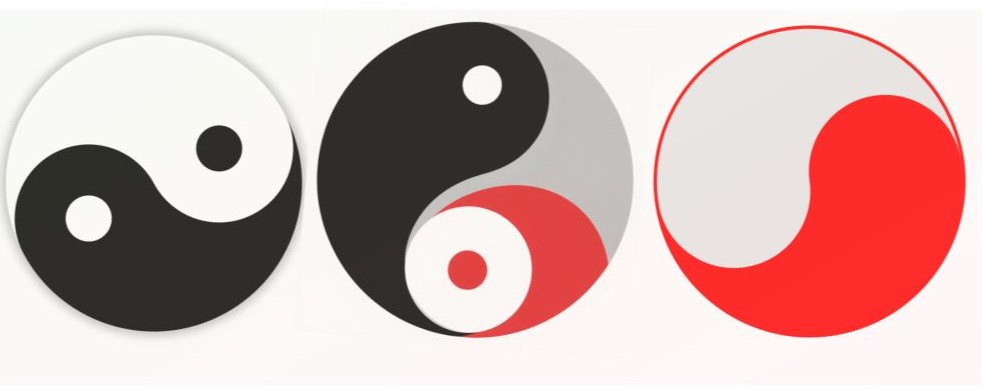
Its emblem, the Monad, reinforces this suspicion. A circle divided by a wavy line, it symbolises balance between production and consumption. Once again, society is imagined not as a messy community of competing interests, but as a system of energetic equilibrium. It is hard not to notice how closely this mirrors Daoist cosmology. The yin-yang symbol isn’t identical, but the resemblance is unmistakable: dynamic balance, reciprocal forces and the idea that stability emerges from flow rather than from endlessly negotiating discrete encounters.

This raises an awkward question. If technocracy sought balance in natural energy systems, then perhaps this supposedly rational and logical project was quietly borrowing from the Dao. Daoism does not seek to dominate nature; it seeks alignment with it. It interprets reality as process rather than structure, movement rather than command. Technocracy, for all its charts and calculations, seems to echo this sensibility – even as it insists on its own radical modernity.

Things become even more intriguing when we look at some of the cultural and literary output of the 20th century. The century which birthed technocracy also became the great age of dystopian science fiction. Utopias had been more confidently conjured in European literature during the Renaissance. However, moving into the early 20th-century, some notable Utopian fictions were published: A Modern Utopia (H.G. Wells, 1905) imagined a technologically advanced planetary society overseen by a rational ruling class. Red Star (Alexander Bogdanov, 1908) offered a socialist utopia on Mars. Herland (Charlotte Perkins Gilman, 1915) proposed a peaceful feminist civilisation without men, war, or domination.

As the century progressed and industrial systems intensified, the cult of technological solutions became institutionalised, which resulted in technology and utopian thought becoming more intricately entwined. Just as The Age of Reason had spawned the decadence of Romanticism, so the 20th century generated enduring classics of the dystopian genre. We (Yevgeny Zamyatin, 1920) portrayed a society ruled by numbers, logic and surveillance. Brave New World (1932) imagined control achieved through pleasure and conditioning rather than violence. Nineteen Eighty-Four (1949) perfected surveillance and thought control. Fahrenheit 451 (1953) burned books not out of hatred, but in the name of comfort and social equilibrium.

This waxing and waning between Utopia and Dystopia almost traces a Tai Chi trajectory. In Daoist cosmology, reality unfolds from Wu-chi – the undifferentiated void – into yin and yang, and then into Tai Chi: the animated interplay of opposites. Utopian and dystopian narratives feel like a cultural expression of technocratic yin and yang. Both work to enforce a belief system. We are simultaneously captivated by the allure of a technologically perfected, Star Trek-style future and terrified by its erosion of autonomy and self-determination. These narratives do not negate one another; they generate movement between them. Promise and warning. Hope and fear. Order and disorder.

Seen this way, utopian and dystopian stories become the Tai Chi of technocracy. They circulate around the same core assumptions: that society is a system, that humans are manageable, and that balance can be engineered by a priestly class. One narrative seduces us with harmony and efficiency; the other terrifies us with sterility and domination. We are encouraged to welcome AI or fear AI, but in either case we are quietly trained to accept the same premise: that a super-processor should be considered “intelligent.” These are not neutral debates so much as ritual incantations – symbols and spectacles that orient us toward an inevitable, optimised future.

Even our most rational, scientific and secular movements, it seems, still require their myths, their devotees and their Dao.

As always, my a’th kar!

Reading List…

In preparation for my PhD, I have begun reading texts that attempt to articulate the relationship between human and non-human entities – no biggie!

I have chosen to take an object-oriented approach, and I consider the work of Timothy Morton to be core to my future digressions.

Ultimately, I will be investigating the Anthropocene, and will be re-visiting the concept of ritual as a way of articulating the relationship we have with non-human entities.

I will be blogging about significant texts I encounter on my journey, and summarizing any conclusions I may draw.

Maybe you might feel inspired to read them too.