Mesotopia: Significant Findings and Contributions. Partial Revelation

If you spend nearly ten years on a thing – a thesis, a question, an ache – then what do you come away with? This is a problem that many researchers wrestle with long after their viva.

Tryg on the Coast by Will Halfacree

My thesis, Mesotopia: Towards a Place of Lyrical Inquiry (Verran, 2025), emerged from my exploration into the murky realm of meaning-making; into how humans make sense of their environment and articulate this through the art of language. While engaging with methods and approaches of scientific materialism, it was open to other, less quantifiable aspects of understanding. My approach exists between the hard data of environmental science and the soft collapse of attributing a lyrical utterance to a physical sensation. Mesotopia is that middle place. It is a weird, damp, mossy ground where you are forced to admit that you’re guessing, and that guess, that intuition, is something beautiful.

Here’s what I’ve learned, and I offer it not as truth but as partial revelation: all environmental research ends in conjecture. You can measure carbon flux. You can map watersheds, but the moment you ask why – why the tide is rising, why the magpie sings – then you have left the laboratory and entered the weirder world of the poetic. This requires intuition; not as a substitute for rigour, but as its strange twin. The best researchers I know don’t pretend to be robots or LLMs. They listen for what the data doesn’t say.

This became painfully clear when I tried to get a clean historical picture of Celtic culture. I wanted something tethered to the languages themselves: Old Kernewek, the living breath of Breton fragments. What I found instead was a hall of mirrors. There are no objective sources. Texts were scripted by either a monk or a cultist with an agenda. Every archaeological layer has been interpreted by a romantic, a nationalist or a grant committee. Anyone who proclaims certainty about Celtic culture should be eyed the way you’d eye a man selling miracle water from the back of a van.

This is the deeper sickness. Doing a PhD means watching how the money moves. You see funding streams shape ideological and political directions for corporate profit: pharmaceuticals, tech, and weapons. These industries don’t just buy labs. They buy histories too. They buy the humanities, indirectly, turning entire departments into PR factories churning out favourable narratives. There are red lines and guardrails everywhere. You learn them quickly. Don’t scrutinise the military applications or environmental impacts of all this wonderful new tech. Don’t question the ethics of corporate influence on land use. Don’t look at the family backgrounds of financiers recently termed ‘philanthropists’. Do that, and the funding dries up. The list goes on. This is the unspoken rule – to have any kind of career in Western academia, you need to learn when to keep your mouth shut.

I finished my PhD less certain about what is real. So much of academic work seems to be about inventing reality for other people to live in. I admit that I can never find my way through all the misdirections and dead ends, and that any meaningful clarity eludes me. On reflection, I don’t see that as a failure. That is the crack where light gets in. I’ve glimpsed the man behind the velvet curtain of western liberalism, working his bells and whistles and selling his snake oil, and I don’t believe him anymore. I do not believe in the neutrality of universities, nor in the clean hands of Western research culture.

I live in partial revelation. I am always listening. I am certain of nothing and sceptical of everything. However, I can still hope that somewhere – in a different kind of institution with a different way of asking – there is a place where intuition is honoured, funding doesn’t own the questions, and any person is free to research, interrogate or argue controversial positions.

As always, my a’th kar!

Follow this link to a video where I discuss this blog in more detail:
 

Mesotopia: Significant Findings and Contributions

If you are looking for neat conclusions, this isn’t that kind of project. Indeed, I suggest that if you are looking for neat conclusions – you’re probably missing a big part of what makes research interesting. After years of wrestling with sites, words, and the strange space between being in a place and thinking about how I understand it, I have not found a tidy set of answers. Instead, I’ve landed somewhere more interesting: a conviction that meaning is made through a subtle interplay between the environment, the body and the mind. I’ve also found that different forms of expression demand different metaphysics – different philosophies of interpreting what is real – to turn these environmental encounters into something that can be communicated.

Tryg on the Coast by Will Halfacree

Let me put that another way. If you’re making a dance, you might need to focus more on theories that conceive a universe of energies and flows, as these are better suited to speaking about movement. However, if you’re making a lyric about an environmental encounter, you need a little distance to process the encounter, therefore theories that convey a universe of substances. And if you’re trying to make sense of the world while moving through it, then you might need to employ a theory that sits between theories of substances and flows.

Mesotopia, a middle place, is my attempt to do this. It is a place where physical things meet conceptual things, a place of substances and flows, a practice that sits between theory and experience, between knowing and not-knowing. I have found that a theory of object-oriented ontology (OOO), as advanced by Graham Harman, has proven to be really helpful when talking about mesotopia and mesotopian logic.

One of the more unexpected findings of my research is that the Cornish language – Kernewek – is structurally more suited to object-oriented thinking than English. I looked at three features of the Kernewek language that differ from the English language. Firstly, the use of pronominal prepositions; secondly, the favouring of predicate-led constructions; finally, the way nouns often sit before modifiers. I have found that these are not just grammatical quirks. I suggest that they build a world where things don’t exist merely as props for chattering human subjects. In Kernewek, the language itself leans into the idea that objects have their own stubborn presence. English, by contrast, keeps trying to put the speaking subject in the driver’s seat.

When you are trying to express your understanding of the world, the form that communication takes matters. I have found that parataxis – placing phrases side by side without explicit connections – is more significant than syntax for expressing relations to the environment. You don’t explain the space. You juxtapose. You let things sit next to each other, and the space between them does the work. What is the subtle difference between a phrase like ‘good day’ or ‘dydh da’ (literally ‘day good’)? Well, I advance the idea that the English phrase prioritises the subject’s opinion, ‘good’, over the object, ‘day’. Whereas the Kernewek version acknowledges the object, ‘dydh’, before the speaker’s opinion, ‘da’. It’s a subtle difference; however, I propose that this difference articulates a slightly different perspective of my understanding of what a day actually is.

It is useful to consider the significance of Graham Harman’s notion of ‘space’ here. Space, in this sense, is the distance between my physical encounter with an object and the object as I have conceived it in its totality. My physical encounter with a ‘day’ is comprised of various sensory events, such as registering the difference between darkness and light. However, there is much to a day that eludes my certainty – the totality of my understanding of a ‘day’ involves substances and flows that elude my senses, such as planetary objects and rotations. Therefore, the human concept of ‘day’ is simply an educated guess of what a day actually is, and whether or not it is ‘good’ is a human imposition. What’s ‘good’ for humans might not necessarily be ‘good’ for seagulls.

Perhaps the most delicate finding – the one that’s often most difficult for me to explain in simple terms – is this: my understanding of my environment mimics a sensation of knowing, but it’s actually rooted in an experience of not-knowing. For example, my practice of communicating my understanding of my environment involves lyrical composition. While these compositions feel like they’re delivering understanding, what they’re really doing is performing the condition of being amidst things I can’t fully grasp. Hence, I find that I exist in a world of partial revelation.

So no, there are no definitive conclusions here. There is a clearer sense that if you want to understand a place, you have to accept that the place – and the objects within it – keep their secrets. That means finding a philosophy, a language, a compositional practice that doesn’t translate everything back into human terms.

As always, my a’th kar!

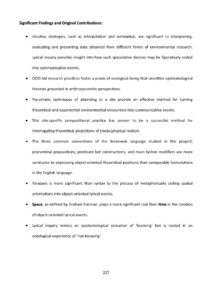
Page 227 from Verran (2025) provides a summary of significant findings:

Summary of Significant Findings and Contributions (Verran, 2025)

Why Are Some Of The Worst People Suddenly So Concerned About My Cornish ‘Identity’?

I remember the moment quite clearly. Back in 2015, I was part of a scrappy, grass-roots effort trying to understand what on earth had happened to London Pride. I’d started digging into the financials, following sponsorship pages and annual reports, trying to work out how something that once felt unruly, provincial and ours had turned into a vast corporate machine. I wrote about it at the time, half in disappointment, half in ironic detachment (4+5). What struck me wasn’t just the money, but who was supplying it.

Barclays, Citi, big law firms like Baker McKenzie, and polished NGOs with immaculate branding such as Exterion had all been sponsoring London Pride events for several years. At some point, amid the spreadsheets and sponsor logos, I asked a very simple question: why do these people care so much about my sexual orientation? When did global finance decide it was emotionally invested in my being a gay man? I didn’t feel particularly ‘seen’, as the cool kids like to say these days, I felt categorised, monetised and branded (3).

That feeling has stayed with me.

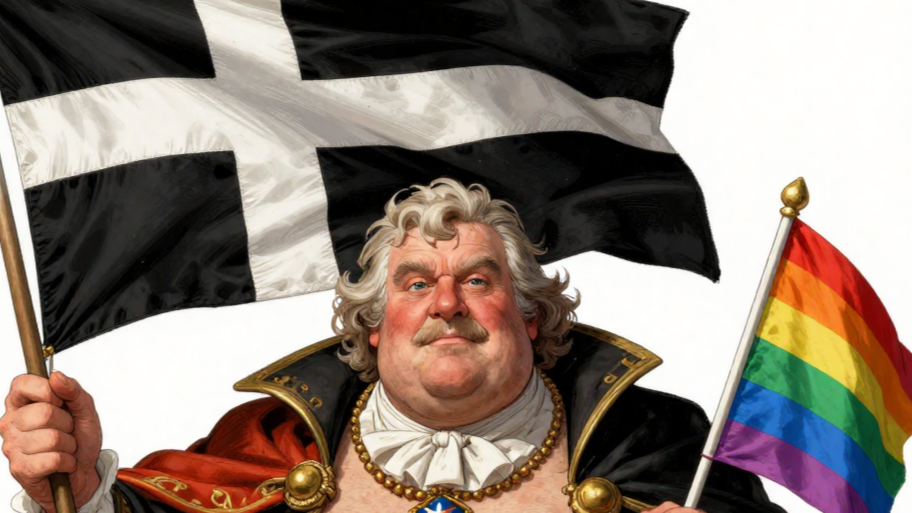
This is roughly what happens when you ask Freepik for a ‘satirical image of a bloaty noble exploiting Cornish and LGBT identities’.

Years later, while researching my PhD on how humans comprehend their environment and articulate that through language, I found myself back in similar emotional territory. I was comparing grammatical features of the two languages of my homeland: English and Kernewek. As I dug deeper into the revival of Kernewek and the cultural discourse orbiting it, the same sensation returned. That tightening in the gut. Why? I thought. Why now? Why, after centuries of neglect, ridicule and outright economic extraction, were some very respectable institutions in the UK suddenly so interested in cultivating a Cornish cultural ‘identity’?

To be clear, I have nothing against LGBT people who pour their time and love into London Pride. Nor do I have anything against Cornish people who work tirelessly to protect Kernewek and explore Cornish culture. I admire the commitment involved in both. This isn’t an attack on grass-roots energy. It’s a plea for scepticism about institutions that have a long, well-documented habit of exploiting grass-roots movements for ends that rarely improve the material conditions of ordinary people.

Here’s the thing – symbolic recognition is cheap. Flags are cheap. Car stickers are cheap. Language initiatives, diversity panels and glossy campaigns are cheap compared to land, mineral rights or meaningful economic redress. If there were serious conversations about who benefits from Cornwall’s land and resources, things might look very different. Imagine if working Cornish people had actually benefited from generations of mining and extraction, rather than watching profits flow elsewhere.

Much of that wealth has continued to flow into multinational corporations. Some large corporations, in general, are known to fund cultural or heritage projects, often as part of wider reputational or social-licence strategies. However, my concern here is not primarily about arts funding, but about extraction and ownership. The Rothschild family, for example, through its company Imerys (formerly Peñarroya), directly profits from Cornish mineral deposits, continuing a long tradition in which the material wealth of Cornwall is extracted while local communities see limited material return (2).

This sits in stark contrast to the symbolic recognition of Cornish culture, such as Kernewek being granted Part III status under the European Charter for Regional or Minority Languages (1). I often find myself asking: would most Cornish people prefer dual-language signposts on every street and road, or would they rather see the profits of kaolin and lithium extraction invested directly into local infrastructure, housing and public services?

What I see is a familiar pattern. Cultural identity is elevated, polished and funded just enough to be celebrated – but not enough to be actually empowered. Difference is encouraged, curated and then quietly weaponised to keep people segmented and manageable. I am deeply suspicious of financial and industrial interests that have held this island, and much of the planet, to ransom for centuries suddenly presenting themselves as champions of minority issues. I do not trust people who have a proven track record of participating in land-theft, exploitation and mass-murder. This is not paranoia; it is historical materialism, grounded in patterns of extraction, enclosure and enforced dependency that are well documented.

I refuse to be separated from my neighbours by each aspect of my identity. I refuse to be further divided and conquered. Yes, I am Cornish. Yes, I am a gay man. But more than that, I am descended from people who have laboured on this island, generation after generation, for the enrichment of a very small number of Mittel European families and their attendant German and Italian banking cartels. This shared material history matters more to me than any corporate badge of recognition ever could.

As always, my a’th kar!

I discuss this blog in more detail in the video below:

References:

(1) Cornwall Council (2026) Cornish language officially granted Part III status. Available at: https://www.cornwall.gov.uk/council-news/environment-culture-and-planning/cornish-language-officially-granted-part-iii-status/ (Accessed: 20/01/2026).

(2) Imerys S.A. (no date) Imerys – Our history. Available at: https://www.imerys.com/imerys-group/our-history/ (Accessed: 20/01/2026).

(3) Pride in London (2015) Sponsor Pride in London 2015. Archive snapshot. Available at: https://web.archive.org/web/20150627020110/https://prideinlondon.org/sponsors/ (Accessed: 20/01/2026).

(4) Verran, T. (2015) “Why we felt the need to bury Pride… #RIPPRIDE #QUEERFIGHTBACK”, Around the world in 80 gays!. Available at: https://tryg-aroundtheworldin80gays.blogspot.com/2015/06/why-we-felt-need-to-bury-pride-rippride.html (Accessed: 20/01/2026).

(5) Verran, T. (2016) “The moment I lost my Pride”, Around the world in 80 gays!. Available at: https://tryg-aroundtheworldin80gays.blogspot.com/2016/05/the-moment-i-lost-my-pride.html (Accessed: 20/01/2026).