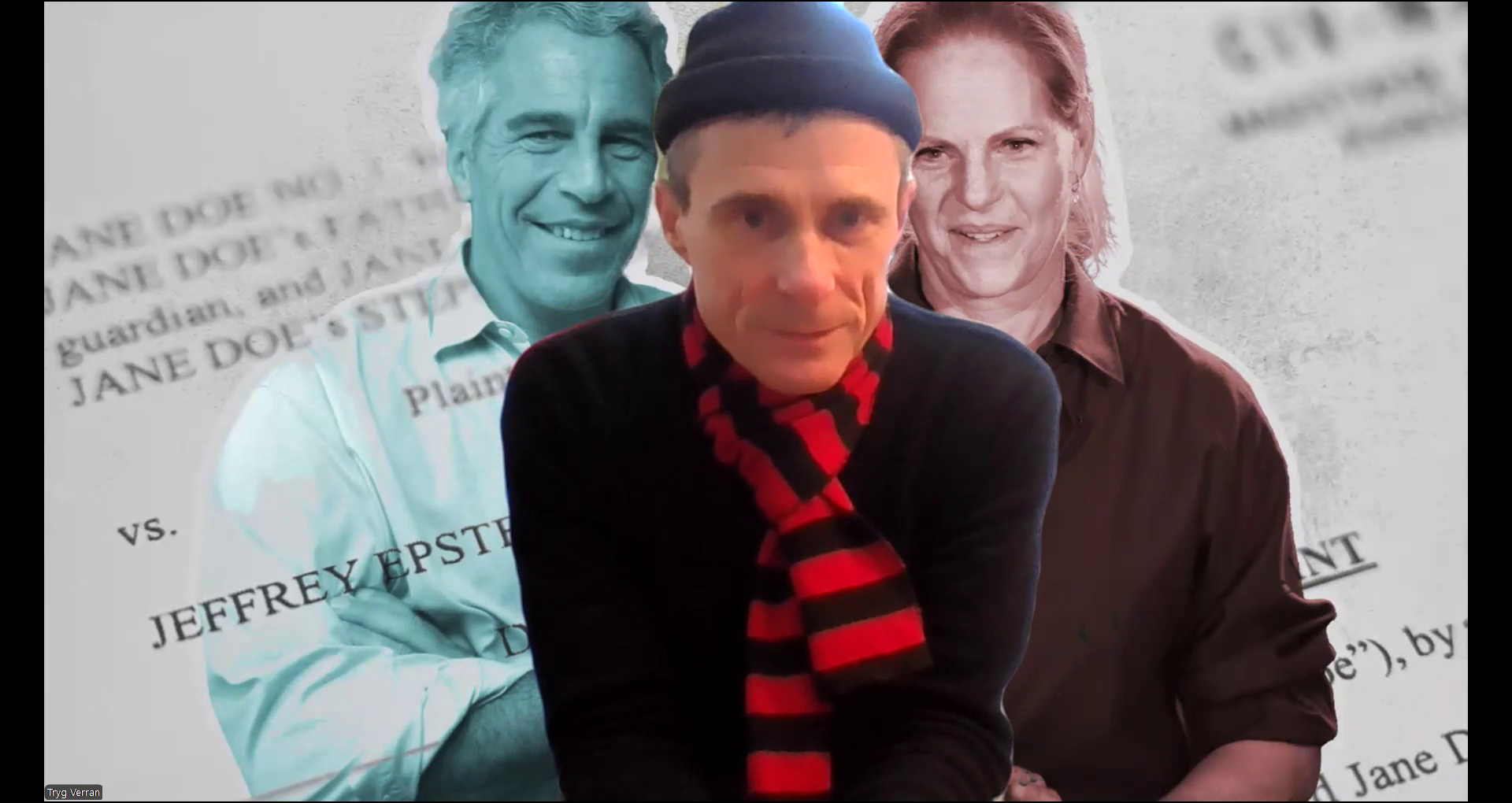
I know. The moment you mention Epstein, half the room switches off and the other half assumes you’re about to spiral into salacious gossip about decadent royals. Fair enough. There’s been no shortage of lurid headlines, often supporting bad faith takes or outright distractions. If you’re involved in grassroots organising – environment, housing, disability rights, local culture – then the Epstein scandal actually matters a great deal. Even here in the Duchy of Cornwall. Especially down here, in fact.

Not because of the sex crimes themselves, horrific as they are. Without sounding flippant, those are not the important part from an organising perspective. What matters is that the Epstein documents give us a rare, unvarnished look at how power actually functions. Not how it claims to function in glossy brochures, mission statements, or charity galas, but how it works when the doors are closed and the theatre stops.
What emerges is a class of people who genuinely believe themselves to be above the law – not metaphorically, literally. They trade influence across governments, intelligence agencies, banks, weapons manufacturers, and ‘philanthropic’ institutions with astonishing ease. The Epstein network shows us that inter-institutional power doesn’t operate through democratic accountability; it operates through personal relationships, financial leverage, kompromat, and shared class interest.
This is vital for grassroots organisers to understand, because so much organising energy is wasted arguing with the performance of power. We petition the institution, we appeal to its stated values, we take part in consultations that are largely ceremonial. Such processes help cultivate the illusion of participation. Meanwhile, the real decisions are being made elsewhere, by people who will never attend a town hall meeting and who don’t particularly care what the public thinks.
One of the more sobering elements of the Epstein story isn’t just who he knew, but what moved through his world: money laundering, arms flows, political interference, even regime change. Governments toppled, leaders removed, and vast sums legally washed clean through cultural, educational, and environmental organisations. That should ring bells for anyone who’s ever wondered why certain funders always seem to back ‘good causes’ while working-class communities remain neglected.
People are still combing through millions of released emails in the US, but already the outline of empire is visible. The Financial Times article on Epstein’s banking connections is revealing in this regard. When you trace those networks outward, you don’t end up in abstract theory – you end up in very real places. Yes, even Cornwall. Through extractive industries like Imerys, and through respected institutions such as wildlife and cultural trusts. This is what global power looks like when it lands locally.
The same family that profits from extracting Cornwall’s mineral reserves also funds organisations that promote ‘greener’ approaches to resource management, including initiatives linked to the Cornwall Wildlife Trust’s Green Recovery Challenge Fund. This does not, in itself, prove any wrongdoing. However, it does help explain why certain environmental impacts, particularly those linked to mineral extraction, are often absent from official campaigning narratives. This is grassroots theatre in action: the same interests profiting from extraction are also funding the boundaries within which ‘opposition’ is allowed to operate.
To be clear, the Epstein revelations are often discussed through the lens of particular social or cultural networks, but focusing on identity alone misses the point. What is being exposed is not a uniquely Zionist phenomenon, but a familiar pattern of elite, transnational power that has historically operated across Mittel-European, British, German, Italian, and American ruling classes alike. This is simply how imperial power has reproduced itself.
Crucially, the people working at the grassroots level of charitable, cultural, or environmental organisations are not villains. Most have little to no awareness of the legacies of wealth tied to colonial extraction in regions such as Rhodesia, Palestine or Somalia for example. My research suggests these same mechanics operate throughout the provinces, particularly within the overtly feudal ‘Duchy’ of Cornwall.
This is why outlets like the TrueAnon podcast and The Grayzone matter. They’ve been doing the unglamorous work of tracing these connections through a historical materialist lens, rather than dismissing them as scandal or conspiracy. They remind us that power has a history, a geography, and a balance sheet.
If grassroots organising is going to be effective, it has to be grounded in reality – not the comforting story we’re told about how the world works, but the uncomfortable truth of how it often does. The Epstein scandal isn’t a distraction from local issues. It’s a brutal lesson in why local struggles are always connected to global systems of power.
As always, my a’th kar!
I discuss this blog in more depth over on YouTube:
References:
(1) Cornwall Wildlife Trust (n.d.) Green Recovery Challenge Fund: Past projects. Available at: https://www.cornwallwildlifetrust.org.uk/what-we-do/past-projects/green-recovery-challenge-fund (Accessed: 9 February 2026).
(2) Financial Times (n.d.) Jeffrey Epstein and the banking system. Financial Times. Available at: https://www.ft.com/content/0d70b7d3-063d-43a0-812b-8b8b3e7c4c47 (Accessed: 9 February 2026).
(3) Imerys (n.d.) Imerys in the United Kingdom: Cornwall operations. Imerys. Available at: https://www.imerys.com/united-kingdom/cornwall (Accessed: 9 February 2026).
(4) Tages-Anzeiger. (2026). Tamedia AG. [online] Available at: https://www.tagesanzeiger.ch/epstein-beriet-ariane-de-rothschild-475024135092 [Accessed 14 Feb. 2026].
(5) @TrueAnonPod Truanon (n.d.) Truanon podcast. Available at: https://soundcloud.com/truanonpod (Accessed: 9 February 2026).
(6) @thegrayzone7996 The Grayzone (n.d.) Discussion on the Epstein files and imperial power structures. YouTube. Available at: https://www.youtube.com/watch?v=r2wz4rGGRGA&t=8s