Mesotopia: Significant Findings and Contributions

If you are looking for neat conclusions, this isn’t that kind of project. Indeed, I suggest that if you are looking for neat conclusions – you’re probably missing a big part of what makes research interesting. After years of wrestling with sites, words, and the strange space between being in a place and thinking about how I understand it, I have not found a tidy set of answers. Instead, I’ve landed somewhere more interesting: a conviction that meaning is made through a subtle interplay between the environment, the body and the mind. I’ve also found that different forms of expression demand different metaphysics – different philosophies of interpreting what is real – to turn these environmental encounters into something that can be communicated.

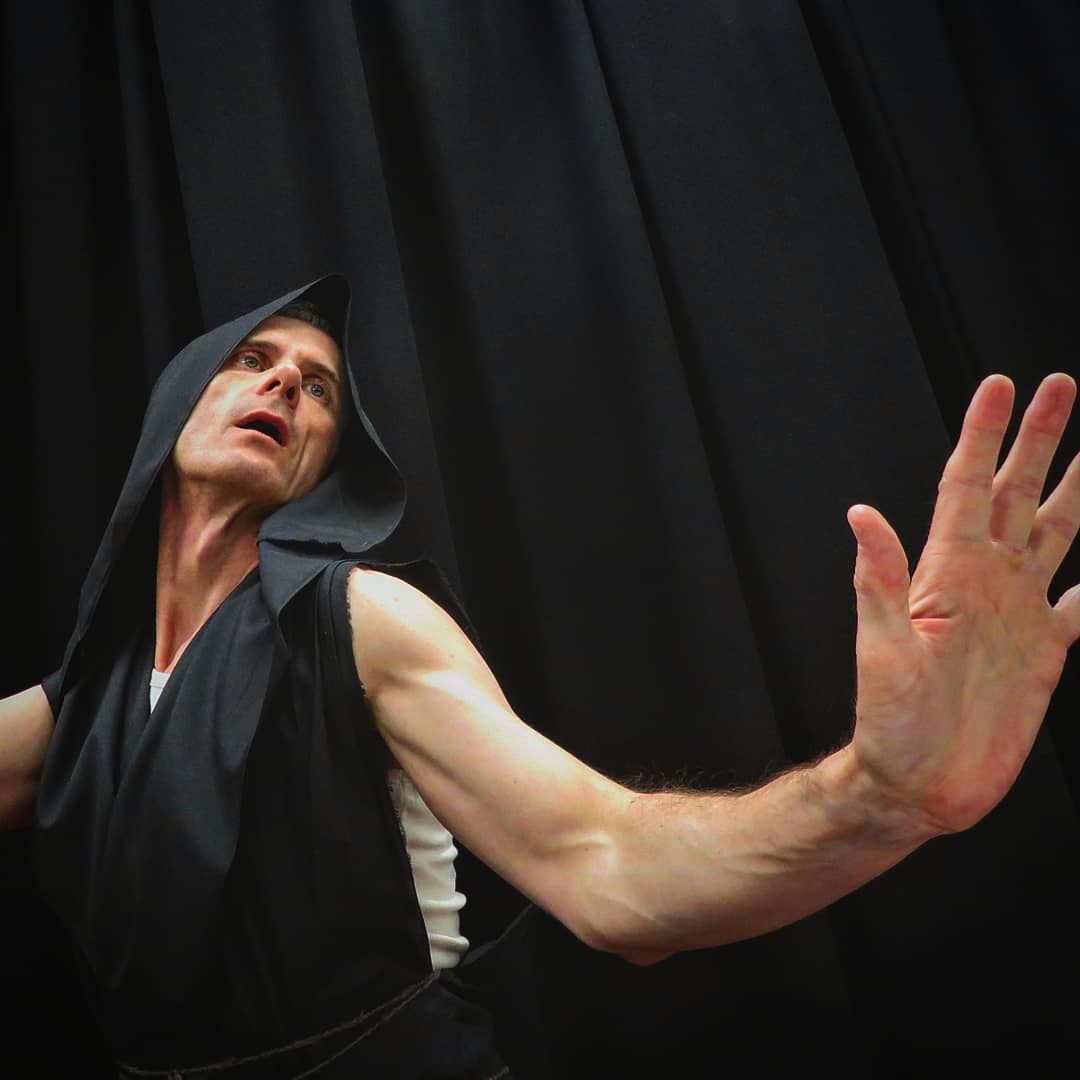
Tryg on the Coast by Will Halfacree

Let me put that another way. If you’re making a dance, you might need to focus more on theories that conceive a universe of energies and flows, as these are better suited to speaking about movement. However, if you’re making a lyric about an environmental encounter, you need a little distance to process the encounter, therefore theories that convey a universe of substances. And if you’re trying to make sense of the world while moving through it, then you might need to employ a theory that sits between theories of substances and flows.

Mesotopia, a middle place, is my attempt to do this. It is a place where physical things meet conceptual things, a place of substances and flows, a practice that sits between theory and experience, between knowing and not-knowing. I have found that a theory of object-oriented ontology (OOO), as advanced by Graham Harman, has proven to be really helpful when talking about mesotopia and mesotopian logic.

One of the more unexpected findings of my research is that the Cornish language – Kernewek – is structurally more suited to object-oriented thinking than English. I looked at three features of the Kernewek language that differ from the English language. Firstly, the use of pronominal prepositions; secondly, the favouring of predicate-led constructions; finally, the way nouns often sit before modifiers. I have found that these are not just grammatical quirks. I suggest that they build a world where things don’t exist merely as props for chattering human subjects. In Kernewek, the language itself leans into the idea that objects have their own stubborn presence. English, by contrast, keeps trying to put the speaking subject in the driver’s seat.

When you are trying to express your understanding of the world, the form that communication takes matters. I have found that parataxis – placing phrases side by side without explicit connections – is more significant than syntax for expressing relations to the environment. You don’t explain the space. You juxtapose. You let things sit next to each other, and the space between them does the work. What is the subtle difference between a phrase like ‘good day’ or ‘dydh da’ (literally ‘day good’)? Well, I advance the idea that the English phrase prioritises the subject’s opinion, ‘good’, over the object, ‘day’. Whereas the Kernewek version acknowledges the object, ‘dydh’, before the speaker’s opinion, ‘da’. It’s a subtle difference; however, I propose that this difference articulates a slightly different perspective of my understanding of what a day actually is.

It is useful to consider the significance of Graham Harman’s notion of ‘space’ here. Space, in this sense, is the distance between my physical encounter with an object and the object as I have conceived it in its totality. My physical encounter with a ‘day’ is comprised of various sensory events, such as registering the difference between darkness and light. However, there is much to a day that eludes my certainty – the totality of my understanding of a ‘day’ involves substances and flows that elude my senses, such as planetary objects and rotations. Therefore, the human concept of ‘day’ is simply an educated guess of what a day actually is, and whether or not it is ‘good’ is a human imposition. What’s ‘good’ for humans might not necessarily be ‘good’ for seagulls.

Perhaps the most delicate finding – the one that’s often most difficult for me to explain in simple terms – is this: my understanding of my environment mimics a sensation of knowing, but it’s actually rooted in an experience of not-knowing. For example, my practice of communicating my understanding of my environment involves lyrical composition. While these compositions feel like they’re delivering understanding, what they’re really doing is performing the condition of being amidst things I can’t fully grasp. Hence, I find that I exist in a world of partial revelation.

So no, there are no definitive conclusions here. There is a clearer sense that if you want to understand a place, you have to accept that the place – and the objects within it – keep their secrets. That means finding a philosophy, a language, a compositional practice that doesn’t translate everything back into human terms.

As always, my a’th kar!

Page 227 from Verran (2025) provides a summary of significant findings:
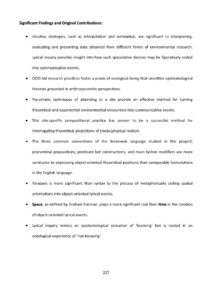
Summary of Significant Findings and Contributions (Verran, 2025)

On Celtic Nationalisms: (Aside) Why Does the UK Keep Spawning Strange Esoteric Cults?

While researching my PhD thesis, Mesotopia: Towards a Place of Lyrical Inquiry (2025), I spent considerable time visiting Celtic language communities and Celtic nationalist meetings across Britain. I went expecting to find what I’d romanticised: the last strongholds of living tradition, people gathering in draughty village halls to keep the old words breathing. What I found instead puzzled me deeply, and has since forced me to rethink my entire understanding of Celtic nationalisms and their revival.

Many of these gatherings were as I had imagined and were in village halls, but at some of these gatherings, I kept meeting members of esoteric orders, like Zionists and Mormons. They sat among Kernewek learners and Celtic nationalists, and I found myself asking the obvious question: what on earth are you doing here?

The answer is stranger than I expected.

The Hebrew Connection:

The links with Zionism emerge from something specific: the revival of the ancient Hebrew language. For many language activists, Hebrew stands as the great success story – a language of liturgy returned to public places. Israeli groups provided practical advice and strategies for growing the Welsh language during the latter half of the 20th century.

Beneath this practical solidarity lurked something more theological. For certain strands of Zionist thought, particularly those influenced by figures like Abraham Isaac Kook, the return to the Land and the revival of Hebrew were not merely nationalist projects but messianic events. So, if the revival of Hebrew carried political and theological significance for funders of the state of Israel, what of the revival of Welsh or Cornish? Is there some hidden financial or theological motive?

A Landscape of Secrets:

The truth is that the United Kingdom has long been a factory for esoteric orders that shape the political world from the shadows. We manufacture them the way Switzerland manufactures cuckoo clocks. To ignore this fact is to misunderstand our history. The history of the UK is littered with secret fraternities of posh boys performing rituals and rites. As ridiculous as they might seem to the uninitiated outsider – these people seem to believe whatever it is they are doing. Aleister Crowley alone spawned an evolving line of Thelemic sex cults, with their “Do what thou wilt” and elaborate initiations for posh boys and poets. The Hermetic Order of the Golden Dawn, the Ordo Templi Orientis, the Typhonian Order – each has promised hidden knowledge to privileged devotees, and many of their practices still reverberate through respectable contemporary societies.

Then there are the British Israelites, who emerged properly in the 19th century with the claim that the British people are literally descended from the Ten Lost Tribes of Israel. John Wilson’s Our Israelitish Origin (1840) gave the movement its founding text, and by the 1880s, Anglo-Israel associations had sprouted across Britain. These were not fringe eccentrics in any simple sense – they included clergy, peers, and at their peak claimed millions of sympathisers throughout the former colonies. It’s no surprise that ideas from the British Israelites heavily influenced the Mormon church in the United States.

And yes – the modern Zionist movement itself, in its current ethno-nationalist political form, emerged from late 19th-century Europe. These aren’t just eccentric social clubs; the reason the US Empire has evolved into a crusading force obsessed with prophecy and rapture, or the state of Israel has become an ethno-supremacist state is because of weird fringe ideas that have gestated right here in the UK. The quirks of many of these cults tap into the same soil of romantic nationalism, biblical prophecy, and the conviction that ancient peoples could be reassembled in the present.

What Do They Want?

The ultimate goals of these secret esoteric societies remain, by design, hidden. We live in what I call a state of partial revelation – we glimpse fragments, but never the full machinery. Theosophists spoke of a coming World Teacher. Crowley announced the Aeon of Horus. British Israelites anticipated the restoration of the Davidic throne through the British monarchy. According to researcher of the occult Tracy Twyman, some secret societies have sought out a mythical ‘twilight language’ which conveys secret knowledge – this might explain an interest in old languages like Hebrew, Welsh, or even Cornish. The more I look into the work of figures like Edward Williams (also known as ‘Iolo Morganwg’) or Robert Morton Nance, the more I become sceptical of their motives or methods. Whatever their goals, scattered through all of the secret societies runs a thread of sectarianism, of chosen peoples, and of elect nations.

What becomes clear, viewed from ground level, is that such groups consistently function against the interests of the uninitiated – which means the common people. They work to create division – to balkanise not only territories but imaginations. The English Mistery of the 1930s, with its mystical feudalism and its “kins” of racially pure Englishmen, sought to roll back democracy and reinstate aristocratic rule. Rolf Gardiner, one of its leaders, wrote explicitly in German journals about reviving long-lost Germanic traditions in the English social order. These are not harmless antiquarians – they are architects of division, fear and paranoia.

Demystifying the Mystery:

Mesotopian logic demands a demystification of meaning-making. Not the crude demystification that pretends mystery doesn’t exist – we can never fully know the real world, and any claim to total knowledge is itself a power move. Rather, an honest demystification that names what is not known, that refuses the priestly gesture of hiding operations behind ritual.

Celtic languages do not belong to esoteric orders. They do not belong to neo-feudal aristocrats or digital landlords or prophets of racial destiny. They belong to the communities that speak them, learn them, dream in them – communities of ordinary people trying to hold onto something precious. The mystifiers would turn these languages into keys to hidden kingdoms. I say: let these languages remain what they are – words for sea and rock and magpie, for love and loss and the hope of conveying something meaningful or, dare I say, beautiful.

As always, my a’th kar.

I discuss this blog in more detail in the video:

References:

Allen, J.H. (1917) Judah’s Sceptre and Joseph’s Birthright. 15th edn. Haverhill, MA: Destiny Publishers. [Originally published 1902].

Armstrong, H.W. (2005) The United States and Britain in Prophecy. Edmund, OK: Philadelphia Church of God. [Originally published 1954].

Bogdan, H. and Starr, M.P. (eds.) (2012) Aleister Crowley and Western Esotericism. Oxford: Oxford University Press.

Carew, M. (2003) Tara and the Ark of the Covenant: A Search for the Ark of the Covenant by British-Israelites on the Hill of Tara (1899-1902). Dublin: Discovery Programme/Royal Irish Academy.

Dietz, B. (2018) ‘Sanderson, William John’, in Oxford Dictionary of National Biography. Oxford: Oxford University Press.

Green, E.H.H. (2002) Ideologies of Conservatism: Conservative Political Ideas in the Twentieth Century. Oxford: Oxford University Press.

Griffiths, R. (1980) Fellow Travellers of the Right: British Enthusiasts for Nazi Germany, 1933-9. London: Constable.

Hedenborg White, M. (2020) ‘Rethinking Aleister Crowley and Thelema: New Perspectives’, Aries: Journal for the Study of Western Esotericism, 21(1), pp. 1-12.

Linehan, T. (2000) British Fascism, 1918-1939: Parties, Ideology and Culture. Manchester: Manchester University Press.

Mirsky, Y. (2022) ‘Rav Kook: The Leading Thinker of Religious Zionism’, Brandeis University Jewish Experience, September. Available at:https://www.brandeis.edu/jewish-experience/history-culture/2022/september/kook-zionism-mirsky.html (Accessed: 16 March 2026).

Pasi, M. (2014) Aleister Crowley and the Temptation of Politics. Abingdon: Routledge. [Originally published in Italian 1999].

Platts-Mills, J. (2001) Muck, Silk and Socialism: Recollections of a Left-wing Queen’s Counsel. Wedmore: Paper Publishing.

Posen Library (no date) Abraham Isaac Kook: Biography. Available at: http://www.posenlibrary.com/author/abraham-isaac-kook (Accessed: 16 March 2026).

Sanderson, W.J. (1927) Statecraft. London: [publisher unknown].

Sanderson, W.J. (1930) That Which Was Lost: A Treatise on Freemasonry and the English Mistery. London: [publisher unknown].

Wikipedia (2006) British Israelism. Available at: https://webarchiveweb.wayback.bac-lac.canada.ca/web/20060913000000/http://en.wikipedia.org:80/wiki/British_Israelism (Accessed: 16 March 2026).

Wikipedia (2025) Hermetic Order of the Golden Dawn. Available at: https://en.wikipedia.org/wiki/Hermetic_Order_of_the_Golden_Dawn (Accessed: 16 March 2026).

Wikipedia (2023) English Mistery. Available at: https://en.wikipedia.org/wiki/English_Mistery (Accessed: 16 March 2026).

Wikipedia Contributors (2025). Iolo Morganwg. Wikipedia. Available at: https://en.wikipedia.org/wiki/Iolo_Morganwg (Accessed: 21 March 2026).

Wikipedia Contributors (2025). Robert Morton Nance. Wikipedia. Available at: https://en.wikipedia.org/wiki/Robert_Morton_Nance (Accessed: 21 March 2026).

Wilson, J. (1840) Our Israelitish Origin. London: [publisher unknown].

Wright, P. (2002) The Village that Died for England. London: Faber and Faber.

Yeats, W.B. (1901) Is the Order of R. R. & A. C. to Remain a Magical Order? London: Privately printed.

Why Are Some Of The Worst People Suddenly So Concerned About My Cornish ‘Identity’?

I remember the moment quite clearly. Back in 2015, I was part of a scrappy, grass-roots effort trying to understand what on earth had happened to London Pride. I’d started digging into the financials, following sponsorship pages and annual reports, trying to work out how something that once felt unruly, provincial and ours had turned into a vast corporate machine. I wrote about it at the time, half in disappointment, half in ironic detachment (4+5). What struck me wasn’t just the money, but who was supplying it.

Barclays, Citi, big law firms like Baker McKenzie, and polished NGOs with immaculate branding such as Exterion had all been sponsoring London Pride events for several years. At some point, amid the spreadsheets and sponsor logos, I asked a very simple question: why do these people care so much about my sexual orientation? When did global finance decide it was emotionally invested in my being a gay man? I didn’t feel particularly ‘seen’, as the cool kids like to say these days, I felt categorised, monetised and branded (3).

That feeling has stayed with me.

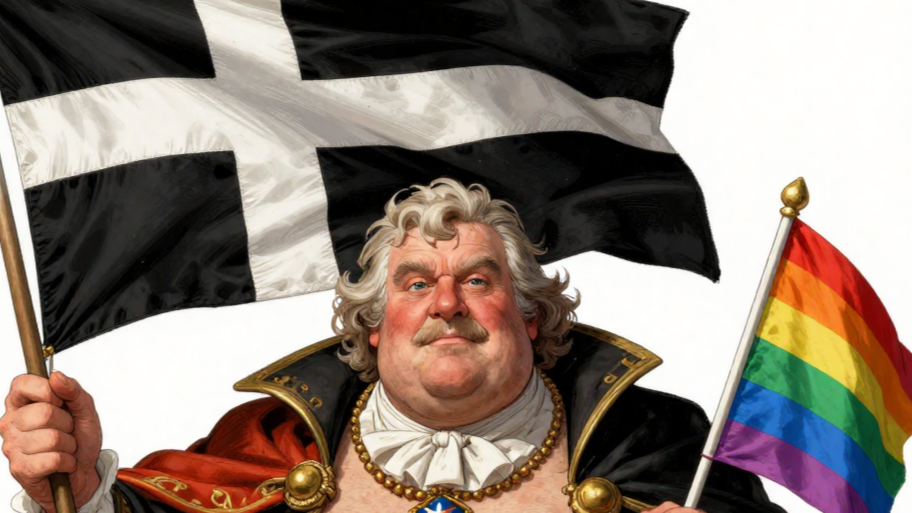
This is roughly what happens when you ask Freepik for a ‘satirical image of a bloaty noble exploiting Cornish and LGBT identities’.

Years later, while researching my PhD on how humans comprehend their environment and articulate that through language, I found myself back in similar emotional territory. I was comparing grammatical features of the two languages of my homeland: English and Kernewek. As I dug deeper into the revival of Kernewek and the cultural discourse orbiting it, the same sensation returned. That tightening in the gut. Why? I thought. Why now? Why, after centuries of neglect, ridicule and outright economic extraction, were some very respectable institutions in the UK suddenly so interested in cultivating a Cornish cultural ‘identity’?

To be clear, I have nothing against LGBT people who pour their time and love into London Pride. Nor do I have anything against Cornish people who work tirelessly to protect Kernewek and explore Cornish culture. I admire the commitment involved in both. This isn’t an attack on grass-roots energy. It’s a plea for scepticism about institutions that have a long, well-documented habit of exploiting grass-roots movements for ends that rarely improve the material conditions of ordinary people.

Here’s the thing – symbolic recognition is cheap. Flags are cheap. Car stickers are cheap. Language initiatives, diversity panels and glossy campaigns are cheap compared to land, mineral rights or meaningful economic redress. If there were serious conversations about who benefits from Cornwall’s land and resources, things might look very different. Imagine if working Cornish people had actually benefited from generations of mining and extraction, rather than watching profits flow elsewhere.

Much of that wealth has continued to flow into multinational corporations. Some large corporations, in general, are known to fund cultural or heritage projects, often as part of wider reputational or social-licence strategies. However, my concern here is not primarily about arts funding, but about extraction and ownership. The Rothschild family, for example, through its company Imerys (formerly Peñarroya), directly profits from Cornish mineral deposits, continuing a long tradition in which the material wealth of Cornwall is extracted while local communities see limited material return (2).

This sits in stark contrast to the symbolic recognition of Cornish culture, such as Kernewek being granted Part III status under the European Charter for Regional or Minority Languages (1). I often find myself asking: would most Cornish people prefer dual-language signposts on every street and road, or would they rather see the profits of kaolin and lithium extraction invested directly into local infrastructure, housing and public services?

What I see is a familiar pattern. Cultural identity is elevated, polished and funded just enough to be celebrated – but not enough to be actually empowered. Difference is encouraged, curated and then quietly weaponised to keep people segmented and manageable. I am deeply suspicious of financial and industrial interests that have held this island, and much of the planet, to ransom for centuries suddenly presenting themselves as champions of minority issues. I do not trust people who have a proven track record of participating in land-theft, exploitation and mass-murder. This is not paranoia; it is historical materialism, grounded in patterns of extraction, enclosure and enforced dependency that are well documented.

I refuse to be separated from my neighbours by each aspect of my identity. I refuse to be further divided and conquered. Yes, I am Cornish. Yes, I am a gay man. But more than that, I am descended from people who have laboured on this island, generation after generation, for the enrichment of a very small number of Mittel European families and their attendant German and Italian banking cartels. This shared material history matters more to me than any corporate badge of recognition ever could.

As always, my a’th kar!

I discuss this blog in more detail in the video below:

References:

(1) Cornwall Council (2026) Cornish language officially granted Part III status. Available at: https://www.cornwall.gov.uk/council-news/environment-culture-and-planning/cornish-language-officially-granted-part-iii-status/ (Accessed: 20/01/2026).

(2) Imerys S.A. (no date) Imerys – Our history. Available at: https://www.imerys.com/imerys-group/our-history/ (Accessed: 20/01/2026).

(3) Pride in London (2015) Sponsor Pride in London 2015. Archive snapshot. Available at: https://web.archive.org/web/20150627020110/https://prideinlondon.org/sponsors/ (Accessed: 20/01/2026).

(4) Verran, T. (2015) “Why we felt the need to bury Pride… #RIPPRIDE #QUEERFIGHTBACK”, Around the world in 80 gays!. Available at: https://tryg-aroundtheworldin80gays.blogspot.com/2015/06/why-we-felt-need-to-bury-pride-rippride.html (Accessed: 20/01/2026).

(5) Verran, T. (2016) “The moment I lost my Pride”, Around the world in 80 gays!. Available at: https://tryg-aroundtheworldin80gays.blogspot.com/2016/05/the-moment-i-lost-my-pride.html (Accessed: 20/01/2026).

Demystifying The Kernewek Language

I have argued in Mesotopia: Towards a Place of Lyrical Inquiry (1) that yes, there is a real world, but no, it does not open itself to our complete comprehension. We are always half-in, half-out of its meanings, fumbling toward the real but never quite gripping it. This weird middle place – a mesh of physical and conceptual terrains – is the domain of the meaning-makers. The poets, the oracles, the interpreters of signs have historically been quite happy to hide their operations behind opulent rituals or clever distractions. But does it have to be this way? My lyrical work has long been an effort to demystify poetics and language, to free these communicative events from the dictates of esoteric schools and elite fraternities who still treat language as a proprietary ritual.

Naming, after all, has long been the preserve of priestly classes: the magi, the monks, the keepers of alphabets and incantations. In many religious orders, “the Word” is not just a tool but a cosmological foundation – articulation itself becomes sacrament. And once you take this seriously, it becomes impossible not to notice how incantations, chants, spells, prophetic mutterings and other religious-poetic forms lean heavily on the idea of language as conduit to hidden truths. This is the vatic, the mantic, the magical dimension of poesis, the belief that words do not merely describe the world but summon, shape, or invoke it.

Modern linguistics attempts to scrub all this clean. Structuralists, post-structuralists, cognitive scientists, psycholinguists; they all gather with laboratory-grade detachment to “demystify” language production. This is good in theory. But if you ignore the presence of mystery altogether, you’re not demystifying anything. You’re merely tucking your priestly robes into your slacks and hoping nobody notices the ancient hems. Many materialist linguists strike me as devout priestly magi decked out in secular boardroom drag. Here’s one of the many unspoken secrets of our supposedly rational institutions: even empirical research often rests on vast scaffolds of speculation. Each irrefutable graph serves as an article of faith – it’s an ‘educated guess’ berobed as a principle.

This is why it is difficult to determine how many theoretical schools are engaged in re-mystifying the archive of human knowledge – although some hide in plain sight. Even Tim Morton, spear-heading investigations into the ecological implications of object-oriented ontology, is overt about (eco)gnostic leanings.

Consider the accelerationists (2): the former CCRU crowd who hallucinated Deleuze and Guattari into a cybernetic fever dream, pushing symbolism to liturgical extremes. Their rapid decoupling of meaning from symbol, in pursuit of some machinic singularity, often sounds to me not unlike kabbalistic numerology or ecstatic glossolalia. It is not insignificant that many modern tech-titans are devotees of Nick Land. Listen to the quasi-prophetic ramblings of Peter Thiel or Marc Andreessen as they speak of merging symbolic and material terrains; you will hear the cadences of a neo-cult, not a scientific proposal. Meanwhile, various deciples of the structuralists continue to worship The Corpus Linguistic with devotional intensity. ‘and the Word was God,’ they seem to say – and seemingly never notice they are mimicking devotees of Thoth, Hermes or even John 1:1 .Once again, the priests return, this time wearing the unbuttoned casuals of liberal intelligentsia.

In contrast, I often return to etymology, a much subtler way of demystifying meaning. Not by banishing mystery, but by acknowledging its layers. English gives the game away easily: most of our “proper” vocabulary is padded with Greek and Latin. The professional-managerial classes (PMC) learn just enough of these roots to keep the bloated machinery of liberal institutions functioning. Autobiography: self-life-writing. Philosophy: love-of-wisdom. Nothing mystical, only inherited structure.

When we apply the same etymological pressure to Kernewek, interesting stories surface. Pysk, the Kernewek word for “fish,” appears to descend from Latin piscis. This aligns with what Celtic linguists tell us: the Brythonic languages had more prolonged contact with Roman, Norman, and Saxon cultures than their Goidelic cousins. History leaves fingerprints on phonemes.

Or – and here’s a mischievous alternative – it suggests that one of the more “colourful” characters in the history of Kernewek revivalism simply inserted Latin or Greek terms (along with Welsh and Breton borrowings) to fill lexical gaps. The line between linguistic evolution and linguistic invention is not always tidy.

On page 76 of my thesis, I discuss Linguist Professor Price’s uncompromising position: Cornish is dead, he insists, and modern “revivals” are “partially invented” (Price, 1984: 134). He writes:

“The Old Celtic speech of Cornwall died out two centuries ago. It is still dead, and will evermore remain so… The present century has seen the propagation by a small band of enthusiasts of a type of language that is partially derived from the old Celtic speech of Cornwall, but it is also partially invented… I shall reserve the term Cornish for the genuine language and refer to the modern pseudo-Cornish as Cornic.”

I do have issues with Price’s framing. As I wrote:

“What is involved in inventing a language? What is a pseudo-language? What does a ‘genuine’ or ‘authentic’ Kernewek sound like? I remain confused by the extent to which Price uses terms such as authentic, genuine, and pseudo in relation to Kernewek.” (Verran, 2025: 76)

Whether or not one accepts Price’s verdict, the point stands: Kernewek should be preserved and spoken as a breathing archive of our past, not re-engineered as an esoteric tool of ethnonationalism. We know too well what can happen when fringe political movements revive ancient languages to manufacture legitimacy. And it doesn’t surprise me that Celtic circles frequently attract a plethora of esoteric characters: Zionists, Catholic Religious Orders, Rosicrucians, Masons, New-Age Druids, Shamans or Wiccans – all projecting mystical significance onto minority languages. Why this conviction that certain tongues contain secret indigenous wisdom? Romantic nationalism, folklore, and the Arcadian fantasy of an unbroken Celtic lineage have all fed this impulse.

The more I learn about figures like Iolo Morganwg or Robert Morton Nance – who seem to have consciously cultivated a priestly order of Celtic mystics modelled on Julius Caesar’s accounts of ancient Britons – the more frustrated I become. We don’t need to live inside the art projects of eccentric artists or poets – and yes, that includes me! Trust me, we definitely shouldn’t live inside anything I create.

As a poet, I enjoy bending language into unorthodox shapes. I fabricate littoral places inside my verse, places that shimmer and sometimes misbehave. But I do not belong to the mystery schools of modern priestly classes, who still seem intent on fabricating material realities for entire populations to inhabit according to the whims of neo-feudal aristocrats or digital landlords.

For me, the mystery is not something to eradicate but something to remain in dialogue with. I continue to wrestle with the languages I have inherited. I am consciously rejecting past myths or Arthurian tropes all too often associated with Celtic languages. Through lyrical poetry, I keep listening – probing the metaphysical uncertainties that Kernewek, in all its contested life and afterlife, continues to stir.

As always, my a’th kar!

All References Available From Verran, 2025:

(1) Verran, T. (2025) Mesotopia: Towards a Place of Lyrical Inquiry. Thesis. University of Plymouth. Available at: https://doi.org/10.24382/nv45-pk79

(2) Monoskop.org. (2017). Cybernetic Culture Research Unit – Monoskop. [online] Available at: https://monoskop.org/Cybernetic_Culture_Research_Unit.

Introducing Klewes: Listening in the Expanded Field

When I first began formulating the ideas that would eventually become my concept of mesotopia, I needed a way to describe the strange middle-ground where perception, place, and meaning fold into one another. I sensed that our encounters with the world happen both ‘out there’ and ‘in here’ but identifying with any kind of precision that place between ‘out there’ and ‘in here’ would require contemplation of both the psychological and somatic techniques involved in meaning making – hence my ongoing research into psy-omatic practice (1). Before working on my thesis, I had been playing with a method that helped me navigate that in-between space with more precision. That practice is what I now call klewes.

Klewes by Maruay Makekurdchoo (2018)

Klewes is a word from Kernewek, the Cornish language, meaning “to hear, think, feel, perceive.” The word immediately resonated with me. Its definition already gestures beyond the narrow sense of hearing and toward a fuller, more embodied mode of knowing. I realised that what I needed was a practice of attending that begins with the body’s capacity to listen – not just with the ears, but with everything capable of sensing vibration. I wasn’t seeking a metaphor. I wanted a method. So klewes became the name for that method.

The procedure is simple, but the effects can be disarming. When I arrive at a site of composition – whether a field, a coastal path, an abandoned industrial corner, or a patch of woodland – I lie down. I close my eyes. I take long, slow breaths for about fifteen minutes, sometimes a bit more, until my attention begins to settle. With my vision removed from the foreground, something else starts to happen: the body reorients itself. The ground becomes not a surface beneath me but a resonant partner. Vibrations travel upward – small tremors, shifting pressures, the faint hum of heat working its way through soil and stone. In those moments, I begin to “hear” with the back of my skull, with my ribs, with the folds of clothing touching the ground.

This is what I mean by listening in the expanded field.

The point of klewes isn’t to romanticise nature or to retreat into some meditative cocoon. It’s a deliberate unsettling of the visual habits that dominate our encounters with place. Modern life, and even much ecological thinking, leans heavily on the eye: the view, the image, the landscape. Vision often leads to a sense of distance reinforcing an “I over here” observing a “world over there.” That separation underpins an anthropocentric way of relating, one in which the human becomes the sole interpreter of meaning.

When I practise klewes, I don’t begin with seeing. I begin with hearing. The site arrives first as vibration, pressure, pulse. Instead of interpreting the place, I let the place impress itself upon me. Hearing – expanded into feeling – becomes a way of entering into relation without assuming that what I see defines what is there.

I’ve found that this shifts the entire tone of composition. Rather than imposing structure onto the site, I allow the site to tune me. The thinking, composing or writing that follows carries traces of that initial, ear-led encounter. It is quieter, more porous, and more situated.

Klewes is, ultimately, an invitation: to hear our way into place, to perceive without rushing to picture, and to recognise that the world meets us long before we claim to look at it.

As always, my a’th kar!

References:

(1)Verran, T. (2025) Introducing the Psy-omatics of Encounter. https://myathkar.org/introducing-the-psy-omatics-of-encounter/

(2) Verran, T. (2025) Mesotopia: Towards a Place of Lyrical Inquiry. Pearl. The University of Plymouth.