Why the Epstein Scandal Matters to Grass-roots Organising – Yes, Even in Cornwall!

I know. The moment you mention Epstein, half the room switches off and the other half assumes you’re about to spiral into salacious gossip about decadent royals. Fair enough. There’s been no shortage of lurid headlines, often supporting bad faith takes or outright distractions. If you’re involved in grassroots organising – environment, housing, disability rights, local culture – then the Epstein scandal actually matters a great deal. Even here in the Duchy of Cornwall. Especially down here, in fact.

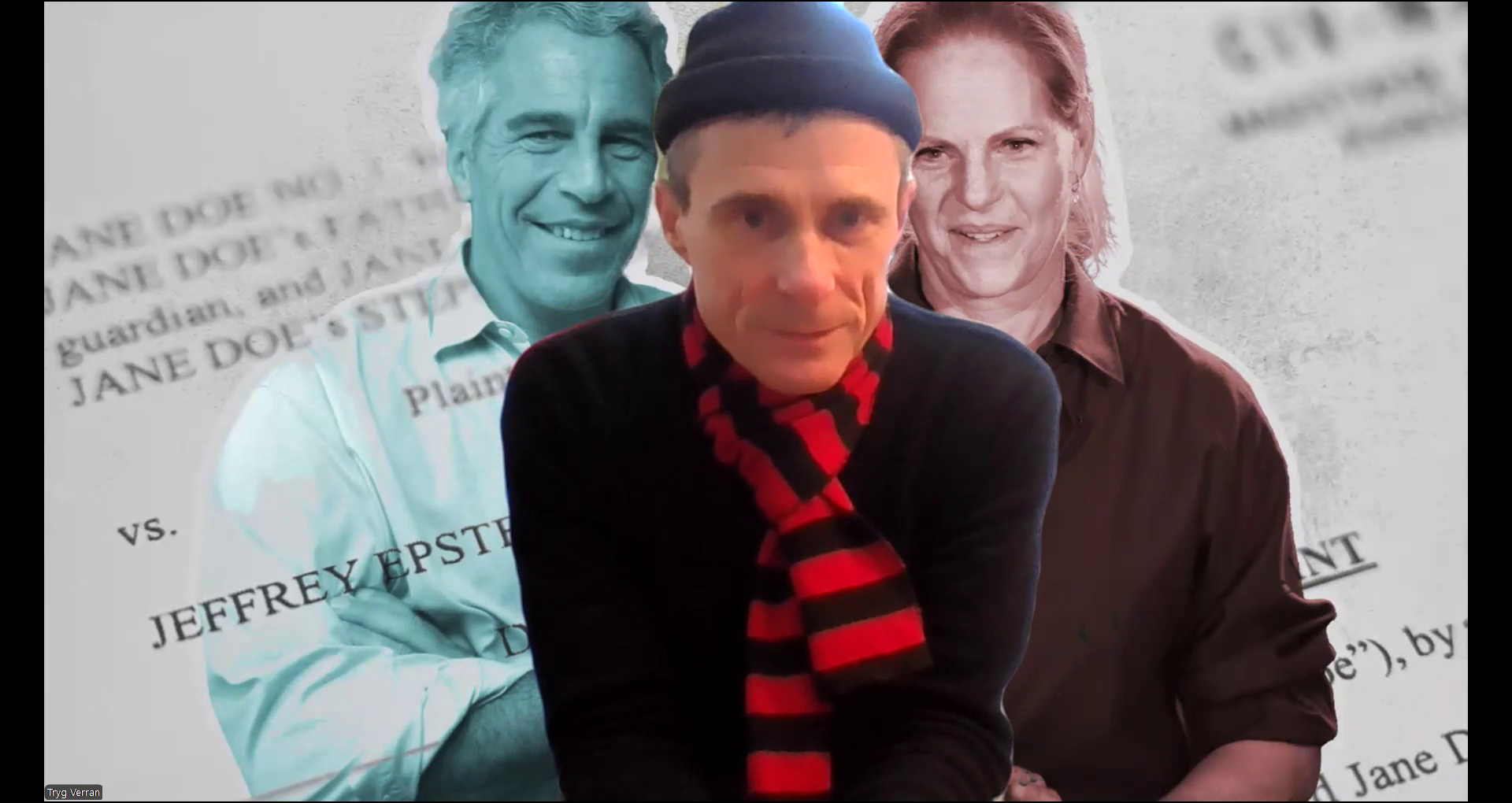
Thanks to Tamedia for the background image.

Not because of the sex crimes themselves, horrific as they are. Without sounding flippant, those are not the important part from an organising perspective. What matters is that the Epstein documents give us a rare, unvarnished look at how power actually functions. Not how it claims to function in glossy brochures, mission statements, or charity galas, but how it works when the doors are closed and the theatre stops.

What emerges is a class of people who genuinely believe themselves to be above the law – not metaphorically, literally. They trade influence across governments, intelligence agencies, banks, weapons manufacturers, and ‘philanthropic’ institutions with astonishing ease. The Epstein network shows us that inter-institutional power doesn’t operate through democratic accountability; it operates through personal relationships, financial leverage, kompromat, and shared class interest.

This is vital for grassroots organisers to understand, because so much organising energy is wasted arguing with the performance of power. We petition the institution, we appeal to its stated values, we take part in consultations that are largely ceremonial. Such processes help cultivate the illusion of participation. Meanwhile, the real decisions are being made elsewhere, by people who will never attend a town hall meeting and who don’t particularly care what the public thinks.

One of the more sobering elements of the Epstein story isn’t just who he knew, but what moved through his world: money laundering, arms flows, political interference, even regime change. Governments toppled, leaders removed, and vast sums legally washed clean through cultural, educational, and environmental organisations. That should ring bells for anyone who’s ever wondered why certain funders always seem to back ‘good causes’ while working-class communities remain neglected.

People are still combing through millions of released emails in the US, but already the outline of empire is visible. The Financial Times article on Epstein’s banking connections is revealing in this regard. When you trace those networks outward, you don’t end up in abstract theory – you end up in very real places. Yes, even Cornwall. Through extractive industries like Imerys, and through respected institutions such as wildlife and cultural trusts. This is what global power looks like when it lands locally.

The same family that profits from extracting Cornwall’s mineral reserves also funds organisations that promote ‘greener’ approaches to resource management, including initiatives linked to the Cornwall Wildlife Trust’s Green Recovery Challenge Fund. This does not, in itself, prove any wrongdoing. However, it does help explain why certain environmental impacts, particularly those linked to mineral extraction, are often absent from official campaigning narratives. This is grassroots theatre in action: the same interests profiting from extraction are also funding the boundaries within which ‘opposition’ is allowed to operate.

To be clear, the Epstein revelations are often discussed through the lens of particular social or cultural networks, but focusing on identity alone misses the point. What is being exposed is not a uniquely Zionist phenomenon, but a familiar pattern of elite, transnational power that has historically operated across Mittel-European, British, German, Italian, and American ruling classes alike. This is simply how imperial power has reproduced itself.

Crucially, the people working at the grassroots level of charitable, cultural, or environmental organisations are not villains. Most have little to no awareness of the legacies of wealth tied to colonial extraction in regions such as Rhodesia, Palestine or Somalia for example. My research suggests these same mechanics operate throughout the provinces, particularly within the overtly feudal ‘Duchy’ of Cornwall.

This is why outlets like the TrueAnon podcast and The Grayzone matter. They’ve been doing the unglamorous work of tracing these connections through a historical materialist lens, rather than dismissing them as scandal or conspiracy. They remind us that power has a history, a geography, and a balance sheet.

If grassroots organising is going to be effective, it has to be grounded in reality – not the comforting story we’re told about how the world works, but the uncomfortable truth of how it often does. The Epstein scandal isn’t a distraction from local issues. It’s a brutal lesson in why local struggles are always connected to global systems of power.

As always, my a’th kar!

I discuss this blog in more depth over on YouTube:

References:

(1) Cornwall Wildlife Trust (n.d.) Green Recovery Challenge Fund: Past projects. Available at: https://www.cornwallwildlifetrust.org.uk/what-we-do/past-projects/green-recovery-challenge-fund (Accessed: 9 February 2026).

(2) Financial Times (n.d.) Jeffrey Epstein and the banking system. Financial Times. Available at: https://www.ft.com/content/0d70b7d3-063d-43a0-812b-8b8b3e7c4c47 (Accessed: 9 February 2026).

(3) Imerys (n.d.) Imerys in the United Kingdom: Cornwall operations. Imerys. Available at: https://www.imerys.com/united-kingdom/cornwall (Accessed: 9 February 2026).

(4) Tages-Anzeiger. (2026). Tamedia AG. [online] Available at: https://www.tagesanzeiger.ch/epstein-beriet-ariane-de-rothschild-475024135092 [Accessed 14 Feb. 2026].

(5)  @TrueAnonPod  Truanon (n.d.) Truanon podcast. Available at: https://soundcloud.com/truanonpod (Accessed: 9 February 2026).

(6)  @thegrayzone7996  The Grayzone (n.d.) Discussion on the Epstein files and imperial power structures. YouTube. Available at: https://www.youtube.com/watch?v=r2wz4rGGRGA&t=8s

Why Are Some Of The Worst People Suddenly So Concerned About My Cornish ‘Identity’?

I remember the moment quite clearly. Back in 2015, I was part of a scrappy, grass-roots effort trying to understand what on earth had happened to London Pride. I’d started digging into the financials, following sponsorship pages and annual reports, trying to work out how something that once felt unruly, provincial and ours had turned into a vast corporate machine. I wrote about it at the time, half in disappointment, half in ironic detachment (4+5). What struck me wasn’t just the money, but who was supplying it.

Barclays, Citi, big law firms like Baker McKenzie, and polished NGOs with immaculate branding such as Exterion had all been sponsoring London Pride events for several years. At some point, amid the spreadsheets and sponsor logos, I asked a very simple question: why do these people care so much about my sexual orientation? When did global finance decide it was emotionally invested in my being a gay man? I didn’t feel particularly ‘seen’, as the cool kids like to say these days, I felt categorised, monetised and branded (3).

That feeling has stayed with me.

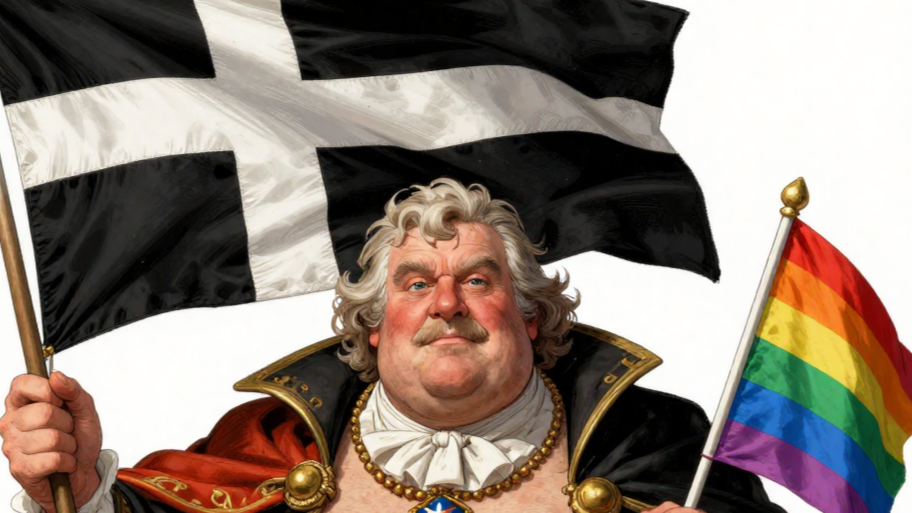
This is roughly what happens when you ask Freepik for a ‘satirical image of a bloaty noble exploiting Cornish and LGBT identities’.

Years later, while researching my PhD on how humans comprehend their environment and articulate that through language, I found myself back in similar emotional territory. I was comparing grammatical features of the two languages of my homeland: English and Kernewek. As I dug deeper into the revival of Kernewek and the cultural discourse orbiting it, the same sensation returned. That tightening in the gut. Why? I thought. Why now? Why, after centuries of neglect, ridicule and outright economic extraction, were some very respectable institutions in the UK suddenly so interested in cultivating a Cornish cultural ‘identity’?

To be clear, I have nothing against LGBT people who pour their time and love into London Pride. Nor do I have anything against Cornish people who work tirelessly to protect Kernewek and explore Cornish culture. I admire the commitment involved in both. This isn’t an attack on grass-roots energy. It’s a plea for scepticism about institutions that have a long, well-documented habit of exploiting grass-roots movements for ends that rarely improve the material conditions of ordinary people.

Here’s the thing – symbolic recognition is cheap. Flags are cheap. Car stickers are cheap. Language initiatives, diversity panels and glossy campaigns are cheap compared to land, mineral rights or meaningful economic redress. If there were serious conversations about who benefits from Cornwall’s land and resources, things might look very different. Imagine if working Cornish people had actually benefited from generations of mining and extraction, rather than watching profits flow elsewhere.

Much of that wealth has continued to flow into multinational corporations. Some large corporations, in general, are known to fund cultural or heritage projects, often as part of wider reputational or social-licence strategies. However, my concern here is not primarily about arts funding, but about extraction and ownership. The Rothschild family, for example, through its company Imerys (formerly Peñarroya), directly profits from Cornish mineral deposits, continuing a long tradition in which the material wealth of Cornwall is extracted while local communities see limited material return (2).

This sits in stark contrast to the symbolic recognition of Cornish culture, such as Kernewek being granted Part III status under the European Charter for Regional or Minority Languages (1). I often find myself asking: would most Cornish people prefer dual-language signposts on every street and road, or would they rather see the profits of kaolin and lithium extraction invested directly into local infrastructure, housing and public services?

What I see is a familiar pattern. Cultural identity is elevated, polished and funded just enough to be celebrated – but not enough to be actually empowered. Difference is encouraged, curated and then quietly weaponised to keep people segmented and manageable. I am deeply suspicious of financial and industrial interests that have held this island, and much of the planet, to ransom for centuries suddenly presenting themselves as champions of minority issues. I do not trust people who have a proven track record of participating in land-theft, exploitation and mass-murder. This is not paranoia; it is historical materialism, grounded in patterns of extraction, enclosure and enforced dependency that are well documented.

I refuse to be separated from my neighbours by each aspect of my identity. I refuse to be further divided and conquered. Yes, I am Cornish. Yes, I am a gay man. But more than that, I am descended from people who have laboured on this island, generation after generation, for the enrichment of a very small number of Mittel European families and their attendant German and Italian banking cartels. This shared material history matters more to me than any corporate badge of recognition ever could.

As always, my a’th kar!

I discuss this blog in more detail in the video below:

References:

(1) Cornwall Council (2026) Cornish language officially granted Part III status. Available at: https://www.cornwall.gov.uk/council-news/environment-culture-and-planning/cornish-language-officially-granted-part-iii-status/ (Accessed: 20/01/2026).

(2) Imerys S.A. (no date) Imerys – Our history. Available at: https://www.imerys.com/imerys-group/our-history/ (Accessed: 20/01/2026).

(3) Pride in London (2015) Sponsor Pride in London 2015. Archive snapshot. Available at: https://web.archive.org/web/20150627020110/https://prideinlondon.org/sponsors/ (Accessed: 20/01/2026).

(4) Verran, T. (2015) “Why we felt the need to bury Pride… #RIPPRIDE #QUEERFIGHTBACK”, Around the world in 80 gays!. Available at: https://tryg-aroundtheworldin80gays.blogspot.com/2015/06/why-we-felt-need-to-bury-pride-rippride.html (Accessed: 20/01/2026).

(5) Verran, T. (2016) “The moment I lost my Pride”, Around the world in 80 gays!. Available at: https://tryg-aroundtheworldin80gays.blogspot.com/2016/05/the-moment-i-lost-my-pride.html (Accessed: 20/01/2026).

Sober Talk: The Politics of Fun. Written at/ with/ for Pattaya 2025

When I first became sober eleven years ago, the line I heard most often from old drinking companions was: “You used to be so much fun!” At first, I honestly believed them. Yes I used to be fun. I had been a spirited drunk, the first on the dance-floor, the man who could stretch a mildly amusing anecdote into a raucous tale of comedic exaggeration. There I was, the very embodiment of a boozy raconteur fun distilled into human form.

That’s what I told myself, anyway.

The truth was: I was deeply unhappy. I used revelry as a way to mask the creeping recognition of malignant trauma. I believed that fun was performance: the loud laugh, the daring dare, the clever comeback. Fun was something manufactured, something flung outward as distraction. It wasn’t until I stopped drinking that I recognised just how much emotional labour had gone into appearing fun, and how little joy I had actually experienced.

In day to day life, sobriety gets interpreted as accusation. People don’t tend to hear “I don’t drink,” they hear, “I disapprove of your drinking.” They don’t hear choice – they hear judgment. How do we talk about things that aren’t conventionally regarded as ‘fun’ without sounding like pious pricks?

Here’s something I’ve slowly come to understand: the politics of fun is fundamentally about not noticing. I’m not just talking about ‘drunk’ fun either – so much fun is learning how to switch off noticing certain things. It’s a conspiracy of selective blindness. Alcohol helped me blur the boring, soften the painful and gloss over the inconvenient. Sobriety, on the other hand, is the opposite of that. Sobriety is noticing – often against your will.

When I stopped drinking, the world sharpened. I suddenly noticed that A+E departments weren’t mysteriously chaotic on Saturday nights – they were flooded with intoxicated people who had fallen, crashed or fought. I noticed that many of the people I had grown up with – perfectly average ‘social drinkers’ – might more honestly be described as functioning alcoholics. I noticed how many relationships quietly revolved around the highs and lows of alcohol use. I noticed that behind many of the funniest people I knew lurked deep wells of avoidance, anxiety, grief and violence.

Alcohol was the soft-focus filter on reality. By removing it, reality became uncomfortably clear.

This great ‘noticing’ I have been continuing to experience has not been limited to the effects of substance misuse. No, it has affected me on a profoundly personal and political level. I started to notice that most of the things we buy or use are mined, farmed or produced by an invisible underclass of peasants. That’s not fun. I started to notice that so much of the world is actually built by slave or exploited labour – that’s not ‘fun’ either. I also started to notice endless war machines producing millions of displaced people wandering the world looking for sanctuary – so I volunteered to work in refugee camps. That, my friends, is definitely not fun.

So what can we do? You can’t just demand that everyone stops having fun any more than you can dictate what is or isn’t fun. I don’t have the answer. The problem is – so much of life for so many people just isn’t fun. In order to have fun, you have to not notice the trafficked people building your ‘wellness holiday retreat’ or serving your wine. You have to not notice that the economic heart of so much fun is that someone somewhere is losing out.

Now, before anyone feels judged – let me be clear: I don’t care what people choose to do with their bodies, their evenings, or their holidays. I don’t hold some puritanical moral high ground. I don’t deliver sermons. I am not the ghost of Christmas Temperance. I choose sobriety because I like it. I like noticing things. It suits me.

I’ve been trying to balance ‘noticing’ with ‘fun’ and believe that I’m much more fun now than I was as a drunken jester. My attention is real. My presence is not performance. Unfortunately, some of my former drinking buddies disagree – chiefly because I no longer serve as supporting cast in the theatre of their intoxication, but that’s just the way it is now – I can’t go back to ‘not noticing’.

It’s actually really challenging for me to live in the UK, given that so much of UK life revolves around substance misuse and existing in a state of ‘not noticing’. Fun now – for me – is clarity. It’s noticing. It’s connection. It’s feeling it all rather than numbing it away. And if that makes me “no fun” to the still-blurred, then so be it. I’d rather notice.

As always,  my a’th kar!