
I want to begin in the present moment, because that is where the mesotopian event lives. Not as an abstract idea floating above experience, and not as a fixed material fact beneath it, but as something that happens when I meet an object and realise that meaning is being made with me, not simply handed to me. The mesotopian event is my attempt to describe that fleeting, charged instant of encounter – the moment when thought, sensation, intuition and language briefly co-habit the same room.
In my 2025 thesis, Mesotopia: Towards a Place of Lyrical Inquiry, I draw heavily on Graham Harman’s concept of The Quadruple Object. Harman suggests that any object – whether a stone, a poem, or a political idea – is held together by four poles: the real object (RO), the real quality (RQ), the sensual object (SO), and the sensual quality (SQ). These poles do not collapse into one another; instead, they are sustained by four tensions: time, space, essence, and eidos. For Harman, all objects – human and other-than-human alike – encounter one another through these tensions.
A key insight for me is this: objects endure precisely because they withdraw. Their essence is never fully accessible. I can touch a limpet, describe it, argue with it, write about it – but something always escapes me. This is not a failure of perception. It is the very condition that makes meaning possible.
Essence, then, names the tension between the real object and its real qualities, both of which remain partially withheld during any encounter. Time emerges as the tension between the sensual object and its sensual qualities. I know, for example, that a limpet has lived longer because its shell is rougher than the smoother shells of younger limpets. Space, meanwhile, is the tension between the sensual object and its real qualities. It is not the distance between objects, but the gap between the limpet as I encounter it and the real qualities that make it a limpet at all. I interpret eidos as something closer to intuition: the felt sense that arises as I try to conceive the real object through the sensual qualities available to me. I encounter a rough, conical shell and intuit the older limpet recoiling from my touch within.
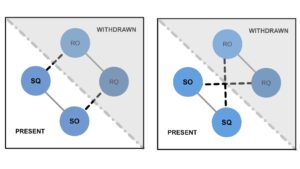
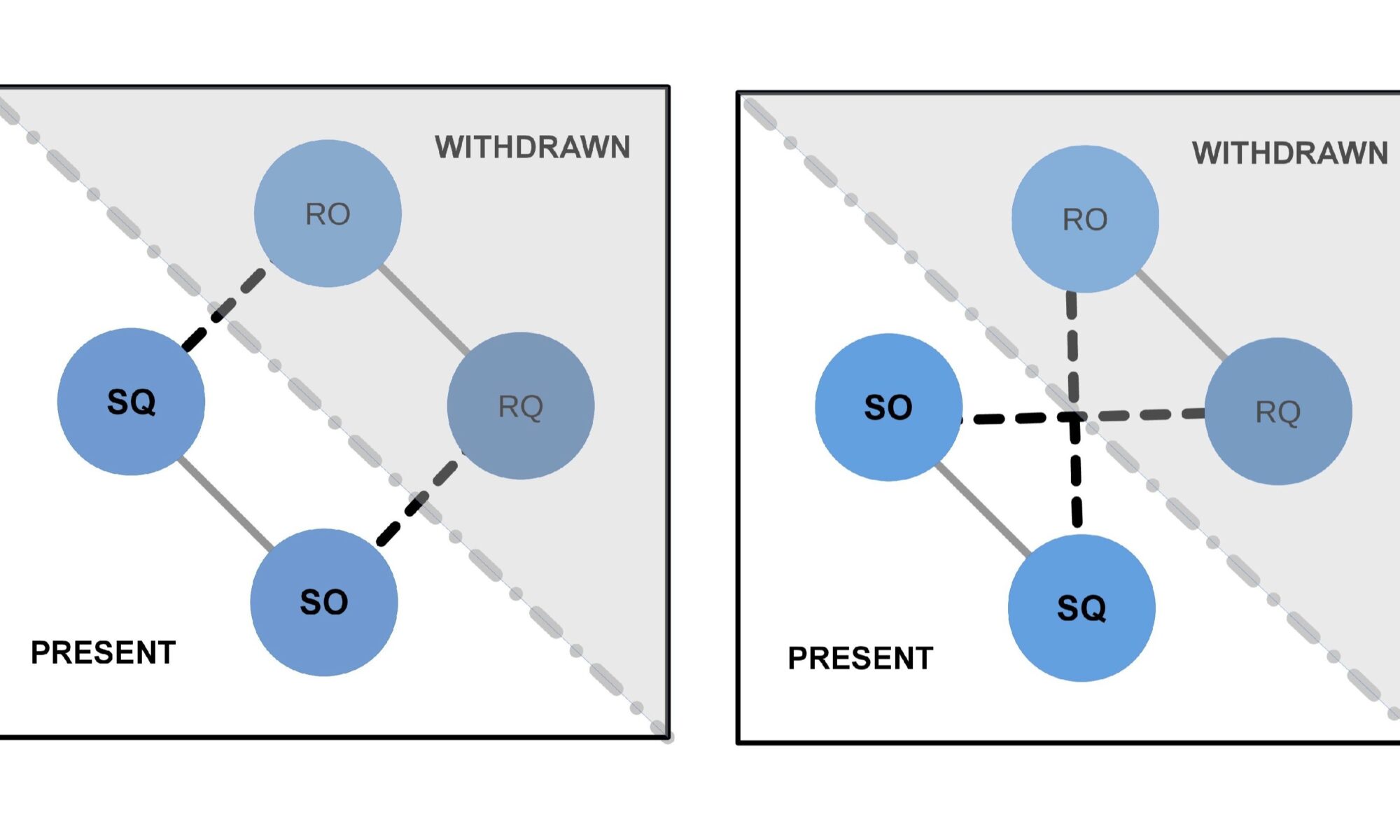
The diagram from my thesis helps to clarify this. The four poles are held apart, with certain relations fixed and others activated. The dashed lines mark moments of tension and movement. The mesotopian event occurs along these lines, where space and eidos interact while time and essence quietly hold their ground.
The mesotopian event happens when I consciously step into this condition. During such an encounter, two tensions remain fixed. Time is fixed because the encounter happens now – not in memory, not in projection, but in the present moment of attention. Essence is fixed because it remains withdrawn. No amount of cleverness will prise it open. It stays put, stubborn and generative.
What does move are space and eidos. I turn the sensual object – the object as it appears to me – through its sensual qualities. I attend to texture, rhythm, tone, association, metaphor. I let intuition lead rather than command. This turning is not analytical in the conventional sense; it is exploratory, almost playful. I am guessing at the object’s withheld essence, fully aware that I will never arrive – and that this is precisely the point.
I describe mesotopia as a place between conceptual and physical terrains. In that in-between space, encounters with objects reveal multiple agents of causation. Meaning is no longer a straight line from subject to object. Instead, it becomes something composed, situated and contingent.
Ultimately, the mesotopian event is an ethics of attention. It asks me to slow down, to resist the urge to dominate experience with explanation, and to trust that which withdraws is just as important as what appears. Meaning, in this view, is not something I extract from the world. It is something that happens between us – briefly, beautifully, and never quite the same way twice.
As always, my a’th kar!
I expand on this post in the following video:
References:
Harman, Graham. (2011) The Quadruple Object, Zero Books.
Verran, Tristan. (2025) Mesotopia: Towards a Place of Lyrical Inquiry. Thesis. University of Plymouth. https://pearl.plymouth.ac.uk/ada-theses/113/