Pride to Arrogance

I’m a word nerd. I always have been. Give me a fancy word and I’ll happily disappear down an etymological rabbit hole. Words aren’t just labels; they often carry complicated philosophies and histories. They tell us how people once felt about things, and sometimes how they still do.

Margate Pride by Jason Pay 2016

Take pride.

We tend to treat Pride – with a capital P – as an unqualified good. It is banners and glitter and rainbows filling the streets. It is colourful defiance. It’s what Aretha Franklin was getting at when she sang about pride as “a deeper love.” After centuries of shame being attached to people who have chosen alternative ways of loving and presenting themselves, pride has been a necessary corrective.

Yet as an emotional state, pride has always been ambiguous. The traditional moralists were not entirely wrong to rank it high among the deadly sins. Not because feeling good about yourself is wicked, but because pride untethered can curdle into arrogance. Push it a little further and you get hubris – an ancient Greek warning sign that someone is about to fall flat on their face.

So let’s unpack my understanding of pride. Too much pride insists that not only am I worthy, but that I am flawless. Not only that my way of loving and living is legitimate, but that it is morally superior. That is the pivot point where something liberatory can harden into something faintly sanctimonious.

The antidote to arrogance is humility. Not humiliation or self-erasure, but the quiet recognition that I am one human among many, and that all of us are fallible.

Living a liberated sex life doesn’t make me a bad person, but it also doesn’t make me a saint. It doesn’t grant prophetic insight or moral authority. It simply means I am navigating the same tempestuous terrain as everyone else: desire, pleasure, guilt, connection, and loneliness. I’m not exceptional; I’m just another awkward mammal – albeit one who can claim a few good songs.

I’ve been thinking a lot about this since reconnecting with friends and colleagues at Margate Pride. The experience has also brought another word to mind: community.

These days all sorts of organisations often brand groups of people with shared interests ‘communities’; the cycling community, the vegan community, the queer community. However, the word originally meant something closer to ‘the common people’ – those who share a place. Not the nobility; not the clergy; just the rest of us muddling through together. When I talk about community cohesion, it’s this older meaning I have in mind.

If we take that definition seriously, grass-roots engagement stops being about curating safe rooms full of ideological twins. Instead, it becomes about speaking to neighbours you might not agree with on everything. It requires enough humility to listen to what people actually say, and to recognise that we probably share more concerns than we assume.

In my experience, stepping outside your comfort zone is surprisingly productive. Most of my conversations with non-LGBT+ people within many communities have been positive. It turns out, the man who loathes ‘woke culture’ is also worried about paying his heating bill. The woman who doesn’t understand why everyone suddenly uses the word ‘queer’ is desperately anxious about her mum’s hospital waiting list.

Material concerns cut across identity in surprising ways.

For example, you might be a trendy queer artist and struggling to pay your rent and bills. Congratulations! You’re just like most people living on your street. You might be fighting for access to life-saving treatment because you’re HIV positive or trans. Most people I speak with are also fighting for access to different forms of life-saving healthcare. When you focus on housing, wages and healthcare you discover common ground, and on common ground, you can build something sturdier than a slogan or an annual event.

The secret to effective community grass-roots organising is no secret at all, it’s just talking with the people who live around you.

Pride got us out of the shadows. Humility might help us grow in the daylight.

As always, my a’th kar.

I discuss this blog in more depth over on my YouTube channel:

Mesotopia: ‘High Weirdness’ Against a Priestly Class.

I have a lingering suspicion that every movement, no matter how exploratory or liberatory it begins, eventually generates its own clergy. The people who explain its meaning to the rest of us. Not the be-robed, incense-and-lace variety (though give it time), but the interpretive class – the ones who assure you that what you think you’re seeing isn’t quite what you’re seeing, and luckily, they have the key. This caste hasn’t vanished; it has simply donned the corporate drag of the professional-managerial class.

Mesotopia, at least as I understand it, refuses that comfort.

If mesotopia is anything, it is the awkward recognition that the world is real – stubbornly real – but never fully available. Objects exceed us. Systems exceed us. Institutions exceed us. Yet each of us possesses the capacity to make meaning through our encounters with the environments we inhabit. And this is the crucial point: that process does not require a priestly caste to mediate it. Partial revelation is not the same thing as authorised revelation.

We live in an age addicted to interpretation. Scroll any feed and you’ll find someone explaining what the data really means, what the conflict really signifies, what the text actually implies. It’s a lucrative posture. It flatters the explainer and infantilises the audience. The message is always the same: the real is too complex for you. Leave it to us.

Mesotopia pushes back.

If meaning happens in the encounter – if it is co-constituted in that charged space between me and what I meet – then no one gets to claim exclusive access to it. The mesotopian event is democratic in the most unsettling way. It insists that you are already implicated in the making of sense. There is no backstage pass.

This is not relativism. The world bites. History happened. Power concentrates. Money moves in very specific directions. But the claim that only a sanctioned cadre can interpret these realities is itself a power move. It is theology dressed up as theory.

You see it everywhere. In academia, it appears as jargon that sometimes functions less as precision and more as initiation rite. In activism, where sometimes a deviation from approved vocabulary can feel like heresy. In politics, where technocrats speak as though code and program were sacred texts decipherable only by the ordained.

Mesotopia requires a certain slowness – a willingness to dwell in encounter. Each experience is turned through association and intuition as we try to understand the environment in which we find ourselves. Yes, the real withdraws. Yes, structures operate beyond immediate perception. But that does not invalidate lived encounter; it intensifies its importance. The fact that we never grasp the whole does not mean we grasp nothing. It means we work provisionally, relationally, in good faith.

A priestly class thrives on the promise of total vision. Mesotopia is content with fragments.

There is something profoundly anti-authoritarian about admitting that revelation is always partial. It levels the field. It allows disagreement without excommunication. It acknowledges that I might hear something you don’t, and you might notice something I’ve missed – not because one of us is enlightened, but because we are differently positioned within the same recalcitrant world.

The danger, of course, is that mesotopia itself becomes doctrine. That someone eventually writes the catechism: “Thou shalt interpret thus.” I can already hear the conference panels.

So let me be clear. This is not a retreat into the political monad, nor a New Age hymn to the sovereign self. We are not isolated atoms floating above our biological or socio-political milieu. Our environments include community, history, institutions and power. Meaning-making happens within those entanglements, not outside them. Nor do I believe in some private enlightenment waiting at the end of sufficient introspection.

Mesotopia is not a ladder to ascend above others. It is a reminder that we are already entangled in something that exceeds us – and that none of us owns the veil.

No robes. No incense. No vestments. No authorised intermediaries.

Just the difficult, ordinary work of meeting a world that will never fully disclose itself – and refusing to let anyone claim exclusive rights to its mystery.

As always, my a’th kar!

I discuss this post in more detail on my YouTube channel:

References:

Davis, Erik. (2019). High Weirdness: Drugs, Esoterica, and Visionary Experience in the Seventies. MIT Press.

Verran, Tristan. (2025) Mesotopia: Towards a Place of Lyrical Inquiry. University of Plymouth Archive.

Mesotopia: Towards a Politics of Partial Revelation

One of the quietly awkward things about Object-Oriented Ontology (OOO) is watching very clever people try to prise a politics out of it without breaking the crockery. Graham Harman tends to sidestep the issue, while Timothy Morton leans into it with a kind of earnest bravado. Morton’s move toward ecognosticism, and the attempt to locate this within a Marxist framework in texts like Humankind, is genuinely interesting. However, it also feels slightly misaligned. Classic Marxism is grounded in class analysis, historically specific struggles, and the evaluation of material and economic exploitation. OOO, by contrast, flattens the ontological field. Everything withdraws. Everything is weird. The risk is that a politics emerging from OOO may be interpreted less as a material project and more as a kind of nihilistic mood that risks favouring apathy over engagement.

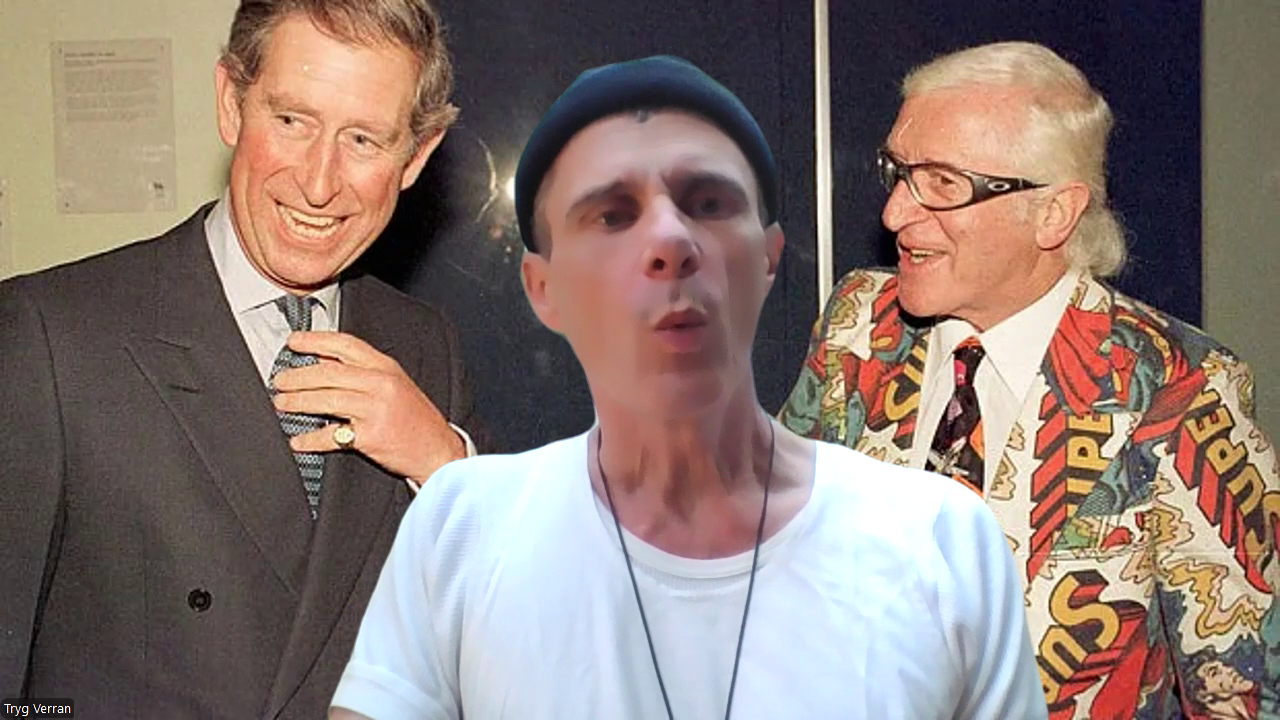
The former Duke of Cornwall with his long-time friend and confidant ‘James’.

I explore this tension more fully in my thesis, Mesotopia: Towards a place of lyrical inquiry, but the short version is this: I admire the effort to push OOO into the political sphere, even when I don’t think it quite lands – and that misfiring is instructive, because it reveals something important about knowledge itself.

While researching the mechanics of mesotopian meaning-making, it became increasingly obvious to me that all research, no matter how rigorous, eventually arrives at a moment of pure conjecture. There is always a moment where the evidence runs out and interpretation takes over. Mesotopia names this space. I live here. We all do, whether we admit it or not. It is a state of partial revelation.

This is not as exotic as it sounds. In fact, it has deep resonances with classic Marxism and even elements of Maoism, where political life is understood to be structurally occluded. Much is withheld – not necessarily because it is illegal, but because it would be politically embarrassing, destabilising, or simply inconvenient if widely known. The very existence of scandals that sit at the periphery of respectable political discourse – such as Operation Gladio or Jeffrey Epstein – points to this condition. Power does not announce itself clearly. Decisions are made elsewhere, in rooms you and I, dear reader, are not invited into, using codes and languages we have not been taught to speak.

My own experiences of working at the fringes of empire have only reinforced my thinking here. I do not know the truth of political machinations at the highest level, but I do know, with absolute certainty, that the general public does not know everything either. This isn’t paranoia. It isn’t fear. It’s political realism.

Often in my research, I return to old-fashioned historical materialist strategies – following flows of money, mapping institutional relationships, noting who funds whom and why. These methods can clarify motivations and alliances that otherwise seem baffling. However, they do not constitute conclusive proof of wrongdoing. Many financial arrangements are perfectly legal. They are simply hidden because they don’t look good under fluorescent light.

This is why I’ve found Erik Davis’s approach in High Weirdness so refreshing. Davis manages to acknowledge the unknown, the speculative, and the unresolved without sliding into mockery or credulity. He takes uncertainty seriously.

I encountered something similar while researching the Cornish language. I plotted the publishing output of writers who have subtly pushed narratives of Baltic and Celtic nationalisms and arrived at a moment of conjecture – why are they doing this? I also didn’t understand why certain groups of people attended some Celtic language meetings. I still don’t. I will never know the inner motives of esoteric groups. Mesotopia teaches me to live with that – not as resignation, but as orientation. Not knowing is not a failure. It is the condition of political life. However, this does not mean that we simply accept ‘not knowing’ as a reason for ‘not doing’. On the contrary, I suggest that a politics of partial revelation encourages us to continue to participate in a project to attend to our local environments even though we cannot possibly know everything.

I can state what I know and intuit what I don’t.

From my research, I observe that industrialists, financiers, and right-wing factions often push nationalist narratives to appeal to the sensibilities of certain minority groups. For what ultimate reason, I cannot know; my intuition, however, is to remain sceptical of their intentions. Partial revelation is the rule, not the exception, and politics begins not with certainty, but with the refusal to be paralysed by its absence.

As always, my a’th kar!

You can follow this link for a video discussion of this blog:

References:
(1) Davis, Erik. (2019). High Weirdness: Drugs, Esoterica, and Visionary Experience in The Seventies. The MIT Press.
(2) Harman, Graham. (2016). Immaterialism: Objects and Social Theory. Polity.
(3) Morton, Timothy. (2017). Humankind: Solidarity with Non-human People. Verso.
(4) Verran, Tristan. (2025). Mesotopia: Towards a Place of Lyrical Inquiry. The University of Plymouth. https://pearl.plymouth.ac.uk/ada-theses/113/

Why Are Some Of The Worst People Suddenly So Concerned About My Cornish ‘Identity’?

I remember the moment quite clearly. Back in 2015, I was part of a scrappy, grass-roots effort trying to understand what on earth had happened to London Pride. I’d started digging into the financials, following sponsorship pages and annual reports, trying to work out how something that once felt unruly, provincial and ours had turned into a vast corporate machine. I wrote about it at the time, half in disappointment, half in ironic detachment (4+5). What struck me wasn’t just the money, but who was supplying it.

Barclays, Citi, big law firms like Baker McKenzie, and polished NGOs with immaculate branding such as Exterion had all been sponsoring London Pride events for several years. At some point, amid the spreadsheets and sponsor logos, I asked a very simple question: why do these people care so much about my sexual orientation? When did global finance decide it was emotionally invested in my being a gay man? I didn’t feel particularly ‘seen’, as the cool kids like to say these days, I felt categorised, monetised and branded (3).

That feeling has stayed with me.

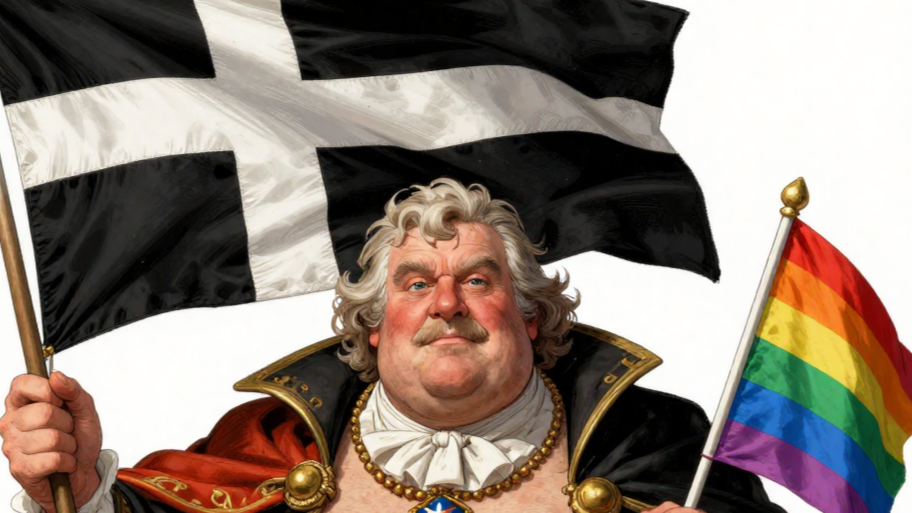
This is roughly what happens when you ask Freepik for a ‘satirical image of a bloaty noble exploiting Cornish and LGBT identities’.

Years later, while researching my PhD on how humans comprehend their environment and articulate that through language, I found myself back in similar emotional territory. I was comparing grammatical features of the two languages of my homeland: English and Kernewek. As I dug deeper into the revival of Kernewek and the cultural discourse orbiting it, the same sensation returned. That tightening in the gut. Why? I thought. Why now? Why, after centuries of neglect, ridicule and outright economic extraction, were some very respectable institutions in the UK suddenly so interested in cultivating a Cornish cultural ‘identity’?

To be clear, I have nothing against LGBT people who pour their time and love into London Pride. Nor do I have anything against Cornish people who work tirelessly to protect Kernewek and explore Cornish culture. I admire the commitment involved in both. This isn’t an attack on grass-roots energy. It’s a plea for scepticism about institutions that have a long, well-documented habit of exploiting grass-roots movements for ends that rarely improve the material conditions of ordinary people.

Here’s the thing – symbolic recognition is cheap. Flags are cheap. Car stickers are cheap. Language initiatives, diversity panels and glossy campaigns are cheap compared to land, mineral rights or meaningful economic redress. If there were serious conversations about who benefits from Cornwall’s land and resources, things might look very different. Imagine if working Cornish people had actually benefited from generations of mining and extraction, rather than watching profits flow elsewhere.

Much of that wealth has continued to flow into multinational corporations. Some large corporations, in general, are known to fund cultural or heritage projects, often as part of wider reputational or social-licence strategies. However, my concern here is not primarily about arts funding, but about extraction and ownership. The Rothschild family, for example, through its company Imerys (formerly Peñarroya), directly profits from Cornish mineral deposits, continuing a long tradition in which the material wealth of Cornwall is extracted while local communities see limited material return (2).

This sits in stark contrast to the symbolic recognition of Cornish culture, such as Kernewek being granted Part III status under the European Charter for Regional or Minority Languages (1). I often find myself asking: would most Cornish people prefer dual-language signposts on every street and road, or would they rather see the profits of kaolin and lithium extraction invested directly into local infrastructure, housing and public services?

What I see is a familiar pattern. Cultural identity is elevated, polished and funded just enough to be celebrated – but not enough to be actually empowered. Difference is encouraged, curated and then quietly weaponised to keep people segmented and manageable. I am deeply suspicious of financial and industrial interests that have held this island, and much of the planet, to ransom for centuries suddenly presenting themselves as champions of minority issues. I do not trust people who have a proven track record of participating in land-theft, exploitation and mass-murder. This is not paranoia; it is historical materialism, grounded in patterns of extraction, enclosure and enforced dependency that are well documented.

I refuse to be separated from my neighbours by each aspect of my identity. I refuse to be further divided and conquered. Yes, I am Cornish. Yes, I am a gay man. But more than that, I am descended from people who have laboured on this island, generation after generation, for the enrichment of a very small number of Mittel European families and their attendant German and Italian banking cartels. This shared material history matters more to me than any corporate badge of recognition ever could.

As always, my a’th kar!

I discuss this blog in more detail in the video below:

References:

(1) Cornwall Council (2026) Cornish language officially granted Part III status. Available at: https://www.cornwall.gov.uk/council-news/environment-culture-and-planning/cornish-language-officially-granted-part-iii-status/ (Accessed: 20/01/2026).

(2) Imerys S.A. (no date) Imerys – Our history. Available at: https://www.imerys.com/imerys-group/our-history/ (Accessed: 20/01/2026).

(3) Pride in London (2015) Sponsor Pride in London 2015. Archive snapshot. Available at: https://web.archive.org/web/20150627020110/https://prideinlondon.org/sponsors/ (Accessed: 20/01/2026).

(4) Verran, T. (2015) “Why we felt the need to bury Pride… #RIPPRIDE #QUEERFIGHTBACK”, Around the world in 80 gays!. Available at: https://tryg-aroundtheworldin80gays.blogspot.com/2015/06/why-we-felt-need-to-bury-pride-rippride.html (Accessed: 20/01/2026).

(5) Verran, T. (2016) “The moment I lost my Pride”, Around the world in 80 gays!. Available at: https://tryg-aroundtheworldin80gays.blogspot.com/2016/05/the-moment-i-lost-my-pride.html (Accessed: 20/01/2026).

Technocrats: High Priests of the Latest Doomsday Cults

In early 2020, I attended a conference put on by tech companies in association with a university in Wellington. The opening provocation was something about preventing public pushback to technocracy. I recall candid questions being exchanged, such as: “How do we stop them from killing us?” That was the tone-setter. Not how do we include people? or how do we serve the public good? but how do we manage the inevitable irritation of the masses when they realise what’s being built for them, rather than with them.

The New Doomsday Cult – Image generated by AI

As the conference unfolded, what struck me most was the paranoia of our self-appointed harbingers of the apocalypse – Bill Gates, Peter Thiel, Marc Andreessen, Jeff Bezos, Elon Musk and their various satellites – as communicated through their acolytes. Beneath the sleek sermons and benevolent rhetoric lies a deep suspicion of the human being. Many of them, and their postulants, appear convinced – after a century of institutionalised technocracy – that the human has become an impediment to progress. There are simply too many people destined for, what Yuval Noah Harari’s calls, the “useless class,” all too fleshy and too fallible to continue serving the sacred pyramid of civilised order. For this divine techno-order to flourish, some necrotic flesh will need to be sacrificed – and no prizes for guessing who that will be.

To hear the tech gurus speculate, often with messianic intensity, on utopian or dystopian futures has been revealing. What appears to be missing from almost all of these visions is people like you and me, dear reader. The human shows up mainly as a problem to be solved; an inefficiency to be optimised away, or a legacy system awaiting decommission. Depending on which esoteric order you belong to, the apocalypse arrives via one of the four horsemen – war, famine, conquest, or death – with the modern add-on of pestilence for good measure. Whatever the mechanism, extinction is assumed. The debate is not if, but how.

From there, the factions emerge. Some devotees of accelerationism argue that we should actively hasten the apocalypse, fusing with technology in order to liberate the human intellect from the messy constraints of the body. This is a rough-and-ready summation of Nick Land’s “Dark Enlightenment,” but it captures the mood: abandon the human form, upload what matters, and let the rest burn. Others imagine a post-catastrophe world of technates – planned communities where survivors are neatly organised and every aspect of life is micro-managed by AI, overseen by a priestly class of ordained engineers.

It all sounds like dreadful pulp science fiction. The trouble is that it’s a fiction sincerely believed by some of the most powerful and influential people on the planet. I see traces of this thinking seeping into policy papers, funding models, research agendas and academic language. Words like “legacy,” “scalability,” and “sustainability” quietly replace older ideas such as curiosity, investigation and lived experience. The human is reduced to a sequence of variables and processes, while faceless systems of governance steadily relegate us to the annals of history.

And yet – here’s where I stay upbeat – this worldview only holds if we accept its premise. It is merely a cult like any other. I refuse the premise that the human is a problem to be solved. We are not a transitional inconvenience on the way to some silicon rapture. We are meaning-making creatures, embedded in places, bodies, histories and relationships that cannot be fully reduced to an algorithm. The real danger of this technocratic doomsday cult is not that it predicts the end of the world, but that it might bring about a world without us in it – not through extinction, but through erasure.

I do not accept that technocratic utopias or dystopias are the only meaningful options for a future that still includes humanity.

As always, my a’th kar!

We Need to Talk About NATO!

Whether we like it or not, people need to start asking some serious questions about what NATO is actually doing – apart from serving, of course, as a ‘peaceful defensive alliance’.

Here’s something I’ve been noticing, behind the slick corporate think-tank presentations and branding, where NATO operates on the ground, there are frequently covert operations, huge propaganda campaigns, coups, assassinations, armed militias running around murdering people, false-flags, mass civilian casualties and – coincidently – US corporations on hand to profit from rebuilding critical infrastructure (1).

Not that most people I have met at NATO conferences seem to be aware of any of this. The type of person you meet at a NATO conference is the kind of mid-wit functionary who believes that Putin has been running the US executive branch since 2015, and that the CIA cares about Queer rights in Iran.

If you’ve read my earlier posts – Why You Should Be Embarrassed to Be Associated with UK News and Is Cornish Nationalism Part of a Broader Strategy of Tension? – you’ll know I don’t shy away from asking challenging questions about power, policy, and influence. NATO seems to echo the role that the East India Company played in the (former) British Empire – it’s a bloated non-governmental institution that meddles in disputes for shareholder profits. The NATO shaped elephant in the room just got more difficult to ignore, and it should be obvious to anyone paying attention that whatever has happened in Ukraine has certainly been facilitated in large part by NATO.

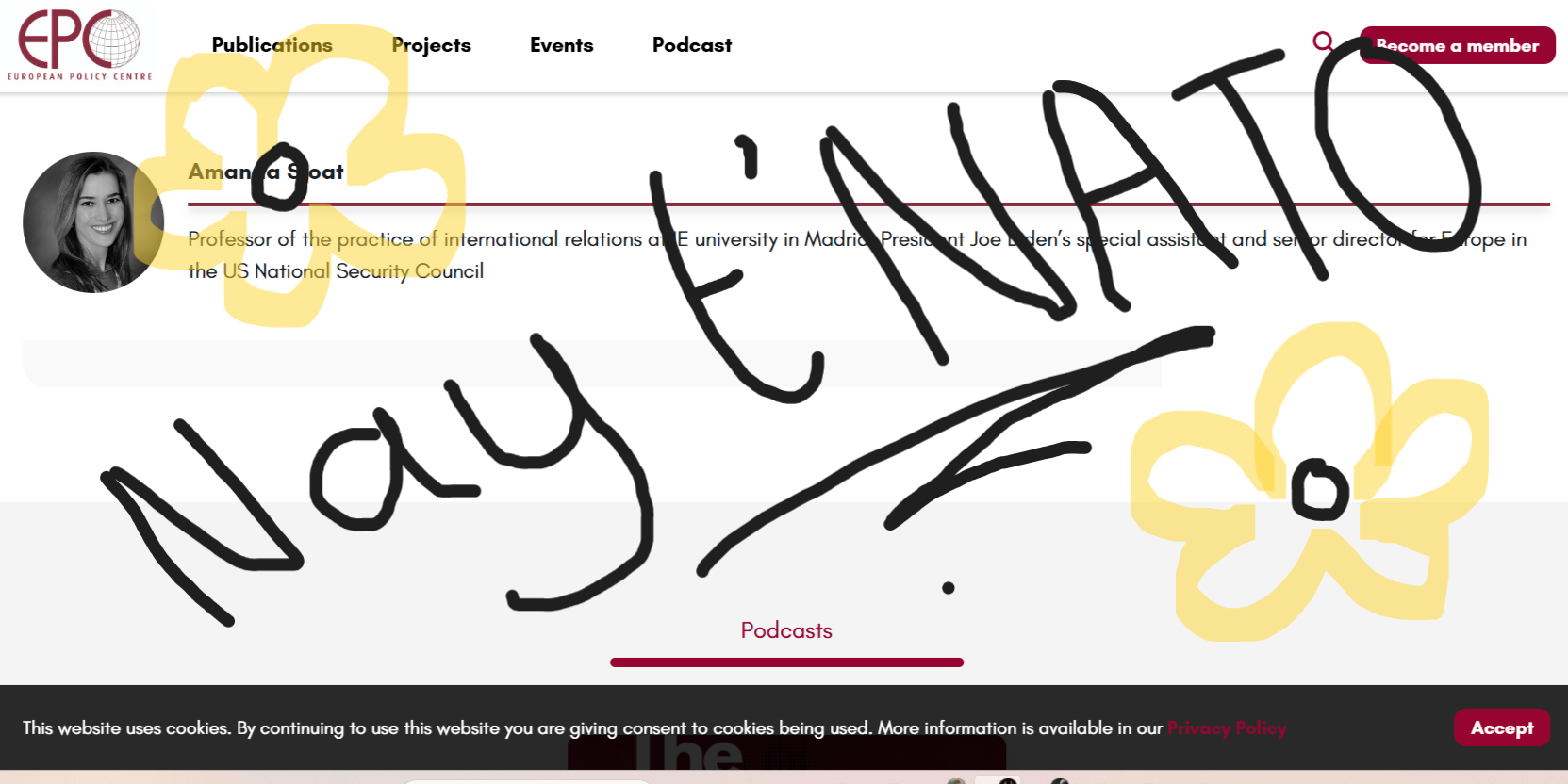
Amanda Sloat, who was Biden’s top Europe strategist on the U.S. National Security Council, let slip in a candid moment that what Western policymakers allowed to happen with NATO and Ukraine helped make this devastating war possible. She said that if Ukraine had clearly told Russia it would not join NATO – or if U.S. and UK envoys had advised Ukraine to drop that aspiration – this “may well have prevented the destruction and loss of life” we’ve witnessed over the past three years (2).

Not that this is news to anyone with the slightest understanding of NATO’s – uh, shall we say “colourful” history. To be clear: Sloat’s revelations are coming from a conversation with pranksters posing as Ukrainian officials, and yes, it’s apparent that while Amanda Sloat has served as an administrative functionary, she seems blissfully unaware of the gritty underside of NATO operations. But here it is, proof that Western policymakers considered explicitly ruling out NATO membership for Ukraine, and then decided against it. That decision, Sloat implies, might have made all the difference (2).

So let’s unpack this.

For years, people who said NATO expansion was reckless – especially into Ukraine – were shouted down, called “conspiracy theorists,” or worse, accused of being “Kremlin puppets.” This isn’t fringe commentary any more (not that it ever was) it’s an admission from inside the policymaking apparatus. Sloat just admitted, off the record, that maybe it was a strategic misstep. I’m going to go out on a limb here and suggest that it wasn’t a strategic misstep at all, because chaos, fear and destruction seem to be the common outcomes of all NATO interventions. It’s almost like this chaos is the strategy – some wily conspiracy theorists might call this a strategy of tension! It’s hard to know precisely what NATO is doing, so much of their activities are mired in deep reservoirs of PR bullshit and think-tank wonk. A lot of this requires faith and devotion. People are obliged to trust an opaque organisation that seems to operate without any meaningful oversight or accountability – I’m not going to do that. How many people have to die before we really start to get an honest look at what NATO has been doing for decades?

My personal experience of being on the fringes of empire – where NATO operatives have a documented history of proactively employing the services of some groups who we’re all supposed to fear – reminds me that power without accountability is dangerous. Does anyone believe that NATO had nothing to do with overthrowing Assad and installing a member of al-Qaeda and ISIS as its newly besuited Israel-friendly ruler? I mean, I don’t pretend to know everything about the middle-east, but surely anyone looking at how this fucking scumbag al-Julani is now being paraded around the halls of ‘respectable’ Western governance like a hero can see this is an utterly shameless PR campaign (3). Whether it’s the Balkans, Afghanistan, Iraq, Libya, or now Ukraine, NATO’s footprint has always left debris in its wake – but of course, as we have always been told, it’s just a ‘peaceful, defensive alliance’.

As always, my a’th kar!

References:

(1) Wadhams, N. (2025). BlackRock’s Larry Fink Joins Trump Team Talks to Rebuild Ukraine. [online] Bloomberg.com. Available at: https://www.bloomberg.com/news/articles/2025-12-10/blackrock-s-larry-fink-joins-trump-team-talks-to-rebuild-ukraine [Accessed 17 Dec. 2025].

(2) Big News Network.com. (2022). Ukraine could have avoided conflict with one key step – ex-Biden adviser. [online] Available at: https://www.bignewsnetwork.com/news/278749126/ukraine-could-have-avoided-conflict-with-one-key-step-ex-biden-adviser?utm_source=chatgpt.com [Accessed 17 Dec. 2025].

(3) Proletarian TV (2025). The sad downfall of the Syrian government. [online] YouTube. Available at: https://www.youtube.com/watch?v=rHdIDWKuQM8 [Accessed 20 Dec. 2025].

Demystifying The Kernewek Language

I have argued in Mesotopia: Towards a Place of Lyrical Inquiry (1) that yes, there is a real world, but no, it does not open itself to our complete comprehension. We are always half-in, half-out of its meanings, fumbling toward the real but never quite gripping it. This weird middle place – a mesh of physical and conceptual terrains – is the domain of the meaning-makers. The poets, the oracles, the interpreters of signs have historically been quite happy to hide their operations behind opulent rituals or clever distractions. But does it have to be this way? My lyrical work has long been an effort to demystify poetics and language, to free these communicative events from the dictates of esoteric schools and elite fraternities who still treat language as a proprietary ritual.

Naming, after all, has long been the preserve of priestly classes: the magi, the monks, the keepers of alphabets and incantations. In many religious orders, “the Word” is not just a tool but a cosmological foundation – articulation itself becomes sacrament. And once you take this seriously, it becomes impossible not to notice how incantations, chants, spells, prophetic mutterings and other religious-poetic forms lean heavily on the idea of language as conduit to hidden truths. This is the vatic, the mantic, the magical dimension of poesis, the belief that words do not merely describe the world but summon, shape, or invoke it.

Modern linguistics attempts to scrub all this clean. Structuralists, post-structuralists, cognitive scientists, psycholinguists; they all gather with laboratory-grade detachment to “demystify” language production. This is good in theory. But if you ignore the presence of mystery altogether, you’re not demystifying anything. You’re merely tucking your priestly robes into your slacks and hoping nobody notices the ancient hems. Many materialist linguists strike me as devout priestly magi decked out in secular boardroom drag. Here’s one of the many unspoken secrets of our supposedly rational institutions: even empirical research often rests on vast scaffolds of speculation. Each irrefutable graph serves as an article of faith – it’s an ‘educated guess’ berobed as a principle.

This is why it is difficult to determine how many theoretical schools are engaged in re-mystifying the archive of human knowledge – although some hide in plain sight. Even Tim Morton, spear-heading investigations into the ecological implications of object-oriented ontology, is overt about (eco)gnostic leanings.

Consider the accelerationists (2): the former CCRU crowd who hallucinated Deleuze and Guattari into a cybernetic fever dream, pushing symbolism to liturgical extremes. Their rapid decoupling of meaning from symbol, in pursuit of some machinic singularity, often sounds to me not unlike kabbalistic numerology or ecstatic glossolalia. It is not insignificant that many modern tech-titans are devotees of Nick Land. Listen to the quasi-prophetic ramblings of Peter Thiel or Marc Andreessen as they speak of merging symbolic and material terrains; you will hear the cadences of a neo-cult, not a scientific proposal. Meanwhile, various deciples of the structuralists continue to worship The Corpus Linguistic with devotional intensity. ‘and the Word was God,’ they seem to say – and seemingly never notice they are mimicking devotees of Thoth, Hermes or even John 1:1 .Once again, the priests return, this time wearing the unbuttoned casuals of liberal intelligentsia.

In contrast, I often return to etymology, a much subtler way of demystifying meaning. Not by banishing mystery, but by acknowledging its layers. English gives the game away easily: most of our “proper” vocabulary is padded with Greek and Latin. The professional-managerial classes (PMC) learn just enough of these roots to keep the bloated machinery of liberal institutions functioning. Autobiography: self-life-writing. Philosophy: love-of-wisdom. Nothing mystical, only inherited structure.

When we apply the same etymological pressure to Kernewek, interesting stories surface. Pysk, the Kernewek word for “fish,” appears to descend from Latin piscis. This aligns with what Celtic linguists tell us: the Brythonic languages had more prolonged contact with Roman, Norman, and Saxon cultures than their Goidelic cousins. History leaves fingerprints on phonemes.

Or – and here’s a mischievous alternative – it suggests that one of the more “colourful” characters in the history of Kernewek revivalism simply inserted Latin or Greek terms (along with Welsh and Breton borrowings) to fill lexical gaps. The line between linguistic evolution and linguistic invention is not always tidy.

On page 76 of my thesis, I discuss Linguist Professor Price’s uncompromising position: Cornish is dead, he insists, and modern “revivals” are “partially invented” (Price, 1984: 134). He writes:

“The Old Celtic speech of Cornwall died out two centuries ago. It is still dead, and will evermore remain so… The present century has seen the propagation by a small band of enthusiasts of a type of language that is partially derived from the old Celtic speech of Cornwall, but it is also partially invented… I shall reserve the term Cornish for the genuine language and refer to the modern pseudo-Cornish as Cornic.”

I do have issues with Price’s framing. As I wrote:

“What is involved in inventing a language? What is a pseudo-language? What does a ‘genuine’ or ‘authentic’ Kernewek sound like? I remain confused by the extent to which Price uses terms such as authentic, genuine, and pseudo in relation to Kernewek.” (Verran, 2025: 76)

Whether or not one accepts Price’s verdict, the point stands: Kernewek should be preserved and spoken as a breathing archive of our past, not re-engineered as an esoteric tool of ethnonationalism. We know too well what can happen when fringe political movements revive ancient languages to manufacture legitimacy. And it doesn’t surprise me that Celtic circles frequently attract a plethora of esoteric characters: Zionists, Catholic Religious Orders, Rosicrucians, Masons, New-Age Druids, Shamans or Wiccans – all projecting mystical significance onto minority languages. Why this conviction that certain tongues contain secret indigenous wisdom? Romantic nationalism, folklore, and the Arcadian fantasy of an unbroken Celtic lineage have all fed this impulse.

The more I learn about figures like Iolo Morganwg or Robert Morton Nance – who seem to have consciously cultivated a priestly order of Celtic mystics modelled on Julius Caesar’s accounts of ancient Britons – the more frustrated I become. We don’t need to live inside the art projects of eccentric artists or poets – and yes, that includes me! Trust me, we definitely shouldn’t live inside anything I create.

As a poet, I enjoy bending language into unorthodox shapes. I fabricate littoral places inside my verse, places that shimmer and sometimes misbehave. But I do not belong to the mystery schools of modern priestly classes, who still seem intent on fabricating material realities for entire populations to inhabit according to the whims of neo-feudal aristocrats or digital landlords.

For me, the mystery is not something to eradicate but something to remain in dialogue with. I continue to wrestle with the languages I have inherited. I am consciously rejecting past myths or Arthurian tropes all too often associated with Celtic languages. Through lyrical poetry, I keep listening – probing the metaphysical uncertainties that Kernewek, in all its contested life and afterlife, continues to stir.

As always, my a’th kar!

All References Available From Verran, 2025:

(1) Verran, T. (2025) Mesotopia: Towards a Place of Lyrical Inquiry. Thesis. University of Plymouth. Available at: https://doi.org/10.24382/nv45-pk79

(2) Monoskop.org. (2017). Cybernetic Culture Research Unit – Monoskop. [online] Available at: https://monoskop.org/Cybernetic_Culture_Research_Unit.

Sober Talk: The Politics of Fun. Written at/ with/ for Pattaya 2025

When I first became sober eleven years ago, the line I heard most often from old drinking companions was: “You used to be so much fun!” At first, I honestly believed them. Yes I used to be fun. I had been a spirited drunk, the first on the dance-floor, the man who could stretch a mildly amusing anecdote into a raucous tale of comedic exaggeration. There I was, the very embodiment of a boozy raconteur fun distilled into human form.

That’s what I told myself, anyway.

The truth was: I was deeply unhappy. I used revelry as a way to mask the creeping recognition of malignant trauma. I believed that fun was performance: the loud laugh, the daring dare, the clever comeback. Fun was something manufactured, something flung outward as distraction. It wasn’t until I stopped drinking that I recognised just how much emotional labour had gone into appearing fun, and how little joy I had actually experienced.

In day to day life, sobriety gets interpreted as accusation. People don’t tend to hear “I don’t drink,” they hear, “I disapprove of your drinking.” They don’t hear choice – they hear judgment. How do we talk about things that aren’t conventionally regarded as ‘fun’ without sounding like pious pricks?

Here’s something I’ve slowly come to understand: the politics of fun is fundamentally about not noticing. I’m not just talking about ‘drunk’ fun either – so much fun is learning how to switch off noticing certain things. It’s a conspiracy of selective blindness. Alcohol helped me blur the boring, soften the painful and gloss over the inconvenient. Sobriety, on the other hand, is the opposite of that. Sobriety is noticing – often against your will.

When I stopped drinking, the world sharpened. I suddenly noticed that A+E departments weren’t mysteriously chaotic on Saturday nights – they were flooded with intoxicated people who had fallen, crashed or fought. I noticed that many of the people I had grown up with – perfectly average ‘social drinkers’ – might more honestly be described as functioning alcoholics. I noticed how many relationships quietly revolved around the highs and lows of alcohol use. I noticed that behind many of the funniest people I knew lurked deep wells of avoidance, anxiety, grief and violence.

Alcohol was the soft-focus filter on reality. By removing it, reality became uncomfortably clear.

This great ‘noticing’ I have been continuing to experience has not been limited to the effects of substance misuse. No, it has affected me on a profoundly personal and political level. I started to notice that most of the things we buy or use are mined, farmed or produced by an invisible underclass of peasants. That’s not fun. I started to notice that so much of the world is actually built by slave or exploited labour – that’s not ‘fun’ either. I also started to notice endless war machines producing millions of displaced people wandering the world looking for sanctuary – so I volunteered to work in refugee camps. That, my friends, is definitely not fun.

So what can we do? You can’t just demand that everyone stops having fun any more than you can dictate what is or isn’t fun. I don’t have the answer. The problem is – so much of life for so many people just isn’t fun. In order to have fun, you have to not notice the trafficked people building your ‘wellness holiday retreat’ or serving your wine. You have to not notice that the economic heart of so much fun is that someone somewhere is losing out.

Now, before anyone feels judged – let me be clear: I don’t care what people choose to do with their bodies, their evenings, or their holidays. I don’t hold some puritanical moral high ground. I don’t deliver sermons. I am not the ghost of Christmas Temperance. I choose sobriety because I like it. I like noticing things. It suits me.

I’ve been trying to balance ‘noticing’ with ‘fun’ and believe that I’m much more fun now than I was as a drunken jester. My attention is real. My presence is not performance. Unfortunately, some of my former drinking buddies disagree – chiefly because I no longer serve as supporting cast in the theatre of their intoxication, but that’s just the way it is now – I can’t go back to ‘not noticing’.

It’s actually really challenging for me to live in the UK, given that so much of UK life revolves around substance misuse and existing in a state of ‘not noticing’. Fun now – for me – is clarity. It’s noticing. It’s connection. It’s feeling it all rather than numbing it away. And if that makes me “no fun” to the still-blurred, then so be it. I’d rather notice.

As always,  my a’th kar!

Is Cornish Nationalism Part of a Broader Strategy of Tension?

The Cold War term ‘strategy of tension’ precisely describes how a deliberate cultivation of fear, division, and polarisation maintains strict political control over entire populations. Nowhere was that logic more clearly institutionalised than in Operation Gladio, the clandestine stay-behind network exposed in western Europe during the early 1990s. The revelations of Gladio, examined in detail by the European Parliament in 1990 (1) and subsequent Italian parliamentary inquiries, demonstrated that NATO-linked structures funded and trained secret paramilitary cells that engaged in manipulation of political life, propaganda, and acts of terrorism designed to discredit left-wing organisations.

The Gladio inquiries confirmed that such networks were real, coordinated through the Clandestine Planning Committee under NATO auspices, and operated without meaningful democratic oversight (1). The absence of accountability remains instructive: if the alliance could sustain covert political operations for decades throughout western Europe, which included false-flag terror attacks that killed hundreds of citizens, why would anyone, conservative or liberal, not believe that such groups would be capable of carrying out similar operations today?

Furthermore, while researching my thesis I had the feeling that something about the push for Cornish nationalism was off, but I couldn’t quite articulate why I felt like that. Most people I have met who advocate for an independent Cornwall are sincere in their beliefs; however, I detect underlying inconsistencies about what such a nationalist project entails.

When I first read The Last of the Celts (2006) by Marcus Tanner (4), I recall being delighted by its seemingly objective view of Cornish life which resonated with my own politically naïve rural upbringing. It presented the Cornish nationalist movement as well-meaning but misguided in its desire for an independent Cornish nation. The Last of the Celts seemed at odds with Tanner’s earlier work in service of NATO in which he had written of how a cultural revival of Illyrianism and Croatian independence could serve as a vehicle for anti-communist and pro-NATO state projects (5 – 6). As a more conservative commentator, I wondered why he hadn’t presented Cornish independence in a more positive light.

In 2008, Peter Tatchell weighed in with a Guardian article on Cornish devolution which, perhaps unintentionally, fits within Tanner’s Illyrian pattern (7). Framing Cornwall’s cultural revival—its language, economic neglect, and sense of distinctiveness—as grounds for autonomy, Tatchell advanced a civic, human-rights vocabulary of recognition. While ostensibly being anti-NATO, I can’t help noticing that Tatchell often highlights the human rights abuses of NATO’s enemies and therefore subtly re-enforces NATO soft-power.

It is still unclear to me what is meant by the term ‘Cornish Nationalism’. Ask a Cornish nationalist what they mean by Cornish nationalism, and you will get answers that range from the establishment of a homeland for a protected ethnic minority (8), to a collection of qualities that anyone who wishes to can simply adopt. Which is it? Over the course of my research, I have met conservative people who welcome foreign investment to support their status as an ‘ethnic minority’ and left-wing people who don’t want to talk about international class solidarity but would rather work on their spiritual connection to the land. I guess Cornish nationalism is shorthand for a political movement devoid of any principles – it’s essentially whatever you want it to be.

While I cannot prove any Gladio-like covert operation to cultivate this confusion, Cornish nationalism does appear to me to be a convenient way to divert attention away from legitimate critiques of economic disenfranchisement. Such covert operations in the UK are not new. There is plenty of evidence of state infiltration and manipulation of political movements and I encourage readers to follow the ongoing ‘Spycops’ inquiry (9) which documents the shocking lengths to which clandestine state actors will go to infiltrate and manipulate any grass-roots political group vaguely critical of state power.

There are three main reasons why I think Cornish nationalism exhibits qualities akin to a strategy of tension:

1. Fragmentation of Class Solidarity.
In the 1970s and 1980s, Gladio sought to prevent left-wing unity through the creation of internal enemies. Today, the divisions are stoked through the cultivation of increasing ‘identities’. As such, Cornish, Welsh, or Scottish nationalisms re-localise political energy, dividing workers who share economic conditions into segregated cultural blocs.

2. Cultural Channels of Influence.
Where Gladio used paramilitaries, the contemporary state and its allies use funding streams. NATO’s Science for Peace and Security programme, EU cultural grants, and UK regional-resilience projects engage universities, NGOs, and local councils. These initiatives are transparent and lawful, yet they replicate the same institutional geometry: money and legitimacy flowing from transnational power centres into local intermediaries that serve a global neo-liberal politic.

3. Manufactured Instability and Managed Resolution.
A mild level of cultural tension can be politically useful. It sustains the narrative of diversity and democratic pluralism while justifying ongoing engagement by central authorities and security institutions.

Celtic nationalism’s re-emergence within neoliberal Britain functions as both instrument and symptom of capitalist crisis. Deindustrialisation and austerity have hollowed out working-class organisation. Into that void steps cultural revivalism—a politics that offers recognition without redistribution. The Cornish worker, stripped of collective power, finds symbolic compensation in a flag and a revived language.

Antonio Gramsci’s notion of passive revolution is instructive here: the ruling order absorbs elements of popular culture to prevent revolutionary rupture (15). Cornwall’s identity politics, when funded and validated by state and supranational agencies, represents precisely this absorption. It channels anger into manageable narratives of heritage, tourism, and local governance—harmless to capital and convenient to the geopolitical architecture that sustains it.

To invoke Gladio is not to allege bombs beneath Bodmin Moor. It is to recognise that the form of power—its reliance on fragmentation, on fear, on the management of identity—has endured even as its methods have evolved. What has changed is the medium: from covert armies to cultural partnerships, from false-flag violence to discourse management. The strategy of tension has been civilised, bureaucratised, normalised.

Cornish nationalism, like its Celtic counterparts, is sincere, creative, and rooted in genuine grievance. Yet it also illustrates how culture can become an instrument of governance. The historical record of Operation Gladio reveals the capacity of NATO and its affiliates to shape domestic political environments in service of maintaining economic control (10-14). The current celebration of Celtic identity performs a similar ideological function: it fragments working-class unity, redirects discontent into heritage, and sustains the hegemony of the transatlantic order.

As always…

My a’th Kar!

References:

Primary & Institutional Sources

1. European Parliament (1990). Resolution on the Gladio Affair. European Parliament’s 1990 resolution (A3-205/90) Official Journal of the European Communities, C324/201.
— Documents the exposure of clandestine NATO-linked “stay-behind” networks operating in Western Europe during the Cold War.
[Available via European Parliament archives]

2. UK Ministry of Defence. Joint UK–NATO Training Exercises: Annual Reports. (Various years 1995–2023).
— Provides information on joint exercises in South West England, including Cornwall, showing the region’s strategic military role.
[MOD Open Data & Defence Committee reports]

3. Council of Europe (2014). Framework Convention for the Protection of National Minorities: United Kingdom Compliance Report.
— Recognises the Cornish as a national minority, illustrating institutional support for regional cultural identity.


Secondary Literature: Tanner and Cultural Nationalism

4. Tanner, Marcus (2003). The Last of the Celts. Yale University Press.
— Explores cultural revival movements across Celtic regions and their political resonances in the late 20th century.

5. Tanner, Marcus (1997). Croatia: A Nation Forged in War. Yale University Press.
— Examines how cultural and linguistic revival were instrumentalised during post-Soviet transitions in the Balkans.

6. Tanner, Marcus (1990s). Articles for Balkan Insight and related NATO-aligned think tanks.
— Promoted narratives of national self-determination as part of post-Communist democratisation discourse.
[See Balkan Insight archives, c.1995–2001]


Media & Civic Commentary

7. Tatchell, Peter (2008). “Cornwall’s Case for Self-Government.” The Guardian.
— Argues for devolved governance and recognition of Cornish cultural identity within a human-rights framework.
[Available on The Guardian archive]

8. BBC News (2014). “Cornish People Granted Minority Status within the UK.”
— Confirms the official policy shift recognising Cornish distinctiveness.

9. Ongoing ‘Spycops’ Case. (n.d.) Undercover Policing Inquiry: Official Website. [online] Available at: https://www.ucpi.org.uk/


Academic and Analytical Works on NATO and the ‘Strategy of Tension’ 

10. Ganser, Daniele (2005). NATO’s Secret Armies: Operation Gladio and Terrorism in Western Europe. Frank Cass Publishers.
— Scholarly investigation into the historical structure of Gladio and its use of controlled instability for political effect.

11. Kaldor, Mary (2006). New and Old Wars: Organised Violence in a Global Era. Polity Press.
— Analyses how modern warfare and alliances use identity politics to maintain control in post-industrial societies.

12. Harvey, David (2005). A Brief History of Neoliberalism. Oxford University Press.
— Provides the Marxist foundation for understanding how decentralised nationalism can serve to fragment the working class under neoliberal regimes.

13. Anderson, Benedict (1983). Imagined Communities. Verso.
— Foundational text on how national identities are culturally constructed and politically mobilised.

14. Monaghan, Andrew (2017). Power in Modern Europe: NATO, EU and Russia. Manchester University Press.
— Discusses NATO’s post–Cold War soft power strategy and civil-society engagement mechanisms.


Theoretical & Marxist Context

15. Gramsci, Antonio (1971). Selections from the Prison Notebooks. Lawrence & Wishart.
— Introduces the concept of cultural hegemony, crucial for understanding NATO’s ideological influence.

16. Hobsbawm, Eric & Ranger, Terence (eds.) (1983). The Invention of Tradition. Cambridge University Press.
— Explores how cultural symbols are consciously re-engineered to serve political ends.





Why You Should be Embarrassed to be Associated with UK News

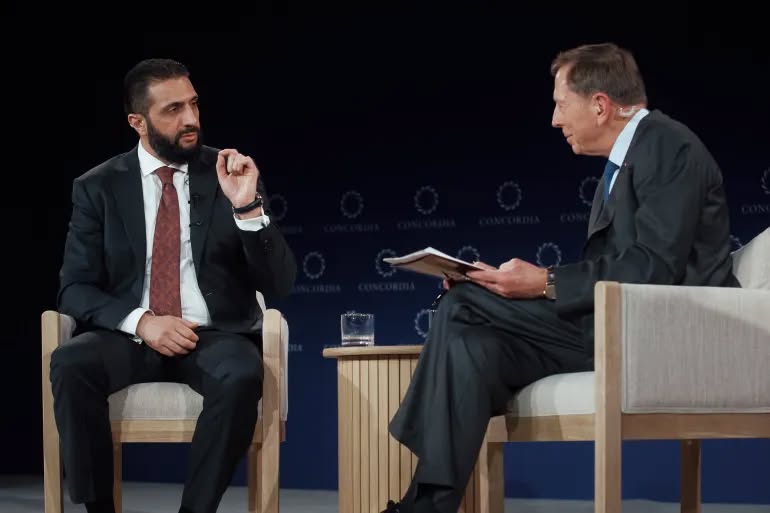
I’m a pretty calm and collected human these days, but when this image by Andres Kudacki for AP dropped into my inbox, my brain immediately broke.

President al Sharaa and David Petraeus (1)

I had been working in different countries for universities as well as with people displaced from various conflicts seeking refuge from (mainly) Iraq, Syria and Palestine. When I returned to the UK, I recall having very awkward conversations with former colleagues of mine who still worked in (quote/unquote) “news” rooms… I remember being called a ‘crank’ for suggesting that the ‘moderate rebels’ who were being supported by various factions of the US empire were actually al-Qaeda and ISIS. People I had met, including Europeans and Israelis, were certain that these ‘terrorist’ organisations were created by the CIA and were supported by NATO, Saudi and Israeli contingents in order to destabilise the region. It wasn’t until 2017 that I started to hear details of a covert operation called ‘Timber Sycamore'(2) which alluded to what I had heard overseas and had been repeating at home.

Hence my broken brain at seeing this picture of the former general and CIA director David Petraeus, sitting there with the member of al-Qaeda and founder of ISIS, who is the now ‘President’ of new and improved, Israel friendly Syria.

Basically, and it should be obvious to everyone, the ongoing tactic of US empire is to create a violent enemy (ISIS, Hamas etc) to serve as a pretext for regime change in order to steal land and resources for a few Mittel-European industrialists and financiers, while UK media institutions generate the cover story. I understand that the internet is full of unverifiable information, right now, it is the only place to access content vaguely critical of US foreign policy. The job of all UK media institutions, including the hallowed Beeb,  is not to inform the general public, but to lie to us. To work in UK media right now, you have to either not know this fact or not care  – either way, nobody should take you seriously.

It doesn’t matter whether you consider yourself ‘left’ or ‘right’, when it comes to trying to discuss anything of real political substance in the UK, most of the time you are arguing over vapour.

I generally keep my mouth shut in most social situations these days; however, the propaganda is so pervasive it’s impossible to avoid even though I don’t have a TV or buy newspapers. I go to the gym and 6-Music is playing and it’s giving 6 bullshit headlines every hour and I think to myself – why on earth would any edgy music artist or DJ want to be associated with any of this?

There’s a point where polite criticism becomes complicity, and when it comes to UK media institutions, that line was crossed decades ago. Today, any attachment to the British press—be it BBC, The Guardian, The Times, or the tabloids—should be a source not of pride or professionalism, but of embarrassment. Why? Because these institutions have consistently failed in their most basic duty: to provide reliable information. I have to ask, is anybody even slightly embarrassed about working at these places?

Take US foreign policy. The record of UK reporting is not one of minor slips or excusable oversights. It is a litany of cowardice and distortion. From Iraq to Afghanistan, from Libya to Syria, the role of the US in destabilising entire regions has been softened, downplayed, or outright rewritten by UK outlets desperate to look ‘serious’ while staying within the boundaries of Washington consensus. When George W. Bush and Tony Blair lied Britain into war, the press marched behind them waving the Union Jack, then quietly shuffled away from accountability once the blood was spilled. The Chilcot Report confirmed what dissenters had said all along—yet by then, who in the press was left with the credibility to confront their own failure?

The same pattern plays out with NATO. Supposedly a defensive alliance, NATO’s history has been one of training extremist terror groups, expansion, provocation, and military adventurism dressed in humanitarian clothing. From the Balkans to Libya, NATO operations have been presented in the UK media as clean interventions to protect civilians, rather than as power plays that leave countries shattered and millions of lives ruined (3). Despite all of this, the mainstream line remains the same: NATO good, NATO necessary, NATO the last bastion of civilisation. The most terrifying thing about all of this is that most people in the UK just accept these lies uncritically. Even the ‘radical’, trendy people continue to turn on the BBC, buy their ‘Radio One Glastonbury’ ticket and participate in the piss-poor theatre of brain-dead content that is ‘rOcK’n’RoLL’.

And then there’s Israel. Where do we even begin with that? Have we finally reached the point where we are allowed to discuss reality yet? I don’t know, I don’t have a TV. The UK press still seems desperate to avoid hurting the feelings of a few neurotic boomers, but I think that strategy has failed. According to YouGuv polling (4) people are thankfully questioning the ‘official’ narrative. Despite the endless manipulation of facts, the mounting evidence of crimes against humanity cannot be ignored. Jewish people from across the political spectrum, from all around the world are outraged by the atrocities being committed in their names and I would encourage you to seek out the work of people like; Norman Finkelstein, Max Blumenthal, Katie Halper, Matt Bernstein, Aaron Mate, as well as the chaps over at ‘Due Dissidence’ (5).

Foreign policy is domestic policy. The perpetuation of these lies regarding foreign policy is essential for maintaining domestic control, which is why UK citizens can never vote against US Empire, Neoliberal financial institutions or NATO. Regardless of whether we consider ourselves conservative or liberal, none of us are free in the UK to discuss the obvious truth about what US empire has been doing all around the world for decades. Personally, I can never respect anyone who works in mainstream news media and I strongly encourage anyone reading this to do the same. Turn them off, tune them out and always assume they are lying to you.

As always,

My a’th Kar!

I discuss this post in more detail in the following video:

References:

(1) Motamedi, M. (2025). Syrian President al-Sharaa sits down with US general who arrested him. [online] Al Jazeera. Available at: https://www.aljazeera.com/news/2025/9/23/syrian-president-al-sharaa-sits-down-with-us-general-who-arrested-him [Accessed 28 Sep. 2025].

(2) Hackett, J. (2025). Covert Action in Irregular Wars: Unraveling the Case of Timber Sycamore in Syria (2012-2017). [online] Available at: https://www.researchgate.net/publication/394277022_Covert_Action_in_Irregular_Wars_Unraveling_the_Case_of_Timber_Sycamore_in_Syria_2012-2017.

(2), Wikipedia. (2022). Timber Sycamore. [online] Available at: https://en.wikipedia.org/wiki/Timber_Sycamore.

(3) Glenn Diesen (2025). Daniele Ganser: NATO’s Dirty Wars – The Legacy of Operation Gladio. [online] YouTube. Available at: https://www.youtube.com/watch?v=3tcbrG8eG88 [Accessed 28 Sep. 2025].

(3) MintPress News (2023). The CIA, NATO and the US Empire with Aaron Good. [online] YouTube. Available at: https://www.youtube.com/watch?v=bQPUBv_YC0A [Accessed 28 Sep. 2025].

(4) Smith, M. (2025). British attitudes to the Israel-Gaza conflict: July 2025 update. [online] Yougov.co.uk. Available at: https://yougov.co.uk/international/articles/52694-british-attitudes-to-the-israel-gaza-conflict-july-2025-update.

(5) Norman Finkelstein. (n.d.). Norman Finkelstein. [online] Available at: https://www.normanfinkelstein.com/.

(5) The Grayzone. (n.d.). The Grayzone – Investigative journalism on empire. [online] Available at: https://thegrayzone.com/.

‌(5) YouTube. (n.d.). Katie Halper. [online] Available at: https://www.youtube.com/channel/UCUsMkDtVyel9USjCTaM42rw [Accessed 28 Sep. 2025].

(5) matt bernstein (2025). The Antisemitism Panic. [online] YouTube. Available at: https://www.youtube.com/watch?v=0S_z0i6SR2E [Accessed 3 Jun. 2025].

(5) YouTube. (n.d.). Due Dissidence. [online] Available at: https://www.youtube.com/channel/UC743NEuMiqYOaUHO4oPhI2Q [Accessed 28 Sep. 2025].