
I often begin by saying that my approach to meaning-making differs sharply from the purely materialist assumption that ‘there is a real world and it can be known’. The mesotopian position, by contrast, begins from the more unsettling but, I think, more honest claim: there is a real world, but it can never be completely known. This is not a retreat into relativism or mysticism; indeed, I argue for demystifying the process of meaning-making. I advance a philosophy of embodied recognition that every act of knowing is situated, partial, and mediated through the strange vehicle of human experience.
In the mesotopia, meaning arises not from the fixed solidity of matter, nor from the abstract play of language, but in the dynamic, lived zone where sensing, thinking, and doing meet. The prefix meso- means “middle,” and it’s in this middle terrain that I locate philosophy as a practice, not as a system. It’s a space of tension, friction, and constant negotiation—where perception and intuition interweave to produce what we take to be “the real.”
Materialism offers the comfort of certainty: a belief that, if we look hard enough, we can strip away illusion and stand before reality as it truly is. The mesotopian approach rejects that fantasy. Instead, it invites us to dwell in partial revelation—to see knowledge as a series of embodied engagements that illuminate fragments of the world while inevitably casting others into shadow. What we call “understanding” is not the conquest of the unknown, but a dance with its irreducible strangeness.
This is where the idea of weirdness enters. In my work, weirdness isn’t about the quirky or bizarre, but about that unsettling quality that appears when reality refuses to be fully domesticated by human thought or desire. The weird announces itself when our conceptual frameworks falter—when the world shows itself to be more alive, more complex, more surprising than our categories allow. Weirdness, then, is not an obstacle to meaning but the sign of meaning’s vitality. It’s the pulse that reminds us we are both active and passive participants in a strange confederation of things that keep their secrets.
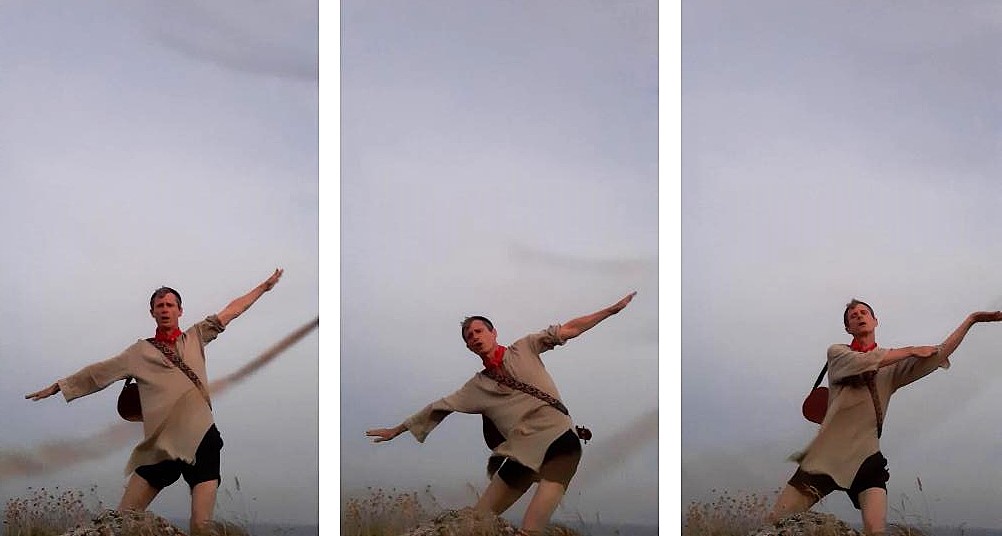
In the mesotopia, to encounter weirdness is to encounter reality itself. Our bodies, our gestures, our creative acts—these are not secondary to thought but integral to it. The way we move, speak, and make art are all ways of negotiating that strange boundary between what can be known and what forever escapes categorisation. Philosophy, in this sense, becomes an art of attunement—a way of staying sensitive to the rhythms of a world that exceeds our grasp.
So the mesotopian project is neither to master the real nor to deny it. It is to inhabit it—to live in that fertile middle space where knowledge and mystery coexist, where the world’s weirdness is not a problem to solve but a companion to think with. To be mesotopian is to make meaning a bodily act, to feel thought as movement, and to accept, joyfully, that the real will always remain just beyond the horizon of what we can name.
As always, my a’th kar.
x
A link to an informal vlog discussing this blog can be found here:
A link to my recent thesis in The University of Plymouth’s archives can be found here:
https://pearl.plymouth.ac.uk/ada-theses/113/